The wild early lives of today's most massive galaxies
January 25, 2012
The wild early lives of today's most massive galaxies

Enlarge

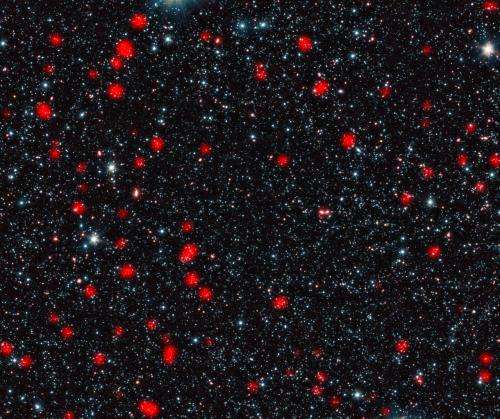
The LABOCA camera on the ESO-operated 12-meter Atacama Pathfinder Experiment (APEX) telescope reveals distant galaxies undergoing the most intense type of star formation activity known, called a starburst. This image shows these distant galaxies, found in a region of sky known as the Extended Chandra Deep Field South, in the constellation of Fornax (The Furnace). The galaxies seen by LABOCA are shown in red, overlaid on an infrared view of the region as seen by the IRAC camera on the Spitzer Space Telescope. By studying how some of these distant starburst galaxies are clustered together, astronomers have found that they eventually become so-called giant elliptical galaxies -- the most massive galaxies in today's universe. The galaxies are so distant that their light has taken around ten billion years to reach us, so we see them as they were about ten billion years ago. Because of this extreme distance, the infrared light from dust grains heated by starlight is redshifted into longer wavelengths, and the dusty galaxies are therefore best observed in submillimeter wavelengths of light. The galaxies are thus known as submillimeter galaxies. Credit: ESO, APEX (MPIfR/ESO/OSO), A. Weiss et al., NASA Spitzer Science Center

(PhysOrg.com) -- Using the APEX telescope, a team of astronomers has found the strongest link so far between the most powerful bursts of star formation in the early Universe, and the most massive galaxies found today. The galaxies, flowering with dramatic starbursts in the early Universe, saw the birth of new stars abruptly cut short, leaving them as massive — but passive — galaxies of aging stars in the present day. The astronomers also have a likely culprit for the sudden end to the starbursts: the emergence of supermassive black holes.

Astronomers have combined observations from the LABOCA camera on the ESO-operated 12-metre Atacama Pathfinder Experiment () with measurements made with ESO's Very Large Telescope, NASA's Spitzer Space Telescope, and others, to look at the way that bright, distant are gathered together in groups or clusters.

The more closely the galaxies are clustered, the more massive are their halos of dark matter — the invisible material that makes up the vast majority of a galaxy's mass. The new results are the most accurate clustering measurements ever made for this type of galaxy.

The galaxies are so distant that their light has taken around ten billion years to reach us, so we see them as they were about ten billion years ago. In these snapshots from the , the galaxies are undergoing the most intense type of activity known, called a starburst.

By measuring the masses of the dark matter halos around the galaxies, and using computer simulations to study how these halos grow over time, the found that these distant starburst galaxies from the early cosmos eventually become giant elliptical galaxies — the most massive galaxies in today's Universe.

This video is not supported by your browser at this time.

Credit: ESO, APEX (MPIfR/ESO/OSO)

"This is the first time that we've been able to show this clear link between the most energetic starbursting galaxies in the early Universe, and the most in the present day," explains Ryan Hickox (Dartmouth College, USA and Durham University, UK), the lead scientist of the team.

Furthermore, the new observations indicate that the bright starbursts in these distant galaxies last for a mere 100 million years — a very short time in cosmological terms — yet in this brief time they are able to double the quantity of stars in the galaxies. The sudden end to this rapid growth is another episode in the history of galaxies that astronomers do not yet fully understand.

"We know that massive elliptical galaxies stopped producing stars rather suddenly a long time ago, and are now passive. And scientists are wondering what could possibly be powerful enough to shut down an entire galaxy's starburst," says Julie Wardlow (University of California at Irvine, USA and Durham University, UK), a member of the team.

The team's results provide a possible explanation: at that stage in the history of the cosmos, the starburst galaxies are clustered in a very similar way to quasars, indicating that they are found in the same halos. Quasars are among the most energetic objects in the Universe — galactic beacons that emit intense radiation, powered by a supermassive black hole at their centre.

There is mounting evidence to suggest the intense starburst also powers the quasar by feeding enormous quantities of material into the black hole. The quasar in turn emits powerful bursts of energy that are believed to blow away the galaxy's remaining gas — the raw material for — and this effectively shuts down the star formation phase.

"In short, the galaxies' glory days of intense star formation also doom them by feeding the giant black hole at their centre, which then rapidly blows away or destroys the star-forming clouds," explains David Alexander (Durham University, UK), a member of the team.

More information: This research is presented in a paper to appear in the journal Monthly Notices of the Royal Astronomical Society on 26 January 2012.

Provided by ESO (news : web)

4.4 /5 (5 votes)  

Filter


Move the slider to adjust rank threshold, so that you can hide some of the comments.


Display comments: newest first

Tuxford
Jan 25, 2012

Rank: 1 / 5 (2)
This is so easy! They have it backwards: It is more likely to be the quasar ejecting new matter into the surrounding galaxy that powers the intense starburst. Once the quasar rapidly grows too large and extremely active, the star formation is likely slowed, as the central galactic region is simply too unstable. We already know that stars in our own galaxy are moving radially toward the galactic anti-center.

And yes, giant ellipticals are the final phase of galactic evolution in LaViolette's Continuous Creation model.

And dark matter halo's are likely the pre-nucleation etheric stability condition, where matter is more likely to form spontaneously. This etheric state is augmented by nearby matter, thereby forming galactic halos. This state also refracts light, forming Einstein rings.
Shootist
Jan 25, 2012

Rank: not rated yet
Olivaar, is that you?

Sir Fred would appreciate your shilling for his cosmology. At least until the aether part.
Rank 4.4 /5 (5 votes)
Related Stories
Relevant PhysicsForums posts
  • What is this spectrum I took?
    created9 hours ago
  • Orientation of Space
    created9 hours ago
  • Geologically Active Moon Now: NASA
    created16 hours ago
  • advice on building a science fair telescope
    created22 hours ago
  • Rise of the Sun
    created22 hours ago
  • Uncertainty of planetary orbital period
    createdFeb 19, 2012
  • More from Physics Forums - General Astronomy

More news stories

Spitzer finds solid buckyballs in space

(PhysOrg.com) -- Astronomers using data from NASA's Spitzer Space Telescope have, for the first time, discovered buckyballs in a solid form in space. Prior to this discovery, the microscopic carbon spheres ...

Space & Earth / Astronomy

created 11 hours ago | popularity 4.7 / 5 (12) | comments 6 | with audio podcast

Going up: Japan builder eyes space elevator

A Japanese construction firm claimed Wednesday it could execute an out-of-this-world plan to put tourists in space within 40 years by building an elevator that stretches a quarter of the way to the moon.

Space & Earth / Space Exploration

created 18 hours ago | popularity 3.5 / 5 (13) | comments 24

ENASA satellite finds Earth's clouds are getting lower

(PhysOrg.com) -- Earth's clouds got a little lower -- about one percent on average -- during the first decade of this century, finds a new NASA-funded university study based on NASA satellite data. The results ...

Space & Earth / Earth Sciences

created 15 hours ago | popularity 5 / 5 (8) | comments 9 | with audio podcast

Fresh scandal embroils US climate science debate

A fresh scandal over climate change has erupted in the United States after leaked documents appeared to show a right-wing funded campaign to influence how climate science is taught in schools.

Space & Earth / Environment

created 7 hours ago | popularity 4.4 / 5 (7) | comments 6

World's oceans get an acid bath

Among the repercussions of global climate change, the effect of ocean acidification on marine life is one of the least-understood variables.

Space & Earth / Environment

created 14 hours ago | popularity 4.3 / 5 (6) | comments 4 | with audio podcast


Researchers build first physical 'metatronic' circuit

(PhysOrg.com) -- The technological world of the 21st century owes a tremendous amount to advances in electrical engineering, specifically, the ability to finely control the flow of electrical charges using ...

Faster than light neutrinos? More like faulty wiring

You can shelf your designs for a warp drive engine (for now) and put the DeLorean back in the garage; it turns out neutrinos may not have broken any cosmic speed limits after all.

Physicists surprised by disappearing and reappearing superconductivity in iron selenium chalcogenides

Superconductivity is a rare physical state in which matter is able to conduct electricity -- maintain a flow of electrons -- without any resistance. This phenomenon can only be found in certain materials at low temperatures, ...

Scientists create potent molecules aimed at treating muscular dystrophy

While RNA is an appealing drug target, small molecules that can actually affect its function have rarely been found. But now scientists from the Florida campus of The Scripps Research Institute have for the first time designed ...

Stanford research team cracks animated NuCaptcha

(PhysOrg.com) -- The research team from Stanford University, led by Elie Bursztein, that previously had cracked regular CAPTCHAs and then audio CAPTCHAs, now has also successfully cracked the animated version called NuCapt ...

Less is more: Study of tiny droplets could have big impact on industrial applications

(PhysOrg.com) -- Under a microscope, a tiny droplet slides between two fine hairs like a roller coaster on a set of rails until — poof — it suddenly spreads along them, a droplet no more.