Winged dinosaur Archaeopteryx dressed for flight
January 24, 2012
Winged dinosaur Archaeopteryx dressed for flight

Enlarge

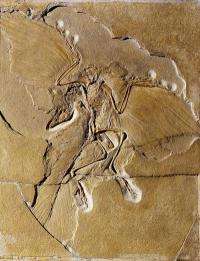
Paleontologists have long thought that Archaeopteryx fossils, including this one discovered in Germany, placed the dinosaur at the base of the bird evolutionary tree. Credit: Humboldt Museum für Naturkunde Berlin

Since its discovery 150 years ago, scientists have puzzled over whether the winged dinosaur Archaeopteryx represents the missing link in birds' evolution to powered flight. Much of the debate has focused on the iconic creature's wings and the mystery of whether — and how well — it could fly.

Some secrets have been revealed by an international team of researchers led by Brown University. Through a novel analytic approach, the researchers have determined that a well-preserved feather on the raven-sized dinosaur's wing was black. The color and parts of cells that would have supplied pigment are evidence the wing feathers were rigid and durable, traits that would have helped to fly.

The team also learned from its examination that Archaeopteryx's feather structure is identical to that of living birds, a discovery that shows modern wing feathers had evolved as early as 150 million years ago in the Jurassic period. The study, which appears in Nature Communications, was funded by the National Geographic Society and the U.S. Air Force Office of Scientific Research.

"If Archaeopteryx was flapping or gliding, the presence of melanosomes [pigment-producing parts of a cell] would have given the feathers additional structural support," said Ryan Carney, an evolutionary biologist at Brown and the paper's lead author. "This would have been advantageous during this early evolutionary stage of dinosaur flight."

This video is not supported by your browser at this time.

Using new research techniques and tools, Ryan Carney and colleagues determined that the 150-million-year-old Archaeopteryx feather was black, which would have provided structural advantages to the raven-sized dinosaur’s wings during flight. Credit: Mike Cohea and Richard Lewis, Brown University

The Archaeopteryx feather was discovered in a limestone deposit in Germany in 1861, a few years after the publication of Charles Darwin's On the Origin of Species. Paleontologists have long been excited about the fossil and other Archaeopteryx specimens, thinking they place the dinosaur at the base of the bird evolutionary tree. The traits that make Archaeopteryx an evolutionary intermediate between and birds, scientists say, are the combination of reptilian features (teeth, clawed fingers, and a bony tail) and avian features (feathered and a wishbone).

The lack of knowledge of Archaeopteryx's feather structure and color bedeviled scientists. Carney, with researchers from Yale University, the University of Akron, and the Carl Zeiss laboratory in Germany, analyzed the feather and discovered that it is a covert, so named because these feathers cover the primary and secondary wing feathers birds use in flight. After two unsuccessful attempts to image the melanosomes, the group tried a more powerful type of scanning electron microscope at Zeiss, where the group located patches of hundreds of the structures still encased in the fossilized feather.

"The third time was the charm, and we finally found the keys to unlocking the feather's original color, hidden in the rock for the past 150 million years," said Carney, a graduate student in the Department of Ecology and Evolutionary Biology, studying with Stephen Gatesy.

Melanosomes had long been known to be present in other fossil feathers, but had been misidentified as bacteria. In 2006, coauthor Jakob Vinther, then a graduate student at Yale, discovered melanin preserved in the ink sac of a fossilized squid. "This made me think that melanin could be fossilized in many other fossils such as feathers," said Vinther, now a postdoctoral researcher at the University of Texas–Austin. "I realized that I had opened a whole new chapter of what we can do to understand the nature of extinct feathered dinosaurs and birds."

This video is not supported by your browser at this time.

The team measured the length and width of the sausage-shaped melanosomes, roughly 1 micron long and 250 nanometers wide. To determine the melanosome's color, Akron researchers Matthew Shawkey and Liliana D'Alba statistically compared Archaeopteryx's melanosomes with those found in 87 species of living birds, representing four feather classes: black, gray, brown, and a type found in penguins. "What we found was that the feather was predicted to be black with 95 percent certainty," Carney said.

Next, the team sought to better define the melanosomes' structure. For that, they examined the fossilized barbules — tiny, rib-like appendages that overlap and interlock like zippers to give a feather rigidity and strength. The barbules and the alignment of melanosomes within them, Carney said, are identical to those found in modern birds.

What the pigment was used for is less clear. The black color of the Archaeopteryx wing feather may have served to regulate body temperature, act as camouflage or be employed for display. But it could have been for flight, too.

"We can't say it's proof that Archaeopteryx was a flier. But what we can say is that in modern bird feathers, these melanosomes provide additional strength and resistance to abrasion from flight, which is why wing feathers and their tips are the most likely areas to be pigmented," Carney said. "With Archaeopteryx, as with today, the melanosomes we found would have provided similar structural advantages, regardless of whether the pigmentation initially evolved for another purpose."

Provided by Brown University (news : web)

4.8 /5 (4 votes)  

Filter


Move the slider to adjust rank threshold, so that you can hide some of the comments.


Display comments: newest first

jsa09
Jan 25, 2012

Rank: 3 / 5 (1)
found one feather was black but the next one might be a different colour.
vega12
Jan 25, 2012

Rank: 5 / 5 (1)
True, but finding even one with this pigmentation means that there was at least that melanosome in the gene pool at the time, which is an important discovery nonetheless.
tj10
Jan 25, 2012

Rank: 1 / 5 (1)
First, congrats on this discovery! Job well done, but a D- for interpretation!
They claim this is a missing link, but Dr A Feduccia, a bird expert at the U of NC says: "Paleontologists have tried to turn Archaeopteryx into an earth-bound, feathered dinosaur. But its not. It is a bird, a perching bird."

First they say modern wing feathers evolved 150 million years ago! Then this: "The barbules and the alignment of melanosomes within them are identical to those found in modern birds." Amazing!

Did it fly or not? Good Q! No flight means, we have to believe these complex modern day flight feathers evolved for some other purpose, yet were perfect for flight! Incredible!

But if it could fly, then we must believe that these feathers along with the avian lung, muscular/skeletal changes & flight software for the brain just popped into existence almost as if they were created and then suddenly stopped evolving for 150m years!

Pick your poison. Neither stance seems credible!
Rank 4.8 /5 (4 votes)
Related Stories
Relevant PhysicsForums posts
  • Eye biology videos
    created4 hours ago
  • Flowering Plant Revived After 30,000 Years in Permafrost
    createdFeb 21, 2012
  • Toba volcano eruptions - 1.000 - 10,000 breeding pairsunb
    createdFeb 20, 2012
  • How is a specific gene removed from DNA
    createdFeb 20, 2012
  • Reproduction and Human evolution
    createdFeb 19, 2012
  • Viruses: Living or Non-living organisms
    createdFeb 19, 2012
  • More from Physics Forums - Biology

More news stories

Global influence of U.S. Constitution on the decline, study reveals

The U.S. Constitution's global influence is on the decline, finds a new study by David S. Law, JD, PhD, professor of law at Washington University in St. Louis.

Other Sciences / Economics & Business

created 18 hours ago | popularity 4.5 / 5 (2) | comments 8

Immigration chief seeks to reassure Silicon Valley

(AP) -- The Obama administration's top immigration official said Wednesday he wants to keep more foreign-born high-tech entrepreneurs in the U.S. But to make that happen, he said he needs those entrepreneurs to turn their ...

Other Sciences / Other

created 9 hours ago | popularity 5 / 5 (2) | comments 0

What is the value of a green card? Researcher calculates increase in income

Just what does it mean to get a green card? To some applicants, about $1,000 each month.

Other Sciences / Economics & Business

created 17 hours ago | popularity not rated yet | comments 2

Increasingly, children's books are where the wild things aren't: study

Was your favorite childhood book crawling with wild animals and set in places like jungles or deep forests? Or did it take place inside a house or in a city, with few if any untamed creatures in sight?

Other Sciences / Social Sciences

created 11 hours ago | popularity 4.8 / 5 (4) | comments 0

Making the bones speak

In a narrow, modest laboratory in Michigan State University’s Giltner Hall, students pore over African skeletons from the Middle Ages in an effort to make the bones speak.

Other Sciences / Archaeology & Fossils

created 18 hours ago | popularity not rated yet | comments 0


Researchers build first physical 'metatronic' circuit

(PhysOrg.com) -- The technological world of the 21st century owes a tremendous amount to advances in electrical engineering, specifically, the ability to finely control the flow of electrical charges using ...

Spitzer finds solid buckyballs in space

(PhysOrg.com) -- Astronomers using data from NASA's Spitzer Space Telescope have, for the first time, discovered buckyballs in a solid form in space. Prior to this discovery, the microscopic carbon spheres ...

Faster than light neutrinos? More like faulty wiring

You can shelf your designs for a warp drive engine (for now) and put the DeLorean back in the garage; it turns out neutrinos may not have broken any cosmic speed limits after all.

Physicists surprised by disappearing and reappearing superconductivity in iron selenium chalcogenides

Superconductivity is a rare physical state in which matter is able to conduct electricity -- maintain a flow of electrons -- without any resistance. This phenomenon can only be found in certain materials at low temperatures, ...

Stanford research team cracks animated NuCaptcha

(PhysOrg.com) -- The research team from Stanford University, led by Elie Bursztein, that previously had cracked regular CAPTCHAs and then audio CAPTCHAs, now has also successfully cracked the animated version called NuCapt ...

Going up: Japan builder eyes space elevator

A Japanese construction firm claimed Wednesday it could execute an out-of-this-world plan to put tourists in space within 40 years by building an elevator that stretches a quarter of the way to the moon.