World's first magnetic soap produced
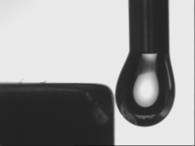
Scientists from the University of Bristol have developed a soap, composed of iron rich salts dissolved in water, that responds to a magnetic field when placed in solution. The soap's magnetic properties were proved with neutrons at the Institut Laue-Langevin to result from tiny iron-rich clumps that sit within the watery solution. The generation of this property in a fully functional soap could calm concerns over the use of soaps in oil-spill clean ups and revolutionise industrial cleaning products.
Scientists have long been searching for a way to control soaps (or surfactants as they are known in industry) once they are in solution to increase their ability to dissolve oils in water and then remove them from a system. The team at the University of Bristol have previously worked on soaps sensitive to light, carbon dioxide or changes in pH, temperature or pressure. Their latest breakthrough, reported in Angewandte Chemie, is the world's first soap sensitive to a magnetic field.
Ionic liquid surfactants, composed mostly of water with some transition metal complexes (heavy metals like iron bound to halides such as bromine or chlorine) have been suggested as potentially controllable by magnets for some time, but it had always been assumed that their metallic centres were too isolated within the solution, preventing the long-range interactions required to be magnetically active.
The team at Bristol, led by Professor Julian Eastoe, produced their magnetic soap by dissolving iron in a range of inert surfactant materials composed of chloride and bromide ions, very similar to those found in everyday mouthwash or fabric conditioner. The addition of the iron creates metallic centres within the soap particles.
To test its properties, the team introduced a magnet to a test tube containing their new soap lying beneath a less dense organic solution. When the magnet was introduced the iron-rich soap overcame both gravity and surface tension between the water and oil, to levitate through the organic solvent and reach the source of the magnetic energy, proving its magnetic properties.
Once the surfactant was developed and shown to be magnetic, Professor Eastoe's team took it to the Institut Laue-Langevin, the world's flagship centre for neutron science, and home to the world's most intense neutron source, to investigate the science behind its remarkable property.
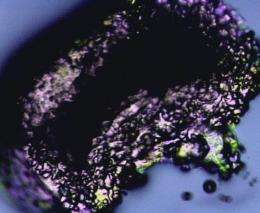
When surfactants are added to water they are known to form tiny clumps (particles called micelles). Scientists at ILL used a technique called neutron scattering to confirm that it was this clumping of the iron-rich surfactant that brought about its magnetic properties.
Dr Isabelle Grillo, head of the Chemistry Laboratories at ILL said: "The particles of surfactant in solution are too small to see using light but are easily revealed by neutron scattering which we use to investigate the structure and behaviour of all types of materials at the atomic and molecular scale."
The potential applications of magnetic surfactants are huge. Their responsiveness to external stimuli allows a range of properties, such as their electrical conductivity, melting point, the size and shape of aggregates and how readily its dissolves in water to be altered by a simple magnetic on and off switch. Traditionally these factors, which are key to the effective application of soaps in a variety of industrial settings, could only be controlled by adding an electric charge or changing the pH, temperature or pressure of the system, all changes that irreversibly alter the system composition and cost money to remediate.
Its magnetic properties also makes it easier to round up and remove from a system once it has been added, suggesting further applications in environmental clean ups and water treatment. Scientific experiments which require precise control of liquid droplets could also be made easier with the addition of this surfactant and a magnetic field.
Professor Julian Eastoe of the University of Bristol said: "As most magnets are metals, from a purely scientific point of view these ionic liquid surfactants are highly unusual, making them a particularly interesting discovery. From a commercial point of view, though these exact liquids aren't yet ready to appear in any household product, by proving that magnetic soaps can be developed, future work can reproduce the same phenomenon in more commercially viable liquids for a range of applications from water treatment to industrial cleaning products."
Peter Dowding an industrial chemist, not involved in the research said: "Any systems which act only when responding to an outside stimulus that has no effect on its composition is a major breakthrough as you can create products which only work when they are needed to. Also the ability to remove the surfactant after it has been added widens the potential applications to environmentally sensitive areas like oil spill clean ups where in the past concerns have been raised."
More information: Angewandte Chemie, DOI: 10.1002/anie.201108010
Journal information: Angewandte Chemie
Provided by University of Bristol


