'Worm speak' uses chemicals to communicate
January 26, 2012
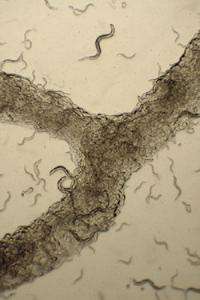
These small, transparent roundworms have a highly evolved language -- they combine chemical fragments to create precise molecular messages that control social behavior, reports a new study co-authored by scientists at the Boyce Thompson Institute. Image: Frank Schroeder, BTI/Cornell
(PhysOrg.com) -- A species of small, transparent roundworms have a highly evolved language in which they combine chemical fragments to create precise molecular messages that control social behavior, reports a new study from the Boyce Thompson Institute (BTI) at Cornell and the California Institute of Technology (Caltech).
The research, published in the January issue of PLoS Biology (10:1), holds promise in helping to develop new treatments for the more than 20 percent of the world's population infected with nematodes and for agricultural producers whose crops are destroyed by the pests.
"Learning about how nematodes communicate opens up new possibilities for prevention of nematode infection in humans and nematode control in agricultural settings," said co-author Frank Schroeder, a Cornell adjunct assistant professor of chemistry and chemical biology and a scientist at BTI, an independent affiliate of Cornell. BTI postdoctoral researcher Stephan von Reuss, one of the two lead authors of the study, added that "using the worms' own language, we may be able to disrupt their development and reproduction or attract them to lethal environments."
The worms, Caenorhabditis elegans, is a lab-friendly model species for research on how chemical signals affect development and behavior. In 2008, Schroeder and colleagues had discovered that nematodes use chemical signals as sexual attractants, which provided the first hint that nematodes use chemistry to communicate.
"What we understand now is that nematodes use complex messages that consist of molecules put together in a modular fashion," said Schroeder. "They put together different chemical fragments depending on what they want to say."
For example, the researchers found several molecules that tell nematodes to scatter and disperse. These molecules consist of only two building blocks. But adding a third building block called an indole changes the meaning completely: instead of "go away" the message becomes "everybody come here." Nematode messages get even more complex by combining two or more different molecules, just like combining different words in a sentence makes for more complex meaning.
Schroeder and his team used a new analytical method called comparative metabolomics to analyze the chemicals made by worms. By comparing the body chemistry of normal, wild-type worms with the chemistry of worms that have a signaling defect, i.e., "worms that can't talk," the researchers detected molecules that were only present in wild-type worms, but not in "silent" worms. These molecules then turned out to form the "language of the worm."
These results show that by combining molecules that include different types of chemical building blocks, worms have developed a sophisticated chemical language that they use to organize their communities. The discovery provides a new window into the chemistry of life and suggests that many other animal species including vertebrates may produce similar signaling molecules to control behavior and other biological functions.
As a next step, the researchers will explore how the worms' nervous system senses and deciphers the different chemical messages. "Understanding the worm's language is just a first step -- we now need to figure out how the worm decodes and makes these molecules," Schroeder said.
The study was funded by the National Institutes of Health and the Howard Hughes Medical Institute. Other members of the Schroeder lab who contributed to the study were graduate students Neelanjan Bose, Parag Mahanti and Oran G. O'Doherty.
-
Worm seeks worm: Researchers find chemical cues driving aggregation in nematodes
Jan 12, 2012 |
not rated yet |
0
-
Buenos 'notch-es': Universal signaling pathway found to regulate sleep
May 05, 2011 |
not rated yet |
0
-
Making microscopic worms into a more deadly insecticide
Jan 15, 2010 |
not rated yet |
0
-
Evolution keeps sex determination flexible
Sep 12, 2011 |
not rated yet |
0
-
Possible new hope for crops battling parasitic infection
Jan 16, 2009 |
not rated yet |
0
-
Stars containing dark matter should look different from other stars
Feb 20, 2012 |
4.5 / 5 (17) |
11
-
Physicists discover evidence of rare hypernucleus, a component of strange matter
Feb 17, 2012 |
4.7 / 5 (38) |
22
-
Fast photon control brings quantum photonic technologies closer
Feb 13, 2012 |
5 / 5 (8) |
1
-
Engineers build first sub-10-nm carbon nanotube transistor
Feb 01, 2012 |
4.9 / 5 (36) |
32
-
Something old, something new: Evolution and the structural divergence of duplicate genes
Jan 31, 2012 |
4.6 / 5 (7) |
1
-
Eye biology videos
4 hours ago
-
Flowering Plant Revived After 30,000 Years in Permafrost
Feb 21, 2012
-
Toba volcano eruptions - 1.000 - 10,000 breeding pairsunb
Feb 20, 2012
-
How is a specific gene removed from DNA
Feb 20, 2012
-
Reproduction and Human evolution
Feb 19, 2012
-
Viruses: Living or Non-living organisms
Feb 19, 2012
- More from Physics Forums - Biology
More news stories
Surprising diversity at a synapse hints at complex diversity of neural circuitry
A new study reveals a dazzling degree of biological diversity in an unexpected place a single neural connection in the body wall of flies.
11 hours ago |
5 / 5 (4) |
0
|
Men might not 'become extinct' after all: Theory of the 'rotting' Y chromosome dealt a fatal blow
If you were to discover that a fundamental component of human biology has survived virtually intact for the past 25 million years, you'd be quite confident in saying that it is here to stay.
14 hours ago |
5 / 5 (6) |
1
|
New family of legless amphibians found in India
Since before the age of dinosaurs it has burrowed unbothered beneath the monsoon-soaked soils of remote northeast India - unknown to science and mistaken by villagers as a deadly, miniature snake.
21 hours ago |
5 / 5 (9) |
3
Climate change affects bird migration timing in North America
Bird migration timing across North America has been affected by climate change, according to a study published Feb. 22 in the open access journal PLoS ONE.
10 hours ago |
4.5 / 5 (2) |
2
New iridescent lizard species found in Cambodia
A new species of lizard with striking iridescent rainbow skin, a long tail and very short legs has been discovered in the rainforest in northeast Cambodia, conservationists announced Wednesday.
10 hours ago |
not rated yet |
0
Researchers build first physical 'metatronic' circuit
(PhysOrg.com) -- The technological world of the 21st century owes a tremendous amount to advances in electrical engineering, specifically, the ability to finely control the flow of electrical charges using ...
Spitzer finds solid buckyballs in space
(PhysOrg.com) -- Astronomers using data from NASA's Spitzer Space Telescope have, for the first time, discovered buckyballs in a solid form in space. Prior to this discovery, the microscopic carbon spheres ...
Faster than light neutrinos? More like faulty wiring
You can shelf your designs for a warp drive engine (for now) and put the DeLorean back in the garage; it turns out neutrinos may not have broken any cosmic speed limits after all.
Physicists surprised by disappearing and reappearing superconductivity in iron selenium chalcogenides
Superconductivity is a rare physical state in which matter is able to conduct electricity -- maintain a flow of electrons -- without any resistance. This phenomenon can only be found in certain materials at low temperatures, ...
Stanford research team cracks animated NuCaptcha
(PhysOrg.com) -- The research team from Stanford University, led by Elie Bursztein, that previously had cracked regular CAPTCHAs and then audio CAPTCHAs, now has also successfully cracked the animated version called NuCapt ...
Going up: Japan builder eyes space elevator
A Japanese construction firm claimed Wednesday it could execute an out-of-this-world plan to put tourists in space within 40 years by building an elevator that stretches a quarter of the way to the moon.
Jan 26, 2012
Rank: not rated yet
Jan 26, 2012
Rank: not rated yet
Jan 27, 2012
Rank: not rated yet
Jan 27, 2012
Rank: not rated yet
Dr. Cutlers original studies in the 70s showed that women who have regular sex with men have more regular menstrual cycles than women who have sporadic sex. Regular sex delayed the decline of oestrogen and made women more fertile. This led the research team to look for what the man was providing in the equation. By 1986 they realized it was pheromones.
The logical conclusion is, women are kind of human worms.