100 year Starship Project has a new leader
January 12, 2012 By Paul Scott Anderson, Universe Today
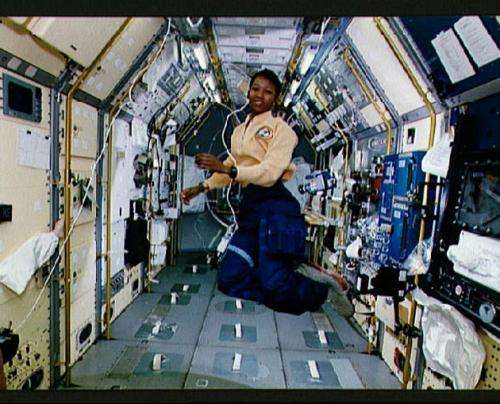
Mae Jemison. Credit: NASA
You may have heard by now about the 100 Year Starship project, a new research initiative to develop the technology required to send a manned mission to another star. The project is jointly sponsored by NASA and the Defense Advanced Research Projects Agency (DARPA). It will take that long just to make such a trip feasible, hence the name. So were a long ways off from naming any crew members or a starship captain, but the project itself does have a new leader, a former astronaut.
Mae Jemison, a former Space Shuttle astronaut, has been appointed the position by DARPA. She was also the first African-American woman to go into space, in 1992. Her own non-profit educational organization, the Dorothy Jemison Foundation for Excellence (in honor of her late mother) was chosen to work with DARPA, receiving a $500,000 contract. That funding is just seed money, to start the process of developing the framework needed for such an ambitious undertaking. The focus at this point is to create a foundation that can last long enough to research the technology required, rather than the actual government-funded building of the spacecraft.
As stated by the proposal, the goal is to develop a viable and sustainable non-governmental organization for persistent, long-term, private-sector investment into the myriad of disciplines needed to make long-distance space travel viable.
From the projects mission statement:
The 100 Year Starship (100YSS) study is an effort seeded by DARPA to develop a viable and sustainable model for persistent, long-term, private-sector investment into the myriad of disciplines needed to make long-distance space travel practicable and feasible.
The genesis of this study is to foster a rebirth of a sense of wonder among students, academia, industry, researchers and the general population to consider why not and to encourage them to tackle whole new classes of research and development related to all the issues surrounding long duration, long distance spaceflight.
DARPA contends that the useful, unanticipated consequences of such research will have benefit to the Department of Defense and to NASA, as well as the private and commercial sector.
This endeavor will require an understanding of questions such as: how do organizations evolve and maintain focus and momentum for 100 years or more; what models have supported long-term technology development; what resources and financial structures have initiated and sustained prior settlements of new worlds?
With todays technology, it would take about 100,000 years to reach just the nearest star, Alpha Centauri. That time would hopefully be reduced significantly with the development of new, faster propulsion methods.
The dream of travelling to the stars may still be a long ways off in the future before becoming reality, but we are getting closer. Ad astra!
More information about the 100 Year Starship project is here.
Source: Universe Today
-
DARPA wants your ideas for a 100-year starship
May 23, 2011 |
not rated yet |
0
-
Pentagon dreams of Star Trek interstellar travel
Jun 16, 2011 |
not rated yet |
0
-
Through hardship to the stars
Jan 04, 2012 |
not rated yet |
0
-
DARPA's new spy satellite could provide real-time video from anywhere on Earth
Dec 21, 2011 |
not rated yet |
0
-
Q&A: Saying goodbye to the space shuttle
Jul 11, 2011 |
not rated yet |
0
-
Stars containing dark matter should look different from other stars
Feb 20, 2012 |
4.5 / 5 (17) |
11
-
Physicists discover evidence of rare hypernucleus, a component of strange matter
Feb 17, 2012 |
4.7 / 5 (38) |
22
-
Fast photon control brings quantum photonic technologies closer
Feb 13, 2012 |
5 / 5 (8) |
1
-
Engineers build first sub-10-nm carbon nanotube transistor
Feb 01, 2012 |
4.9 / 5 (36) |
32
-
Something old, something new: Evolution and the structural divergence of duplicate genes
Jan 31, 2012 |
4.6 / 5 (7) |
1
-
Calculating the magnitude
2 hours ago
-
What is this spectrum I took?
12 hours ago
-
Orientation of Space
13 hours ago
-
Geologically Active Moon Now: NASA
20 hours ago
-
advice on building a science fair telescope
Feb 22, 2012
-
Rise of the Sun
Feb 22, 2012
- More from Physics Forums - General Astronomy
More news stories
Spitzer finds solid buckyballs in space
(PhysOrg.com) -- Astronomers using data from NASA's Spitzer Space Telescope have, for the first time, discovered buckyballs in a solid form in space. Prior to this discovery, the microscopic carbon spheres ...
14 hours ago |
4.7 / 5 (12) |
8
|
Going up: Japan builder eyes space elevator
A Japanese construction firm claimed Wednesday it could execute an out-of-this-world plan to put tourists in space within 40 years by building an elevator that stretches a quarter of the way to the moon.
Space & Earth / Space Exploration
21 hours ago |
3.5 / 5 (13) |
26
ENASA satellite finds Earth's clouds are getting lower
(PhysOrg.com) -- Earth's clouds got a little lower -- about one percent on average -- during the first decade of this century, finds a new NASA-funded university study based on NASA satellite data. The results ...
Space & Earth / Earth Sciences
18 hours ago |
5 / 5 (8) |
13
|
Fresh scandal embroils US climate science debate
A fresh scandal over climate change has erupted in the United States after leaked documents appeared to show a right-wing funded campaign to influence how climate science is taught in schools.
11 hours ago |
4.1 / 5 (9) |
8
World's oceans get an acid bath
Among the repercussions of global climate change, the effect of ocean acidification on marine life is one of the least-understood variables.
18 hours ago |
4.3 / 5 (6) |
4
|
Researchers build first physical 'metatronic' circuit
(PhysOrg.com) -- The technological world of the 21st century owes a tremendous amount to advances in electrical engineering, specifically, the ability to finely control the flow of electrical charges using ...
Faster than light neutrinos? More like faulty wiring
You can shelf your designs for a warp drive engine (for now) and put the DeLorean back in the garage; it turns out neutrinos may not have broken any cosmic speed limits after all.
Physicists surprised by disappearing and reappearing superconductivity in iron selenium chalcogenides
Superconductivity is a rare physical state in which matter is able to conduct electricity -- maintain a flow of electrons -- without any resistance. This phenomenon can only be found in certain materials at low temperatures, ...
Stanford research team cracks animated NuCaptcha
(PhysOrg.com) -- The research team from Stanford University, led by Elie Bursztein, that previously had cracked regular CAPTCHAs and then audio CAPTCHAs, now has also successfully cracked the animated version called NuCapt ...
Flesh-eating bacteria inspire superglue
(PhysOrg.com) -- A bio-inspired superglue has been developed by Oxford University researchers that cant be matched for sticking molecules together and not letting go.
Scientists create potent molecules aimed at treating muscular dystrophy
While RNA is an appealing drug target, small molecules that can actually affect its function have rarely been found. But now scientists from the Florida campus of The Scripps Research Institute have for the first time designed ...
Jan 12, 2012
Rank: 5 / 5 (10)
Jan 12, 2012
Rank: 5 / 5 (10)
Jan 12, 2012
Rank: 4.9 / 5 (7)
Jan 12, 2012
Rank: 1.7 / 5 (22)
Jan 12, 2012
Rank: 5 / 5 (14)
1ly = 5,869,713,600,000 miles
Closest star is 24,652,797,120,000 miles away
To cover that distance in 100 years you would need an average velocity of 28,123,200 miles per hour, or 7,812 miles per second, which is about 4% light speed
The fastest speed we have achieved in space with an unmanned probe is about 157,000 mph. We would need to AVERAGE 180 times faster than that to make it to Proxima Centauri in 100 years. Given a long acceleration time our top speed would have to be much higher than that still.
Jan 12, 2012
Rank: 1.7 / 5 (24)
Also, FrankHerpes stop hiding in the shadows and voting everything I say down to 1. Come out and make a valid argument. Or you could always go plague an elementary school forum where your wit might match that of its users.
Jan 12, 2012
Rank: 3.1 / 5 (7)
Jan 12, 2012
Rank: 4.8 / 5 (5)
Avoiding a large body is one thing, knowing that a rogue comet, asteroid, etc. is quite another. At such speeds, I suspect ANY collision with ANY size body would be devistating. Let the robotic starships try it a few times just to "prove" the safety of such a journey. It may me more viable to hollow out the moon, populate it and push it along a near endless journey. seems like a waste of money, all things considered. If anything, head towards the more populated center of the galaxy. More possible realms to pick from once you get to the new neighborhood.
Jan 12, 2012
Rank: 4 / 5 (4)
They are manbearpigs and have the skill of extreme hibernation.
Jan 12, 2012
Rank: 3.5 / 5 (4)
For some reason I don't think that would be any easier...
Jan 12, 2012
Rank: 4 / 5 (10)
14 posts in 2 hours... typical
Jan 12, 2012
Rank: 1.8 / 5 (16)
Jan 12, 2012
Rank: 5 / 5 (6)
Jan 12, 2012
Rank: 3 / 5 (2)
Please think and research before you post or you will continue to be... suggestified.
Jan 12, 2012
Rank: 4 / 5 (5)
Then they should consider changing their name... because "100 year starship" sounds an awful lot like a ship designed for a 100 year trip.
Jan 12, 2012
Rank: 3.7 / 5 (3)
Or people could not make assumptions (I know, ridiculous right?) and get the facts before they build opinions based on those baseless assumptions.
Or even better yet,
Jan 12, 2012
Rank: 1.5 / 5 (4)
Jan 12, 2012
Rank: 5 / 5 (6)
Jan 12, 2012
Rank: not rated yet
Jan 12, 2012
Rank: 5 / 5 (4)
Jan 12, 2012
Rank: 5 / 5 (8)
No, because it's unnecessary. Spacetime within gravitationally bound systems like a galaxy and even galaxy clusters does not experience 'expansion'. Here gravity is too strong and keeps everything together.
Jan 12, 2012
Rank: 3 / 5 (1)
that's a real poser, since travel to faraway stars is unlikely ever to have any economic benefits to a company here on Earth. I think she has her work cut out for her.
The only way I can see this working is if she triggers development in sectors profitable here on Earth that will create these technologies as a byproduct.
Jan 13, 2012
Rank: not rated yet
Antialias, the technologies needed for interstellar flight would have enormous commercial value here on Earth. And they would also greatly benefit our future attempts to "colonize" the rest of our solar system.
Jan 13, 2012
Rank: not rated yet
Like?
I completely agree that we need those technologies for colonization (though I think we will not colonize any other planet in the naive/Hollywood way everybody seems to be imagining). But for the development of such technologies by non government institutions there must be return on investment. And I don't see that with a scenario where we send off colonists which we will never be in direct contact with, ever, again.
Interstellar (or even interplanetary) trade is - at those distances and timeframes - a fantasy.
Jan 14, 2012
Rank: 2.7 / 5 (3)
Jan 14, 2012
Rank: 5 / 5 (1)
Jan 14, 2012
Rank: 1 / 5 (1)
(Oppression, torture and killing of humans - killing and abuse of primates and whales - destructive use of a planet and senseless extermination of species.)
Jan 14, 2012
Rank: not rated yet
I would draw your attention to the following part of the article:
Notice the words 'non-government' and 'private-sector'.
Jan 15, 2012
Rank: not rated yet
Dr Gerard O'Neill and co made the business case in the late 70's. They would be a reality now if our leaders weren't quite so ape like.
Whoever uses the water and materials at the south pole of the moon as raw material to to colonise L4 and 5 will be to gate keepers to the cosmos.
Once we are out of the gravity well we will stay out. Journeys to other stars might be of consuming interest to future generations but living in space will be compulsory.
Jan 15, 2012
Rank: not rated yet
Jan 15, 2012
Rank: not rated yet
Like?! Materials science, rapid prototyping, 3D printing, energy storage, energy management, recycling and remanufacturing, radiation shielding(for data, IT and living things), structural engineering, long-term data storage, data compression, countless medical and pharma advancements, metallurgy, plastics, ceramics, food production, and food storage for off-the-top-of-my-head starters.
Then there are the areas on process management and team management. Plus countless psychology advancements.
And THEN, wow, the arts, humanities and philosophy. From my perspective, this list could dwarf the others. The potential for using this kind of far-reaching initiative to advance humanity is mind-blowing.
Oh, and I didn't even mention the interests of DARPA. They obviously anticipate a wealth of new technologies coming their way from this initiative.
Jan 15, 2012
Rank: not rated yet
Since it will be hard to buy spare parts half-way, there either has to be some facilities to manufacture some kinds of parts, or there has to be built-in redundancy (that is, many systems that cover each other). But this will again add to the complexity.
We can't even build aeroplanes to last 5 years without a total overhaul where they're entirely ripped apart and rebuilt, replacing worn out parts. This is an appalling cost, and airlines would kill to buy planes that don't need this much maintenance.
I don't expect us to have an interstellar ship within the next hundred years.
Jan 15, 2012
Rank: not rated yet
Jan 15, 2012
Rank: not rated yet
Jan 16, 2012
Rank: not rated yet
Who cares about you?
There are people who care about more than themselves. Good thing, too.
Jan 16, 2012
Rank: 1 / 5 (1)
Jan 16, 2012
Rank: not rated yet
Using what as a source of energy? Surely not anything that's along for the ride...
Jan 16, 2012
Rank: not rated yet
You are aware of this niggling detail called relativity?
We have a need to develop all of these anyways. Even without the 100 year starship project. It's not going to get us anything we don't already strive for.
(Not that I think we shouldn't do it. The 100 year starship projekt is definitely something that should be undertaken - but the benefits will be purely idealistic. I wouldn't expect anything commercially worthwhile to come from launching some people on a journey to the stars)
Jan 16, 2012
Rank: not rated yet