2012 BX34: Behind the scenes in the discovery of a near Earth asteroid
Several blockbuster movies, television shows and commercials have depicted the discovery of an asteroid heading towards Earth and usually, somehow, impending doom is averted. But how do the discoveries of Near Earth Objects really happen? Asteroid 2012 BX34 buzzed by Earth last week, and even though this small asteroid was never considered a threat to Earth, its discovery still piqued the interest of the public. It was discovered by Alex Gibbs, an astronomer and software engineer from the Catalina Sky Survey. Universe Today asked Gibbs to share his experiences of being an asteroid hunter and what it was like to find this latest NEO that made the Top-20 list of closest approaches to Earth.
The Catalina Sky Survey is a research program at the University of Arizona and is part of the Spaceguard Survey, a NASA project to discover and catalog Earth-approaching and Potentially Hazardous Asteroids (PHAs).
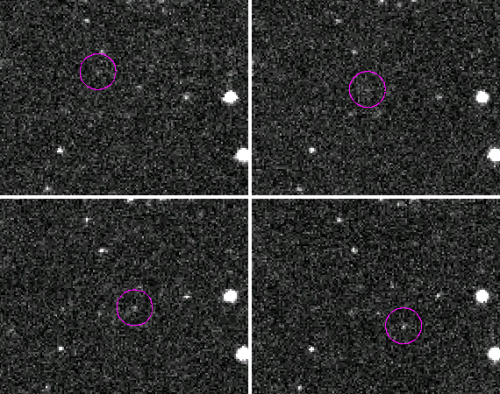
When astronomers look through telescopes, asteroids don’t look much different from stars – they are just points of light. But these points of light are moving; however they are moving slow enough that to detect the motion, astronomers take a series of images, usually four images spaced 10-12 minutes apart.
Then, the observers run specialized software to examine their images for any star-like objects that are moving from one image to the next. The software removes any candidates that correspond to known objects or main-belt asteroids.
Gibbs said the software has a low detection threshold to avoid missing anything, so the observer looks over what the software found and determines which are real. The remaining objects that the software determines could be interesting are then sent in to the Minor Planet Center (MPC) at the Smithsonian Astrophysical Observatory in Cambridge, Massachusetts, for the team or others to follow up.
Gibbs said his discovery images of 2012 BX34 were taken at 10:30 UT (3:30 am in Tucson) on January 25, 2012. He was using a Schmidt telescope on Mount Bigelow. At the time, the object was 1.8 million km away, moving 1.15 degrees/day across the sky, and at 20th magnitude.
On the night of discovery, Gibbs said 2012 BX34 seemed just like most of the NEOs they find. But something unusual happened the following night.
“No one seemed to be able to find it,” Gibbs said via email. “That happens sometimes, but it should have been pretty easy for the observatories that were looking. When my colleague, Rik Hill, found a ‘new’ object nearby I was suspicious that it might be the same object. The object’s rapid increase in brightness and apparent motion had made it difficult to recognize as the same object.”
When Gibbs put the two observations together he could tell they were the same object. But more importantly, he also could tell the object was going to come fairly close to Earth.
“That’s when I emailed the MPC to point out that they were the same object,” Gibbs said.
Even though this is what Gibbs does for a living, certainly there must be a certain thrill (or butterflies in the stomach) when it is realized one of these NEOs is coming fairly close to Earth?
“We realized it was going to come pretty close, but wouldn’t impact,” Gibbs said. “I knew it was small enough that it would disintegrate if it did, so although I was excited, I was also a little disappointed that it wasn’t going to put on more of a show. But I definitely prefer this to it being TOO flashy!”
The software at the MPC also figured out this asteroid was coming close, and just like in the movies, astronomer Gareth Williams, associate director of the MPC, was aroused from his sleep in the middle of the night by a pager message. But, said Williams in an interview with the BBC, “when I saw the miss distance was going to be 10 Earth radii, I said ‘that’s too far for me to get up,’ so I rolled over and went back to sleep.”
“That explains why the emails I exchanged with him later on were so short,” Gibbs said.
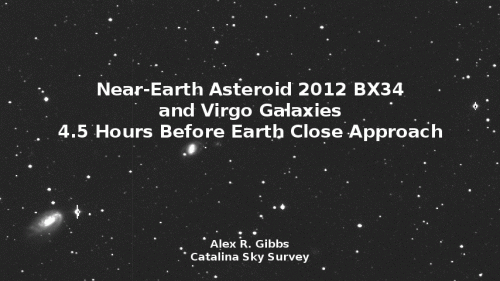
At its closest approach, on January 27 15:15 UT, 2012 BX34 was 59,600 km from the Earth’s surface, moving 729 deg/day, appearing at 14th magnitude, which is 250 times brighter than when Gibbs first saw it.
Gibbs said it is common for discoveries to be followed up by others astronomers, though it’s not a rigid practice.
“Whenever we find something moving in an ‘interesting’ way we send it to the Minor Planet Center, as do all the other surveys,” he said. “The MPC publishes the objects on their public NEO Confirmation Page. Various parties then follow the objects up, both pros and amateurs. Whether an object is deemed interesting or not is primarily determined by software that looks at the motion and brightness, though we can often tell when we see it. We also submit anything that appears to have cometary features.”
As of January 29, 2012, 8,648 Near-Earth objects have been discovered, with about 840 of these NEOs being asteroids with a diameter of approximately 1 kilometer or larger. Also, 1,284 of these NEOs have been classified as PHAs.
“NEOs are ones that come within 1.3 AU of the Sun (since the Earth is at 1 AU it means they pass through our neighborhood),” Gibbs said. “ PHAs are those that are larger than about 150 m (500 ft) and come within 0.05 AU of Earth’s orbit, so that at some point in the future they may cross paths.” (See more info on PHAs here)
“The large asteroids are much brighter than objects like 2012 BX34,” Gibbs said. “We see them as they orbit the Sun, and can determine if they are likely to come close to the Earth at some point. That gives us a lot more time to do something about an impact from the most dangerous asteroids. However, we ought to be doing more to catalog all the asteroids that could potentially take out a city or cause a tsunami. We are finding them now, but not fast enough. An asteroid impact is one of the few predictable and potentially preventable natural disasters.”
Even though asteroid 2012 BX34 was one of the top-20 closest approaches by an asteroid, its size made it a non-issue. While bus-sized sounds pretty big, this is small enough that it would break apart and burn up in the atmosphere. Instead, it passed by harmlessly.
“But a close fly-by like this one serves to remind people that asteroids of all sizes do come by the Earth,” said Gibbs. “We need to be vigilant.”
As for Gibbs, he is back at his job of asteroid hunting, and tonight will be scanning the skies from a larger telescope on Mt. Lemmon in Arizona.
Source: Universe Today


