Castaway lizards provide insight into elusive evolutionary process
February 2, 2012
Hurricane gave researchers a rare opportunity to study evolution

Enlarge

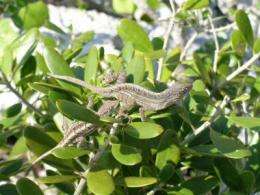
This is a founder pair of Caribbean brown anole lizards, one of the actual colonist couples, shortly after release. They were involved in the first experimental study of the founder effect -- a long-simmering controversy in evolutionary biology -- in a natural setting. The study by UC Davis researchers and others is published in the Feb. 3 edition of the journal Science Express, the online publication of the journal Science. Credit: Manuel Leal/Duke University

A University of Rhode Island biologist who released lizards on tiny uninhabited islands in the Bahamas has shed light on the interaction between evolutionary processes that are seldom observed.

Jason Kolbe, a URI assistant professor of biological sciences, and colleagues from Duke University, Harvard University and the University of California at Davis, found that the lizards' genetic and morphological traits were determined by both natural selection and a phenomenon called founder effects, which occur when species colonize new territory.

Their research was published today in the journal Science.

"We rarely observe founder effects as they happen in nature, but we know that it happens because islands are colonized by new species over time," said Kolbe. "What we didn't know was how these evolutionary mechanisms interact with each other. What we learned is that the differences caused by the founder effects persist even as populations adapt to their new environments."

The founder effect is the loss of that occurs when a new population is established by a very small number of individuals from a larger population. It often results in the new population becoming genetically or morphologically different from the original population.
Castaway lizards offer new look at evolutionary processes
Enlarge

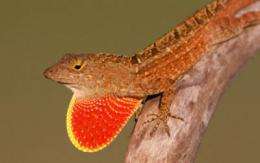
A male brown anole lizard (Anolis sagrei) displays its eye-catching dewlap. Credit: Neil Losin

The scientists randomly collected brown anole lizards from a large island near Great Abaco and released one pair on each of seven nearby islands whose lizard populations had been cleared by a recent hurricane. The source island is forested while the other islands have short, scrub vegetation. Previous research found that anoles living in forests had longer hind limbs than those found in scrub habitat. Lizards with longer limbs can run faster on the broad perches available in forests, while short-limbed lizards are more adept at moving on the narrower perches found in lower vegetation.

The scientists revisited each of the islands over the next four years to measure the lizards' limb length and collect tissue samples for genetic analysis. All of the new populations survived and increased an average of 13-fold in the first two years before leveling off.

"We noticed a founder effect one year after starting the experiment, which resulted in differences among the lizards on the seven islands," Kolbe said. "Some of the islands had lizards with longer limbs and some had lizards with shorter limbs, but that was random with respect to the vegetation on the new islands."

Because the structure of the vegetation on the islands differed from that of the source island, the scientists predicted that natural selection would lead the lizards to develop shorter limbs.

"Over the next four years, the on all the islands experienced a decrease in leg length that is attributable to natural selection," Kolbe explained. "But those that started out with the longest hind limbs still had the longest hind limbs. The fact that the populations maintained their order from longest to shortest limbs throughout the experiment means that both founder effects and contributed to their current differences."

According to Kolbe, founding effects are rarely observed in nature, with most previous studies being conducted in the laboratory. "Ours is the first to study this process experimentally in a natural setting, and we were able to account for multiple through time," he said. "We manipulated the founding of these islands, but everything else about it was natural."

The next step in the research will be to determine how long the founder effects persist before other factors erase its signature.

More information: "Founder Effects Persist Despite Adaptive Differentiation: A Replicated Field Experiment in a Caribbean Lizard," Science.

Provided by University of Rhode Island (news : web)

4.1 /5 (13 votes)  

Rank 4.1 /5 (13 votes)
Relevant PhysicsForums posts
  • Eye biology videos
    created4 hours ago
  • Flowering Plant Revived After 30,000 Years in Permafrost
    createdFeb 21, 2012
  • Toba volcano eruptions - 1.000 - 10,000 breeding pairsunb
    createdFeb 20, 2012
  • How is a specific gene removed from DNA
    createdFeb 20, 2012
  • Reproduction and Human evolution
    createdFeb 19, 2012
  • Viruses: Living or Non-living organisms
    createdFeb 19, 2012
  • More from Physics Forums - Biology

More news stories

Surprising diversity at a synapse hints at complex diversity of neural circuitry

A new study reveals a dazzling degree of biological diversity in an unexpected place – a single neural connection in the body wall of flies.

Biology / Other

created 10 hours ago | popularity 5 / 5 (4) | comments 0 | with audio podcast

Men might not 'become extinct' after all: Theory of the 'rotting' Y chromosome dealt a fatal blow

If you were to discover that a fundamental component of human biology has survived virtually intact for the past 25 million years, you'd be quite confident in saying that it is here to stay.

Biology / Biotechnology

created 13 hours ago | popularity 5 / 5 (6) | comments 1 | with audio podcast

New family of legless amphibians found in India

Since before the age of dinosaurs it has burrowed unbothered beneath the monsoon-soaked soils of remote northeast India - unknown to science and mistaken by villagers as a deadly, miniature snake.

Biology / Plants & Animals

created 21 hours ago | popularity 5 / 5 (8) | comments 3

Climate change affects bird migration timing in North America

Bird migration timing across North America has been affected by climate change, according to a study published Feb. 22 in the open access journal PLoS ONE.

Biology / Ecology

created 9 hours ago | popularity 4.5 / 5 (2) | comments 2

New iridescent lizard species found in Cambodia

A new species of lizard with striking iridescent rainbow skin, a long tail and very short legs has been discovered in the rainforest in northeast Cambodia, conservationists announced Wednesday.

Biology / Plants & Animals

created 10 hours ago | popularity not rated yet | comments 0


Researchers build first physical 'metatronic' circuit

(PhysOrg.com) -- The technological world of the 21st century owes a tremendous amount to advances in electrical engineering, specifically, the ability to finely control the flow of electrical charges using ...

Spitzer finds solid buckyballs in space

(PhysOrg.com) -- Astronomers using data from NASA's Spitzer Space Telescope have, for the first time, discovered buckyballs in a solid form in space. Prior to this discovery, the microscopic carbon spheres ...

Faster than light neutrinos? More like faulty wiring

You can shelf your designs for a warp drive engine (for now) and put the DeLorean back in the garage; it turns out neutrinos may not have broken any cosmic speed limits after all.

Physicists surprised by disappearing and reappearing superconductivity in iron selenium chalcogenides

Superconductivity is a rare physical state in which matter is able to conduct electricity -- maintain a flow of electrons -- without any resistance. This phenomenon can only be found in certain materials at low temperatures, ...

CT colonography shown to be comparable to standard colonoscopy

Computerized tomographic (CT) colonography (CTC), also known as virtual colonoscopy, is comparable to standard colonoscopy in its ability to accurately detect cancer and precancerous polyps in people ages 65 and older, according ...

Stanford research team cracks animated NuCaptcha

(PhysOrg.com) -- The research team from Stanford University, led by Elie Bursztein, that previously had cracked regular CAPTCHAs and then audio CAPTCHAs, now has also successfully cracked the animated version called NuCapt ...