GRAIL returns first video from moon's far side
February 1, 2012
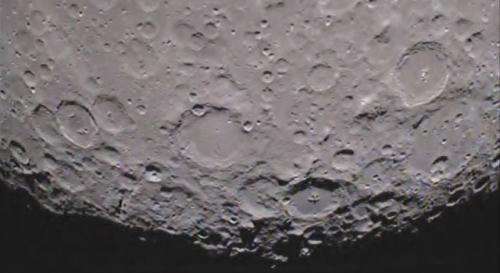
South pole of the far side of the moon as seen from the GRAIL mission's Ebb spacecraft. Image credit: NASA/Caltech-JPL
(PhysOrg.com) -- A camera aboard one of NASA's twin Gravity Recovery And Interior Laboratory (GRAIL) lunar spacecraft has returned its first unique view of the far side of the moon. MoonKAM, or Moon Knowledge Acquired by Middle school students, will be used by students nationwide to select lunar images for study.
GRAIL consists of two identical spacecraft, recently named Ebb and Flow, each of which is equipped with a MoonKAM. The images were taken as part of a test of Ebb's MoonKAM on Jan. 19. The GRAIL project plans to test the MoonKAM aboard Flow at a later date.
In the video, the north pole of the moon is visible at the top of the screen as the spacecraft flies toward the lunar south pole. One of the first prominent geological features seen on the lower third of the moon is the Mare Orientale, a 560-mile-wide (900 kilometer) impact basin that straddles both the moon's near and far side.
The clip ends with rugged terrain just short of the lunar south pole. To the left of center, near the bottom of the screen, is the 93-mile-wide (149 kilometer) Drygalski crater with a distinctive star-shaped formation in the middle. The formation is a central peak, created many billions of years ago by a comet or asteroid impact.
The quality of the video is excellent and should energize our MoonKAM students as they prepare to explore the moon," said Maria Zuber, GRAIL principal investigator from the Massachusetts Institute of Technology in Cambridge.
The twin spacecraft successfully achieved lunar orbit this past New Year's Eve and New Year's Day. Previously named GRAIL-A and GRAIL-B, the washing machine-sized spacecraft received their new names from fourth graders at the Emily Dickinson Elementary School in Bozeman, Mont., following a nationwide student naming contest.
Thousands of fourth- to eighth-grade students will select target areas on the lunar surface and send requests to the GRAIL MoonKAM Mission Operations Center in San Diego. Photos of the target areas will be sent back by the satellites for students to study. The MoonKAM program is led by Sally Ride, America's first woman in space. Her team at Sally Ride Science and undergraduate students at the University of California in San Diego will engage middle schools across the country in the GRAIL mission and lunar exploration. GRAIL is NASA's first planetary mission carrying instruments fully dedicated to education and public outreach.
"We have had great response from schools around the country; more than 2,500 signed up to participate so far," Ride said. "In mid-March, the first pictures of the moon will be taken by students using MoonKAM. I expect this will excite many students about possible careers in science and engineering."
Launched in September 2011, Ebb and Flow periodically perform trajectory correction maneuvers that, over time, will lower their orbits to near-circular ones with an altitude of about 34 miles (55 kilometers). During their science mission, the duo will answer longstanding questions about the moon and give scientists a better understanding of how Earth and other rocky planets in the solar system formed.
-
Twin Grail spacecraft reunite in lunar orbit
Jan 02, 2012 |
not rated yet |
0
-
NASA invites students to name moon-bound spacecraft
Oct 04, 2011 |
not rated yet |
0
-
Students rename NASA moon probes Ebb and Flow
Jan 17, 2012 |
not rated yet |
0
-
To the moon: GRAIL lunar mission scheduled to launch
Sep 08, 2011 |
not rated yet |
0
-
First of NASA's GRAIL spacecraft enters Moon orbit
Jan 01, 2012 |
not rated yet |
0
-
Stars containing dark matter should look different from other stars
Feb 20, 2012 |
4.5 / 5 (17) |
11
-
Physicists discover evidence of rare hypernucleus, a component of strange matter
Feb 17, 2012 |
4.7 / 5 (38) |
22
-
Fast photon control brings quantum photonic technologies closer
Feb 13, 2012 |
5 / 5 (8) |
1
-
Engineers build first sub-10-nm carbon nanotube transistor
Feb 01, 2012 |
4.9 / 5 (36) |
32
-
Something old, something new: Evolution and the structural divergence of duplicate genes
Jan 31, 2012 |
4.6 / 5 (7) |
1
-
Calculating the magnitude
2 hours ago
-
What is this spectrum I took?
12 hours ago
-
Orientation of Space
13 hours ago
-
Geologically Active Moon Now: NASA
20 hours ago
-
advice on building a science fair telescope
Feb 22, 2012
-
Rise of the Sun
Feb 22, 2012
- More from Physics Forums - General Astronomy
More news stories
Spitzer finds solid buckyballs in space
(PhysOrg.com) -- Astronomers using data from NASA's Spitzer Space Telescope have, for the first time, discovered buckyballs in a solid form in space. Prior to this discovery, the microscopic carbon spheres ...
14 hours ago |
4.7 / 5 (12) |
8
|
Going up: Japan builder eyes space elevator
A Japanese construction firm claimed Wednesday it could execute an out-of-this-world plan to put tourists in space within 40 years by building an elevator that stretches a quarter of the way to the moon.
Space & Earth / Space Exploration
21 hours ago |
3.5 / 5 (13) |
26
ENASA satellite finds Earth's clouds are getting lower
(PhysOrg.com) -- Earth's clouds got a little lower -- about one percent on average -- during the first decade of this century, finds a new NASA-funded university study based on NASA satellite data. The results ...
Space & Earth / Earth Sciences
18 hours ago |
5 / 5 (8) |
13
|
Fresh scandal embroils US climate science debate
A fresh scandal over climate change has erupted in the United States after leaked documents appeared to show a right-wing funded campaign to influence how climate science is taught in schools.
11 hours ago |
4.1 / 5 (9) |
8
World's oceans get an acid bath
Among the repercussions of global climate change, the effect of ocean acidification on marine life is one of the least-understood variables.
18 hours ago |
4.3 / 5 (6) |
4
|
Researchers build first physical 'metatronic' circuit
(PhysOrg.com) -- The technological world of the 21st century owes a tremendous amount to advances in electrical engineering, specifically, the ability to finely control the flow of electrical charges using ...
Faster than light neutrinos? More like faulty wiring
You can shelf your designs for a warp drive engine (for now) and put the DeLorean back in the garage; it turns out neutrinos may not have broken any cosmic speed limits after all.
Physicists surprised by disappearing and reappearing superconductivity in iron selenium chalcogenides
Superconductivity is a rare physical state in which matter is able to conduct electricity -- maintain a flow of electrons -- without any resistance. This phenomenon can only be found in certain materials at low temperatures, ...
Stanford research team cracks animated NuCaptcha
(PhysOrg.com) -- The research team from Stanford University, led by Elie Bursztein, that previously had cracked regular CAPTCHAs and then audio CAPTCHAs, now has also successfully cracked the animated version called NuCapt ...
Flesh-eating bacteria inspire superglue
(PhysOrg.com) -- A bio-inspired superglue has been developed by Oxford University researchers that cant be matched for sticking molecules together and not letting go.
Scientists create potent molecules aimed at treating muscular dystrophy
While RNA is an appealing drug target, small molecules that can actually affect its function have rarely been found. But now scientists from the Florida campus of The Scripps Research Institute have for the first time designed ...
Feb 02, 2012
Rank: not rated yet
Feb 02, 2012
Rank: not rated yet
Feb 07, 2012
Rank: not rated yet