Researchers move graphene electronics into 3D
February 2, 2012
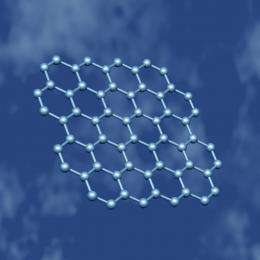
Artistic impression of graphene molecules. Image: University of Manchester
In a paper published this week in Science, a Manchester team lead by Nobel laureates Professor Andre Geim and Professor Konstantin Novoselov has literally opened a third dimension in graphene research. Their research shows a transistor that may prove the missing link for graphene to become the next silicon.
Graphene one atomic plane of carbon is a remarkable material with endless unique properties, from electronic to chemical and from optical to mechanical.
One of many potential applications of graphene is its use as the basic material for computer chips instead of silicon. This potential has alerted the attention of major chip manufactures, including IBM, Samsung, Texas Instruments and Intel. Individual transistors with very high frequencies (up to 300 GHz) have already been demonstrated by several groups worldwide.
Unfortunately, those transistors cannot be packed densely in a computer chip because they leak too much current, even in the most insulating state of graphene. This electric current would cause chips to melt within a fraction of a second.
This problem has been around since 2004 when the Manchester researchers reported their Nobel-winning graphene findings and, despite a huge worldwide effort to solve it since then, no real solution has so far been offered.
The University of Manchester scientists now suggest using graphene not laterally (in plane) as all the previous studies did but in the vertical direction. They used graphene as an electrode from which electrons tunnelled through a dielectric into another metal. This is called a tunnelling diode.
Then they exploited a truly unique feature of graphene that an external voltage can strongly change the energy of tunnelling electrons. As a result they got a new type of a device vertical field-effect tunnelling transistor in which graphene is a critical ingredient.
Dr Leonid Ponomarenko, who spearheaded the experimental effort, said: "We have proved a conceptually new approach to graphene electronics. Our transistors already work pretty well. I believe they can be improved much further, scaled down to nanometre sizes and work at sub-THz frequencies."
"It is a new vista for graphene research and chances for graphene-based electronics never looked better than they are now", adds Professor Novoselov.
Graphene alone would not be enough to make the breakthrough. Fortunately, there are many other materials, which are only one atom or one molecule thick, and they were used for help.
The Manchester team made the transistors by combining graphene together with atomic planes of boron nitride and molybdenum disulfide. The transistors were assembled layer by layer in a desired sequence, like a layer cake but on an atomic scale.
Such layer-cake superstructures do not exist in nature. It is an entirely new concept introduced in the report by the Manchester researchers. The atomic-scale assembly offers many new degrees of functionality, without some of which the tunnelling transistor would be impossible.
"The demonstrated transistor is important but the concept of atomic layer assembly is probably even more important," explains Professor Geim. Professor Novoselov added: "Tunnelling transistor is just one example of the inexhaustible collection of layered structures and novel devices which can now be created by such assembly.
"It really offers endless opportunities both for fundamental physics and for applications. Other possible examples include light emission diodes, photovoltaic devices, and so on."
More information: Field-effect tunneling transistor based on vertical graphene heterostructures, by L. Britnel et al., Science, 2nd February 2012.
-
Graphene's 'Big Mac' creates next generation of chips
Oct 09, 2011 |
not rated yet |
0
-
IBM introduces new graphene transistor
Apr 11, 2011 |
not rated yet |
0
-
Bilayer graphene is another step toward graphene electronics
Aug 11, 2011 |
not rated yet |
0
-
Self-cooling observed in graphene electronics
Apr 03, 2011 |
not rated yet |
0
-
Graphene's 'quantum leap' takes electronics a step closer
Jul 24, 2011 |
not rated yet |
0
-
Stars containing dark matter should look different from other stars
Feb 20, 2012 |
4.5 / 5 (17) |
11
-
Physicists discover evidence of rare hypernucleus, a component of strange matter
Feb 17, 2012 |
4.7 / 5 (38) |
22
-
Fast photon control brings quantum photonic technologies closer
Feb 13, 2012 |
5 / 5 (8) |
1
-
Engineers build first sub-10-nm carbon nanotube transistor
Feb 01, 2012 |
4.9 / 5 (36) |
32
-
Something old, something new: Evolution and the structural divergence of duplicate genes
Jan 31, 2012 |
4.6 / 5 (7) |
1
-
Strength reduction factors for welded edge joints
3 hours ago
-
Specific heat of Al
Feb 21, 2012
-
Strongest steel?
Feb 19, 2012
-
stabilizing Zirconia
Feb 18, 2012
-
How to calculate strength of welds (welded joints)?
Feb 17, 2012
-
Polycarbonate fracture toughness????
Feb 16, 2012
- More from Physics Forums - Materials & Chemical Engineering
More news stories
New nanotechnology converts heat into power when it's needed most
Never get stranded with a dead cell phone again. A promising new technology called Power Felt, a thermoelectric device that converts body heat into an electrical current, soon could create enough juice to make another call ...
16 hours ago |
4 / 5 (8) |
6
|
Researchers discover how different nanomaterial surfaces affect proteins
A new study led by nanotechnology and biotechnology experts at Rensselaer Polytechnic Institute is providing important details on how proteins in our bodies interact with nanomaterials. In their new study, published in the ...
Nanotechnology / Bio & Medicine
10 hours ago |
5 / 5 (2) |
1
|
Graphene is thinnest known anti-corrosion coating
New research has established the "miracle material" called graphene as the world's thinnest known coating for protecting metals against corrosion. Their study on this potential new use of graphene appears ...
Nanotechnology / Nanomaterials
13 hours ago |
4.6 / 5 (7) |
2
|
New technique produces free-standing piezoelectric ferroelectric nanostructures from PZT material
(PhysOrg.com) -- Researchers have developed a soft template infiltration technique for fabricating free-standing piezoelectrically active ferroelectric nanotubes and other nanostructures from PZT ...
17 hours ago |
5 / 5 (5) |
4
|
A new twist on nanowires
Nanowires — microscopic fibers that can be “grown” in the lab — are a hot research topic today, with a variety of potential applications including light-emitting diodes (LEDs) and sensors. ...
19 hours ago |
4.8 / 5 (4) |
0
|
Researchers build first physical 'metatronic' circuit
(PhysOrg.com) -- The technological world of the 21st century owes a tremendous amount to advances in electrical engineering, specifically, the ability to finely control the flow of electrical charges using ...
Spitzer finds solid buckyballs in space
(PhysOrg.com) -- Astronomers using data from NASA's Spitzer Space Telescope have, for the first time, discovered buckyballs in a solid form in space. Prior to this discovery, the microscopic carbon spheres ...
Faster than light neutrinos? More like faulty wiring
You can shelf your designs for a warp drive engine (for now) and put the DeLorean back in the garage; it turns out neutrinos may not have broken any cosmic speed limits after all.
CT colonography shown to be comparable to standard colonoscopy
Computerized tomographic (CT) colonography (CTC), also known as virtual colonoscopy, is comparable to standard colonoscopy in its ability to accurately detect cancer and precancerous polyps in people ages 65 and older, according ...
Physicists surprised by disappearing and reappearing superconductivity in iron selenium chalcogenides
Superconductivity is a rare physical state in which matter is able to conduct electricity -- maintain a flow of electrons -- without any resistance. This phenomenon can only be found in certain materials at low temperatures, ...
Study: Virtual colonoscopy effective screening tool for adults over 65
Computed tomography (CT) colonography can be used as a primary screening tool for colorectal cancer in adults over the age of 65, according to a new study published online in the journal Radiology.
Feb 02, 2012
Rank: not rated yet
Feb 03, 2012
Rank: 3.3 / 5 (3)
Resistance is futile...
Feb 03, 2012
Rank: 5 / 5 (1)
'layer-cake superstructures' <<< i know i heard that somewhere before... oh yes: http://www.jle.co...88sl.jpg (cortical layer structure)
Feb 03, 2012
Rank: 1.5 / 5 (2)
Feb 03, 2012
Rank: 1 / 5 (1)