Hubble zooms in on a magnified galaxy
February 2, 2012
Hubble zooms in on a magnified galaxy

Enlarge

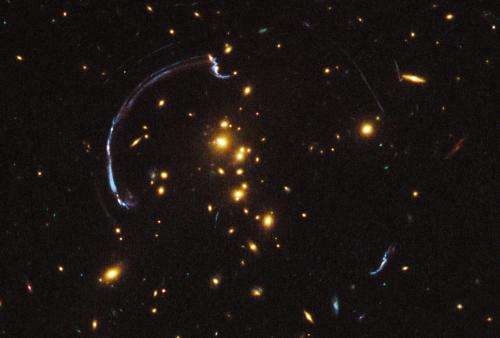
Thanks to the presence of a natural "zoom lens" in space, this is a close-up look at brightest distant "magnified" galaxy in the universe known to date. It is one of the most striking examples of gravitational lensing, where the gravitational field of a foreground galaxy bends and amplifies the light of a more distant background galaxy. In this image the light from a distant galaxy, nearly 10 billion light-years away, has been warped into a nearly 90-degree arc of light in the galaxy cluster RCS2 032727-132623. The galaxy cluster lies 5 billion light-years away. The background galaxy's image is 20 times larger and over three times brighter than typically lensed galaxies. The natural color image was taken in March 2011 with the Hubble Space Telescope's Wide Field Camera 3. Credit: NASA; ESA; J. Rigby (NASA Goddard Space Flight Center); and K. Sharon (Kavli Institute for Cosmological Physics, University of Chicago)

(PhysOrg.com) -- Thanks to the presence of a natural "zoom lens" in space, NASA's Hubble Space Telescope got a uniquely close-up look at the brightest "magnified" galaxy yet discovered.

This observation provides a unique opportunity to study the physical properties of a galaxy vigorously forming stars when the universe was only one-third its present age.

A so-called gravitational lens is produced when space is warped by a massive foreground object, whether it is the sun, a black hole or an entire . The light from more-distant background objects is distorted, brightened and magnified as it passes through this gravitationally disturbed region.

A team of astronomers led by Jane Rigby of NASA's Goddard Space Flight Center in Greenbelt, Md., aimed Hubble at one of the most striking examples of gravitational lensing, a nearly 90-degree arc of light in the RCS2 032727-132623. Hubble's view of the distant is significantly more detailed than could ever be achieved without the help of the .

Hubble zooms in on a magnified galaxy
Enlarge

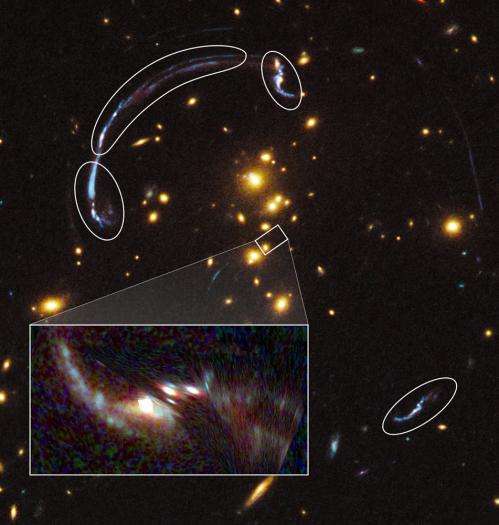
This graphic shows a reconstruction (at lower left) of the brightest galaxy whose image has been distorted by the gravity of a distant galaxy cluster. The small rectangle in the center shows the location of the background galaxy on the sky if the intervening galaxy cluster were not there. The rounded outlines show distinct, distorted images of the background galaxy resulting from lensing by the mass in the cluster. The image at lower left is a reconstruction of what the lensed galaxy would look like in the absence of the cluster, based on a model of the cluster's mass distribution derived from studying the distorted galaxy images. Credit: NASA, ESA, J. Rigby (NASA Goddard Space Flight Center), K. Sharon (Kavli Institute for Cosmological Physics, University of Chicago),  and M. Gladders and E. Wuyts (University of Chicago)

The results have been accepted for publication in the Astrophysical Journal, in a paper led by Keren Sharon of the Kavli Institute for Cosmological Physics at the University of Chicago. Professor Michael Gladders and graduate student Eva Wuyts of the University of Chicago were also key team members.

The presence of the lens helps show how evolved from 10 billion years ago to today. While are fully mature and are at the tail end of their star-formation histories, distant galaxies tell us about the universe's formative years. The light from those early events is just now arriving at Earth. Very distant galaxies are not only faint but also appear small on the sky. Astronomers would like to see how star formation progressed deep within these galaxies. Such details would be beyond the reach of Hubble's vision were it not for the magnification made possible by gravity in the intervening lens region.

In 2006 a team of astronomers using the Very Large Telescope in Chile measured the arc's distance and calculated that the galaxy appears more than three times brighter than previously discovered lensed galaxies. In 2011 astronomers used Hubble to image and analyze the lensed galaxy with the observatory's Wide Field Camera 3.

The distorted image of the galaxy is repeated several times in the foreground lensing cluster, as is typical of gravitational lenses. The challenge for astronomers was to reconstruct what the galaxy really looked like, were it not distorted by the cluster's funhouse-mirror effect.

Hubble's sharp vision allowed astronomers to remove the distortions and reconstruct the galaxy image as it would normally look. The reconstruction revealed regions of star formation glowing like bright Christmas tree bulbs. These are much brighter than any star-formation region in our Milky Way galaxy.

Through spectroscopy, the spreading out of the light into its constituent colors, the team plans to analyze these star-forming regions from the inside out to better understand why they are forming so many stars.

Provided by NASA's Goddard Space Flight Center (news : web)

Filter


Move the slider to adjust rank threshold, so that you can hide some of the comments.


Display comments: newest first

that_guy
Feb 02, 2012

Rank: 2 / 5 (1)
Just staring at that warped picture, I have a hard time justifying that traditional gravitational lensing is the only effect at play here.

It looks like lensing is the primary cause of the anomaly, but I'd like them to reconstruct the geometry of this situation - the light seems to be warped beyond gravitational influence in places.

Basically I'm saying that the distortion ring makes sense. But it appears that the light is not just simply bent like a lens - The zoomed in (Or even unzoomed version) area shows a really strange interaction between the foreground galaxy and the background galaxy - in addition to the apparent need of the light to travel unimpeded through matter that lies in the lensing trajectory.
Deesky
Feb 02, 2012

Rank: 5 / 5 (6)
Basically I'm saying that the distortion ring makes sense. But it appears that the light is not just simply bent like a lens

I think you're thinking too much along the lines of a conventional glass lens to discount the total effect.

The lensing is produced by a particular concentration of mass which tends not to be uniform, like a real lens, so you would expect to see some 'weird' distortions.

The article mentions a funhouse mirror effect, but you could also imagine a perfect glass lens which has been distorted by, say heat, so that it has lumps and depressions. Looking through it would similarly produce weird distortions.
yyz
Feb 02, 2012

Rank: 5 / 5 (4)
"the light seems to be warped beyond gravitational influence in places."

Remember that the visible matter in the galaxy cluster makes up only a small fraction of the total lensing mass of the cluster. Also, the dark matter distribution in the cluster is not homogenous, which gives not only distorted images of the background galaxy but also images of the lensed galaxy with different magnifications.

The paper describing the image reconstruction has an illustration outlining the changing magnification across the field of the cluster(Fig 5): http://hubblesite.../pdf.pdf

I'd also note that the reconstructed image shown here is a composite of four different individual reconstructions of the various images in the photo (Fig 3 in the linked paper has the individual image reconstructions). Individual foreground galaxies in the cluster have also been removed from the final reconstructed image shown here.

Hope some of this helps.
that_guy
Feb 02, 2012

Rank: not rated yet
Gravitational lensing does follow the same type of trajectory as a traditional lens. There are some key differences of course, but you literally can build a lens that would almost exactly mimic the lensing properties of something that a galaxy would cause. It is definitely in the realm of our current technology.

What I'm pointing out here is just an unprovable opinion, that it certainly looks like the lensing trajectories in some places seem to twist around and interact with certain objects in ways that imply extreme modification/twisting/micro lensing beyond what I would expect from a small portion of the total cluster, and yet seem to be unnaffected by more substantial parts of the cluster.

The main parts of the lensing make perfect sense as your paper describes, but the small details in places make me assume that there is much more to uncover in this interaction.
Deesky
Feb 02, 2012

Rank: not rated yet
The main parts of the lensing make perfect sense as your paper describes, but the small details in places make me assume that there is much more to uncover in this interaction.

I'm sorry, but you choose to make a distinction where none is warranted - your 'gut' feeling, not withstanding.
antialias_physorg
Feb 03, 2012

Rank: 5 / 5 (1)
The distorted image of the galaxy is repeated several times in the foreground lensing cluster, as is typical of gravitational lenses.

What I'd really like to see is when we find a galaxy where we have a direct view and also a 'roundabout' view via a gravitational lense off to one side (which would have to be something immensely massive like a black hole). If we can identifiy some salient features in each image then this would allow us to get snapshots of the same galaxy at two different times (since the length of the flight paths of the incoming photons would be different). From this we could extrapolate the motions of stars within a galaxy.
rawa1
Feb 03, 2012

Rank: 1 / 5 (1)
The Hubble space telescope captured an image of a "barred spiral" galaxy that could help us better understand our own Milky Way. http://www.bbc.co...16856812
hemitite
Feb 03, 2012

Rank: 5 / 5 (1)
I think that another possible use for images of this sort is that one could construct a set of time-laps pictures of the magnified galaxy from the scattered "copies" of it around the foreground object. These different views would have taken different routs of varying lengths and thus show that body at different times.

I don't know what the scale of the time differences would be, but it might be several K years.
fmfbrestel
Feb 03, 2012

Rank: not rated yet
an unprovable opinion ... certainly looks like ... in some places seem ... in ways that imply ... beyond what I would expect ... and yet seem


Just staring at all those hedges, I have a hard time not giving you one star.
seb
Feb 05, 2012

Rank: not rated yet
Hmm I wonder what the exposer time is on a photo like that heh

antialias_physorg
Feb 05, 2012

Rank: not rated yet
Here ya go:
http://hubblesite...stfacts/

Exposure time: 2.7 hours.
Rank 5 /5 (13 votes)
Related Stories
Relevant PhysicsForums posts
  • Calculating the magnitude
    created1 hour ago
  • What is this spectrum I took?
    created12 hours ago
  • Orientation of Space
    created12 hours ago
  • Geologically Active Moon Now: NASA
    created19 hours ago
  • advice on building a science fair telescope
    createdFeb 22, 2012
  • Rise of the Sun
    createdFeb 22, 2012
  • More from Physics Forums - General Astronomy

More news stories

Spitzer finds solid buckyballs in space

(PhysOrg.com) -- Astronomers using data from NASA's Spitzer Space Telescope have, for the first time, discovered buckyballs in a solid form in space. Prior to this discovery, the microscopic carbon spheres ...

Space & Earth / Astronomy

created 13 hours ago | popularity 4.7 / 5 (12) | comments 8 | with audio podcast

Going up: Japan builder eyes space elevator

A Japanese construction firm claimed Wednesday it could execute an out-of-this-world plan to put tourists in space within 40 years by building an elevator that stretches a quarter of the way to the moon.

Space & Earth / Space Exploration

created 20 hours ago | popularity 3.5 / 5 (13) | comments 26

ENASA satellite finds Earth's clouds are getting lower

(PhysOrg.com) -- Earth's clouds got a little lower -- about one percent on average -- during the first decade of this century, finds a new NASA-funded university study based on NASA satellite data. The results ...

Space & Earth / Earth Sciences

created 17 hours ago | popularity 5 / 5 (8) | comments 12 | with audio podcast

Fresh scandal embroils US climate science debate

A fresh scandal over climate change has erupted in the United States after leaked documents appeared to show a right-wing funded campaign to influence how climate science is taught in schools.

Space & Earth / Environment

created 10 hours ago | popularity 4.1 / 5 (9) | comments 8

World's oceans get an acid bath

Among the repercussions of global climate change, the effect of ocean acidification on marine life is one of the least-understood variables.

Space & Earth / Environment

created 17 hours ago | popularity 4.3 / 5 (6) | comments 4 | with audio podcast


Researchers build first physical 'metatronic' circuit

(PhysOrg.com) -- The technological world of the 21st century owes a tremendous amount to advances in electrical engineering, specifically, the ability to finely control the flow of electrical charges using ...

Faster than light neutrinos? More like faulty wiring

You can shelf your designs for a warp drive engine (for now) and put the DeLorean back in the garage; it turns out neutrinos may not have broken any cosmic speed limits after all.

CT colonography shown to be comparable to standard colonoscopy

Computerized tomographic (CT) colonography (CTC), also known as virtual colonoscopy, is comparable to standard colonoscopy in its ability to accurately detect cancer and precancerous polyps in people ages 65 and older, according ...

Physicists surprised by disappearing and reappearing superconductivity in iron selenium chalcogenides

Superconductivity is a rare physical state in which matter is able to conduct electricity -- maintain a flow of electrons -- without any resistance. This phenomenon can only be found in certain materials at low temperatures, ...

Study: Virtual colonoscopy effective screening tool for adults over 65

Computed tomography (CT) colonography can be used as a primary screening tool for colorectal cancer in adults over the age of 65, according to a new study published online in the journal Radiology.

Stanford research team cracks animated NuCaptcha

(PhysOrg.com) -- The research team from Stanford University, led by Elie Bursztein, that previously had cracked regular CAPTCHAs and then audio CAPTCHAs, now has also successfully cracked the animated version called NuCapt ...