Northern forests may be losing their ability to trap carbon
February 2, 2012 By Joel N. Shurkin
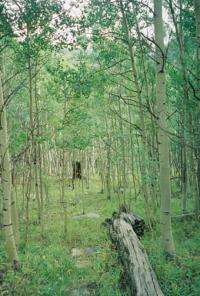
Credit: Linnea Hanson/U.S. Forest Service. Young aspen grove.
The northern forests of western Canada are likely absorbing less carbon dioxide because of climate change, and the decline may be making a bad situation worse, researchers from Quebec and China have concluded.
If the situation remains as it is, the forests may actually put more carbon dioxide back into the air than they absorb, the researchers said. While researchers have seen this happen in tropical rainforests, the new result suggests that this problem could be much more widespread.
The scientists at the University of Quebecs Montreal campus and from several Chinese institutions, reporting in this weeks Proceedings of the National Academy of Sciences, have been able to put numbers to the fears that the ability of northern forests to absorb carbon -- to act as carbon sinks -- was decreasing.
The researchers studied 96 permanent old-growth forests out of 20,000 candidates, concentrating on aspens, which are more sensitive to changes in precipitation.
They deliberately chose forests that were not affected by insect infestation or fires. They then estimated biomass production -- the growth of the trees -- from 1968 to 2008.
Trees in both east and west were dying sooner, but the eastern forests were replacing biomass while the forests in the western provinces of Manitoba, Alberta and Saskatchewan were not. The west has had less precipitation and rising temperatures, which they believe is the cause.
"Our results indicate that since 1963, drought-induced water stress has led to a weakening of the biomass carbon sink across a large area of the western Canadian boreal [northern] forests, with the largest reduction after 2000," they wrote.
Eastern Canadian boreal forests are not showing a similar phenomenon, they said, because trees are being replaced fast enough.
A reduction in biomass does not necessarily mean the forests are actually shrinking. There could be the same number of trees over the same area, but they might be smaller. In this study, the scientists reported the forests actually were getting smaller.
"Over time, more trees died than were regenerated," said Changhui Peng, Director for Ecological Modeling and Carbon Science, Institute of Environment Sciences, University of Quebec at Montreal. "The population of trees is declining."
Dead trees release the carbon back into the atmosphere as they decompose, Peng said.
Peng said until recently, scientists thought the decrease in the carbon sink was restricted to tropical rain forests, but apparently it is happening in the northern latitudes as well.
The theory is that the more and larger the trees and the larger the forests, the more carbon dioxide will be captured, mitigating the greenhouse effect.
The Canadian research seems to indicate that may not be so, Peng said.
Almost half the carbon stored in the worlds forests is in northern latitudes.
The same thing appears to be happening in the American West as well, according to the U.S. Forest Service, although the forests of Western Europe are growing.
"In interior Alaska, were seeing very big decreases in productivity," said Teresa Nettleton Hollingsworth, a research ecologist for the U.S. Forest Service in Fairbanks. Productivity means the growth in biomass.
There also has been higher mortality in trees. But Hollingsworth said there is no evidence the change was due directly to climate change in Alaska. It could also be the result of insect infestation and the increase in forest fires, which are endemic in the area, the indirect results of climate change.
"It could be that the number of trees have stayed the same but that they are not growing as much as they were in the past," she said.
-
World's forests' role in carbon storage immense, profound
Jul 18, 2011 |
not rated yet |
0
-
Study: Amazon trees older than believed
Dec 13, 2005 |
not rated yet |
0
-
Soil nutrition affects carbon sequestration in forests
Dec 13, 2006 |
not rated yet |
0
-
Global warming may affect the capacity of trees to store carbon, study finds
May 25, 2011 |
not rated yet |
0
-
Bacteria on old-growth trees may help forests grow
Jun 07, 2011 |
not rated yet |
0
-
Stars containing dark matter should look different from other stars
Feb 20, 2012 |
4.5 / 5 (17) |
11
-
Physicists discover evidence of rare hypernucleus, a component of strange matter
Feb 17, 2012 |
4.7 / 5 (38) |
22
-
Fast photon control brings quantum photonic technologies closer
Feb 13, 2012 |
5 / 5 (8) |
1
-
Engineers build first sub-10-nm carbon nanotube transistor
Feb 01, 2012 |
4.9 / 5 (36) |
32
-
Something old, something new: Evolution and the structural divergence of duplicate genes
Jan 31, 2012 |
4.6 / 5 (7) |
1
-
Is the Earth really going to die
14 hours ago
-
Do some geologists actually act a lot like Randy Marsh?
Feb 11, 2012
-
Discrepancy between oxygen and carbon-dioxide levels
Feb 09, 2012
-
where gems are found in the world
Feb 09, 2012
-
Wind Waves in Reservoir ~ Wind run-up and Wind set-up
Feb 08, 2012
-
Balance of oxygen in the atmosphere
Feb 01, 2012
- More from Physics Forums - Earth
More news stories
Spitzer finds solid buckyballs in space
(PhysOrg.com) -- Astronomers using data from NASA's Spitzer Space Telescope have, for the first time, discovered buckyballs in a solid form in space. Prior to this discovery, the microscopic carbon spheres ...
14 hours ago |
4.7 / 5 (12) |
8
|
Going up: Japan builder eyes space elevator
A Japanese construction firm claimed Wednesday it could execute an out-of-this-world plan to put tourists in space within 40 years by building an elevator that stretches a quarter of the way to the moon.
Space & Earth / Space Exploration
21 hours ago |
3.5 / 5 (13) |
26
ENASA satellite finds Earth's clouds are getting lower
(PhysOrg.com) -- Earth's clouds got a little lower -- about one percent on average -- during the first decade of this century, finds a new NASA-funded university study based on NASA satellite data. The results ...
Space & Earth / Earth Sciences
18 hours ago |
5 / 5 (8) |
13
|
Fresh scandal embroils US climate science debate
A fresh scandal over climate change has erupted in the United States after leaked documents appeared to show a right-wing funded campaign to influence how climate science is taught in schools.
10 hours ago |
4.1 / 5 (9) |
8
World's oceans get an acid bath
Among the repercussions of global climate change, the effect of ocean acidification on marine life is one of the least-understood variables.
17 hours ago |
4.3 / 5 (6) |
4
|
Researchers build first physical 'metatronic' circuit
(PhysOrg.com) -- The technological world of the 21st century owes a tremendous amount to advances in electrical engineering, specifically, the ability to finely control the flow of electrical charges using ...
Faster than light neutrinos? More like faulty wiring
You can shelf your designs for a warp drive engine (for now) and put the DeLorean back in the garage; it turns out neutrinos may not have broken any cosmic speed limits after all.
Physicists surprised by disappearing and reappearing superconductivity in iron selenium chalcogenides
Superconductivity is a rare physical state in which matter is able to conduct electricity -- maintain a flow of electrons -- without any resistance. This phenomenon can only be found in certain materials at low temperatures, ...
CT colonography shown to be comparable to standard colonoscopy
Computerized tomographic (CT) colonography (CTC), also known as virtual colonoscopy, is comparable to standard colonoscopy in its ability to accurately detect cancer and precancerous polyps in people ages 65 and older, according ...
Stanford research team cracks animated NuCaptcha
(PhysOrg.com) -- The research team from Stanford University, led by Elie Bursztein, that previously had cracked regular CAPTCHAs and then audio CAPTCHAs, now has also successfully cracked the animated version called NuCapt ...
Study: Virtual colonoscopy effective screening tool for adults over 65
Computed tomography (CT) colonography can be used as a primary screening tool for colorectal cancer in adults over the age of 65, according to a new study published online in the journal Radiology.
Feb 02, 2012
Rank: 3.3 / 5 (7)
Feb 02, 2012
Rank: 4.2 / 5 (5)
Are they or aren't they?
Is this actually the case? Any evidence?
Finally, we have something to work with. The forests are getting smaller. Though, after all of the hemming and hawing, I'm not sure that I believe it. Are they being replaced by deserts, undergrowth, or grasslands?
I"m sorry, I was hoping that this article would actually say something. It may or might be doing something isn't telling us anything. Please, try again!
Feb 02, 2012
Rank: 5 / 5 (2)
"Over time, more trees died than were regenerated," said Changhui Peng, Director for Ecological Modeling and Carbon Science, Institute of Environment Sciences, University of Quebec at Montreal. "The population of trees is declining."
"It could be that the number of trees have stayed the same but that they are not growing as much as they were in the past," she said.
The first is a statement of fact which is well supported if you care to search it. The second is an opinion by a different person. How they wound up a paragraph apart in the same article is beyond me. As far as what they are being replaced by....they are living trees being replaced by dead ones dude....no broad change to the overall biosphere yet, it is still a forest. Read this one.....
http://www.physor...sts.html
Feb 02, 2012
Rank: 3 / 5 (2)
It doesn't take a rocket scientist to see that any tree is a carbon sink. How do you think the things grow? By magic? No, they absorb CO2 and turn it into cell walls.
I don't know if I truly believe in the CO2-drought link that they imply, but if it is true, and there is a nonlinear feedback loop that leads to the accelerating desertification of the prairie provinces, then we could be in serious trouble. A non-negligible loss of farmland due to desertification would wreak havoc on the food supply for all of Canada and for a whole lot of developing countries that rely on Canada for assistance.
Feb 02, 2012
Rank: 2.3 / 5 (9)
As only one example, consider the now boldly declared decision to use only specially chosen samples, rather than random ones. "96 permanent old-growth forests out of 20,000 candidates". That spells "ringer"! A "study" is supposed to include random samples, not a handful out of a preponderance of alternatives! And they admit they were specially chosen for not having been affected by insects or fires. But that could just as well mean the forests they looked at were unnatural, comprising trees that don't burn and are so abnormal they don't attract insects! Remember, a rule is that the random sample represents what affects a system and, since that means that forests affected by insects or that experienced fire, since19,904 out of 20,000 forests seem to qualify, that means that, whether you like those forests or not, those ar ethe ones you have to look at!
Feb 02, 2012
Rank: 5 / 5 (1)
Imagine this: In order to do a survey over a large period of time, you have to choose old trees. I know it's difficult to understand.
Feb 02, 2012
Rank: 5 / 5 (5)
Feb 02, 2012
Rank: 2.1 / 5 (7)
Feb 02, 2012
Rank: 3 / 5 (2)
You have to see this from the point of view of someone from central Saskatchewan. To the north, we have vast areas of desert and rock. To the south, we have vast areas of farmland. If the farmland succumbs to desertification in a non-negligible way, then Canada, the US, and many developing countries will be in serious trouble. The fact of the matter is that Saskatchewan is deeply important to the stability of more than just Saskatchewan.
If it is possible to partially avoid desertification through reforestation, then it seems like it's kind of straightforward that we should increase reforestation efforts just to be on the safe side.
This has nothing to do with whether or not the drought was anthropogenic or not.
Feb 02, 2012
Rank: 1 / 5 (4)
Feb 02, 2012
Rank: 5 / 5 (5)
@shalayka.
"If it is possible to partially avoid desertification through reforestation, then it seems like it's kind of straightforward that we should increase reforestation efforts just to be on the safe side.
This has nothing to do with whether or not the drought was anthropogenic or not."
I agree with this 100%. The issue in reforestation is what to use. If the boreal is no longer self sustaining because the species of trees that comprise it cannot adapt, we should be looking at what does thrive and plant accordingly. I live in Ontario but my job will take me to Rocanville at some point this summer so I'm looking forward to the visit to your province. We ran into the same thing here with municipal tree planting. The list had to be altered and most evergreens removed as growing conditions are favoring broad leafed trees.
Feb 02, 2012
Rank: 1.7 / 5 (6)
Feb 02, 2012
Rank: 1.7 / 5 (6)
Feb 02, 2012
Rank: 3.7 / 5 (3)
Isolating the measurements to certain species of trees, simply removed all of the variables that having multiple species would introduce.
To me, it sound these scientists took a good approach to the data acquisition processes.
Feb 03, 2012
Rank: 5 / 5 (2)
Let us all know how you make out....take your time.
Feb 05, 2012
Rank: 1 / 5 (3)
And, consider, just what are they saying when they say carbon is not being absorbed from the atmosphere? Carbon is basic to the molecules associated by "science" with living tissue on earth. If they don't absorb carbon, that means they aren't making carbon molecules for their own cells! So, on the basis of a variety with body chemistry different from all others, the "researchers" are going to conclude necessarily how all the others must behave now.
Feb 06, 2012
Rank: not rated yet
Aspen trees do burn, and they do attract insects, google can help you with this if you still don't get it.
Yes, if you reduce the amount of water trees need to grow, they don't. This isn't species specific.
They didn't say that the trees stopped absorbing carbon, they said the forest as a whole would if death rates outpace new growth...again pretty logical.
Good speech about carbon and it's importance though.