Russia will begin hunt for extrasolar planets
February 2, 2012 by Tammy Plotner, Universe Today
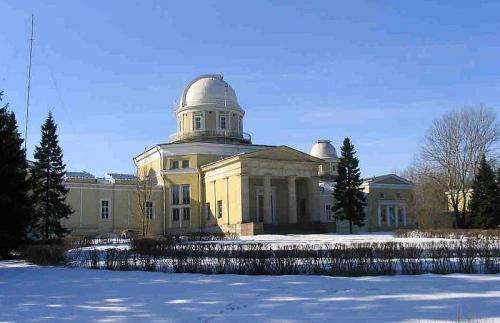
Pulkovo Observatory 2004 - Credit: Vladimir Ivanov
Located just south of Saint Petersburg on Pulkovo Heights, one of the greatest Russian Observatories of all times the Pulkovo Observatory is about to embark on a very noble study. According to the head of the Institute for Space Research, Lev Zelyony, the Soviet telescopes are about to turn their eyes towards deep skies in search of extrasolar planets. Scientists from the Pulkovo Observatory are planning to use ground-based instruments to study the transit of planets around their parent stars, Zelyony said at a roundtable meeting at RIA Novosti headquarters in Moscow.
The observatory was absolutely state-of-the-art when it opened for business in 1839 and employed Wilhelm von Struve as its director. It houses some of the largest refractor telescopes in the world, including a 38-cm (15 in.) aperture refractor and a 30-inch (76 cm) refractor both built by Alvan Clarke and Sons. Fifty years later, they added an astrophysical laboratory, a mechanical workshop and installed one of Europes largest lensed telescope, a 76-cm refractor (30 inch). Later additions to the observatory included a Littrow spectrograph and horizontal solar telescope and the facility blossomed into a world leader in stellar spectroscopy, cataloging and more. Modern improvements include astrograph equipment, an interferometer, radio telescope and even an additional 65-cm (26-inch) refractor. The Pulkovo Observatory is up to the task.
The hunt for exoplanets is one of the most popular aspects of modern astronomy and one of the fastest growing fields. In less than 25 years, 755 and an ever-increasing number of planets have been cataloged and the research just doesnt end. The United States Kepler Mission and French CoRoT space telescope have had their share of fun, but using a ground-based telescope could also be a viable source of planet detection, Zelyony said. He also cited the example of the Hungarian Automated Telescope Network (HATNet) which so far has discovered 29 exoplanets. By using the transit detection method, the Russian astronomers are eager to begin observations where a small change in magnitude could mean a big change in the way their telescopes perceive the stars.
It is an interesting research, which should be pursued, Zelyony said. It will also help us look at our Solar System from a different perspective.
More information: http://en.rian.ru/ … 1069248.html
Source: Universe Today
-
Is another Earth out there?
Oct 21, 2011 |
not rated yet |
0
-
Forest Fire Threatens Whipple Observatory
Jul 18, 2005 |
not rated yet |
0
-
Four new exoplanets to start off the new year!
Jan 06, 2012 |
not rated yet |
0
-
A New Way to Find Earths
Jul 09, 2010 |
not rated yet |
0
-
NASA Releases Kepler Data on Potential Extrasolar Planets
Jun 16, 2010 |
not rated yet |
0
-
Stars containing dark matter should look different from other stars
Feb 20, 2012 |
4.5 / 5 (17) |
11
-
Physicists discover evidence of rare hypernucleus, a component of strange matter
Feb 17, 2012 |
4.7 / 5 (38) |
22
-
Fast photon control brings quantum photonic technologies closer
Feb 13, 2012 |
5 / 5 (8) |
1
-
Engineers build first sub-10-nm carbon nanotube transistor
Feb 01, 2012 |
4.9 / 5 (36) |
32
-
Something old, something new: Evolution and the structural divergence of duplicate genes
Jan 31, 2012 |
4.6 / 5 (7) |
1
-
Calculating the magnitude
1 hour ago
-
What is this spectrum I took?
11 hours ago
-
Orientation of Space
12 hours ago
-
Geologically Active Moon Now: NASA
19 hours ago
-
advice on building a science fair telescope
Feb 22, 2012
-
Rise of the Sun
Feb 22, 2012
- More from Physics Forums - General Astronomy
More news stories
Spitzer finds solid buckyballs in space
(PhysOrg.com) -- Astronomers using data from NASA's Spitzer Space Telescope have, for the first time, discovered buckyballs in a solid form in space. Prior to this discovery, the microscopic carbon spheres ...
13 hours ago |
4.7 / 5 (12) |
8
|
Going up: Japan builder eyes space elevator
A Japanese construction firm claimed Wednesday it could execute an out-of-this-world plan to put tourists in space within 40 years by building an elevator that stretches a quarter of the way to the moon.
Space & Earth / Space Exploration
20 hours ago |
3.5 / 5 (13) |
26
ENASA satellite finds Earth's clouds are getting lower
(PhysOrg.com) -- Earth's clouds got a little lower -- about one percent on average -- during the first decade of this century, finds a new NASA-funded university study based on NASA satellite data. The results ...
Space & Earth / Earth Sciences
17 hours ago |
5 / 5 (8) |
12
|
Fresh scandal embroils US climate science debate
A fresh scandal over climate change has erupted in the United States after leaked documents appeared to show a right-wing funded campaign to influence how climate science is taught in schools.
10 hours ago |
4.1 / 5 (9) |
8
World's oceans get an acid bath
Among the repercussions of global climate change, the effect of ocean acidification on marine life is one of the least-understood variables.
17 hours ago |
4.3 / 5 (6) |
4
|
Researchers build first physical 'metatronic' circuit
(PhysOrg.com) -- The technological world of the 21st century owes a tremendous amount to advances in electrical engineering, specifically, the ability to finely control the flow of electrical charges using ...
Faster than light neutrinos? More like faulty wiring
You can shelf your designs for a warp drive engine (for now) and put the DeLorean back in the garage; it turns out neutrinos may not have broken any cosmic speed limits after all.
CT colonography shown to be comparable to standard colonoscopy
Computerized tomographic (CT) colonography (CTC), also known as virtual colonoscopy, is comparable to standard colonoscopy in its ability to accurately detect cancer and precancerous polyps in people ages 65 and older, according ...
Physicists surprised by disappearing and reappearing superconductivity in iron selenium chalcogenides
Superconductivity is a rare physical state in which matter is able to conduct electricity -- maintain a flow of electrons -- without any resistance. This phenomenon can only be found in certain materials at low temperatures, ...
Study: Virtual colonoscopy effective screening tool for adults over 65
Computed tomography (CT) colonography can be used as a primary screening tool for colorectal cancer in adults over the age of 65, according to a new study published online in the journal Radiology.
Stanford research team cracks animated NuCaptcha
(PhysOrg.com) -- The research team from Stanford University, led by Elie Bursztein, that previously had cracked regular CAPTCHAs and then audio CAPTCHAs, now has also successfully cracked the animated version called NuCapt ...