Tool is new weapon in fight against climate change
February 2, 2012
Tool is new weapon in fight against climate change

Enlarge

A new service, developed by experts at The University of Manchester and The Mersey Forest, will provide vital information to help urban neighborhoods avoid the potentially dangerous effects of climate change.

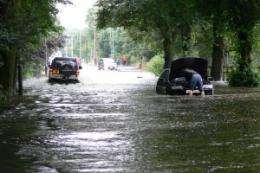
The unique aid, launched this month online, will allow planners, policy makers, local people and developers to assess if new buildings and roads will make neighborhoods intolerably hot or more likely to suffer from flooding.

It will also give cities the ability to assess how green infrastructure – such as trees, vegetation, waterways and lakes - can help neighborhoods adapt to by cooling and reducing runoff.

Heatwaves, river and surface water and flooding are already a major threat to many cities which have not adapted to extreme weather events, argues Dr. Gina Cavan, from the University’s Centre for Urban Regional Ecology (CURE).

In one example, many of the 52,000 lives lost during the European summer heatwave of 2003 were in urban areas, which are warmer than the surrounding countryside, partly as a result of there being less cooling vegetation.

The tool - called STAR –produces temperature and runoff scenarios based on parameters entered by the user within a defined study area.

This includes percentages of land covered with buildings, roads, impervious surfaces, and trees, vegetation, waterways and lakes.

It is the latest product of a collaboration between eight European Union member states aimed at helping cities adapt to the called GRABS.

Led by the Town and Country Planning Association (TCPA), GRABS works with local authorities to raise awareness and devise responses to the impact of climate change.

“City authorities cannot afford to ignore the environmental impact of land use if they are to adapt to the potentially dangerous effects of climate change,” said Dr. Cavan.

"Greening the city is not just about coping with climate change, but also has health, social and economic benefits too.

“Even if the rise in CO2 emissions were stopped tomorrow, extreme surface temperatures and endemic flooding will be an increasing problem in cities by the middle of this century unless something is done.

“But cities can lessen these threats by increasing the amount of their green and the data produced by the STAR tool will help them do that.”

The tool will also help local communities develop their own neighbourhood plans under the Government’s localism agenda and help them ensure the right development happens in the right places.

Developers could also use the tool to test their own development proposals’ green credentials.

Dr. Susannah Gill is from The Mersey Forest and is also a honorary research fellow at The University of Manchester.

She added: “This tool is best used at a neighbourhood scale.

“It tests the impact of different land cover scenarios of greening and development on surface temperatures and runoff under different temperature and precipitation conditions.

“The can be used for any area within the UK, though users in North West England are given up to date data on current land use and future climate change projections.”

More information: Visit the Green and Blue Space Adaptation for Urban Areas and Eco Towns (GRaBS) website at http://www.grabs-eu.org/

To use the tool, visit http://www.ginw.co … ge/startools

Provided by University of Manchester (news : web)

Filter


Move the slider to adjust rank threshold, so that you can hide some of the comments.


Display comments: newest first

rubberman
Feb 02, 2012

Rank: 5 / 5 (1)
IT's a start. The difficulty will be attempting to predict the changes in local weather patterns as a result of the shift in climate. Do you plan for more rain and thunderstorm activity, thereby designing for efficient runoff, or, do you design for capture and targeted pooling to aid in irrigation because of less rainfall?
Rank 5 /5 (1 vote)
Relevant PhysicsForums posts
  • Is the Earth really going to die
    created14 hours ago
  • Do some geologists actually act a lot like Randy Marsh?
    createdFeb 11, 2012
  • Discrepancy between oxygen and carbon-dioxide levels
    createdFeb 09, 2012
  • where gems are found in the world
    createdFeb 09, 2012
  • Wind Waves in Reservoir ~ Wind run-up and Wind set-up
    createdFeb 08, 2012
  • Balance of oxygen in the atmosphere
    createdFeb 01, 2012
  • More from Physics Forums - Earth

More news stories

Spitzer finds solid buckyballs in space

(PhysOrg.com) -- Astronomers using data from NASA's Spitzer Space Telescope have, for the first time, discovered buckyballs in a solid form in space. Prior to this discovery, the microscopic carbon spheres ...

Space & Earth / Astronomy

created 14 hours ago | popularity 4.7 / 5 (12) | comments 8 | with audio podcast

Going up: Japan builder eyes space elevator

A Japanese construction firm claimed Wednesday it could execute an out-of-this-world plan to put tourists in space within 40 years by building an elevator that stretches a quarter of the way to the moon.

Space & Earth / Space Exploration

created 21 hours ago | popularity 3.5 / 5 (13) | comments 26

ENASA satellite finds Earth's clouds are getting lower

(PhysOrg.com) -- Earth's clouds got a little lower -- about one percent on average -- during the first decade of this century, finds a new NASA-funded university study based on NASA satellite data. The results ...

Space & Earth / Earth Sciences

created 18 hours ago | popularity 5 / 5 (8) | comments 13 | with audio podcast

Fresh scandal embroils US climate science debate

A fresh scandal over climate change has erupted in the United States after leaked documents appeared to show a right-wing funded campaign to influence how climate science is taught in schools.

Space & Earth / Environment

created 11 hours ago | popularity 4.1 / 5 (9) | comments 8

World's oceans get an acid bath

Among the repercussions of global climate change, the effect of ocean acidification on marine life is one of the least-understood variables.

Space & Earth / Environment

created 18 hours ago | popularity 4.3 / 5 (6) | comments 4 | with audio podcast


Researchers build first physical 'metatronic' circuit

(PhysOrg.com) -- The technological world of the 21st century owes a tremendous amount to advances in electrical engineering, specifically, the ability to finely control the flow of electrical charges using ...

Faster than light neutrinos? More like faulty wiring

You can shelf your designs for a warp drive engine (for now) and put the DeLorean back in the garage; it turns out neutrinos may not have broken any cosmic speed limits after all.

Physicists surprised by disappearing and reappearing superconductivity in iron selenium chalcogenides

Superconductivity is a rare physical state in which matter is able to conduct electricity -- maintain a flow of electrons -- without any resistance. This phenomenon can only be found in certain materials at low temperatures, ...

Stanford research team cracks animated NuCaptcha

(PhysOrg.com) -- The research team from Stanford University, led by Elie Bursztein, that previously had cracked regular CAPTCHAs and then audio CAPTCHAs, now has also successfully cracked the animated version called NuCapt ...

Flesh-eating bacteria inspire superglue

(PhysOrg.com) -- A bio-inspired superglue has been developed by Oxford University researchers that can’t be matched for sticking molecules together and not letting go.

Scientists create potent molecules aimed at treating muscular dystrophy

While RNA is an appealing drug target, small molecules that can actually affect its function have rarely been found. But now scientists from the Florida campus of The Scripps Research Institute have for the first time designed ...