Small device controls light, advances optical interconnects technology
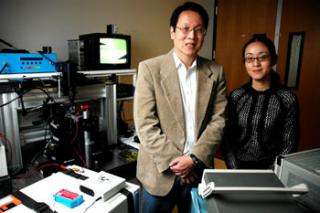
An electrical engineer at the University of Texas at Austin has made a laser light blink while passing through a miniaturized silicon chip, a major step toward developing commercially viable optical interconnects for high performance computers and other devices.
Researchers for decades have sought to harness light as a messenger on silicon chips because light can move thousands of times faster through solid materials than electrons and can carry more information at once, while requiring less energy.
Ray Chen, a professor of electrical engineering, and graduate students Wei Jiang, YongQiang Jiang and Lanlan Gu created a chip made of silicon "photonic crystals" whose complex internal structure slowed light traveling through the chip. The laser light slowed down enough that a small electric current could alter, or modulate, the pattern of light transmission.
"We were able to get our new silicon modulator to control the transmission of laser light, while using 10 times less power than normally needed for silicon modulators," said Chen, who holds the Temple Foundation Endowed Faculty Fellowship No. 4.
He will give an invited talk about the latest update on the miniaturized device on Jan. 25, at the Optoelectronics 2006 Symposia of the SPIE Photonics West Conference in San Jose, Calif.
For light to encode meaningful information, its intensity or other characteristics need to be modulated, just as air that passes through a person's vocal cords is modulated to produce speech sounds by actions that include moving the lips and tongue. Because Chen was able to modify light using electric current, which itself is modifiable, he expects to be able to modulate the light to blink on and off at different rates, or to change in intensity.
Once such silicon modulators are combined with lasers on a silicon platform, these optical chips could become a mainstay of consumer electronic devices, telecommunication systems, biosensors and other devices. In computers, the light-modulating chips would primarily serve to send information between a computer's microprocessors and its memory, a process called interconnection.
"In a Pentium 4, over 50 percent of the computer's power is consumed by interconnection," Chen said. Other advantages of optical chips based on silicon photonic crystals would include their reduced risk of overheating due to lower power needs, the ability to fabricate optical chips primarily with traditional mass-production practices in a silicon foundry and the expected smaller size of optical modulators and other optical silicon elements of the future.
Chen initially published findings on the silicon modulator in the Nov. 28, 2005, issue of the journal Applied Physics Letters. That article described how less than 3 milliwatts of power was needed for light modulation. The length of the special silicon chip the light needed to travel before being modifiable was 80 micrometers (.08 millimeters). That is about 10 times shorter than the best conventional silicon optical modulators. Smaller components help drive manufacturing costs down,and also transmit signals faster.
The shortened length was possible because Chen's laboratory designed the silicon photonic crystals that are the key component of the modulator to have large regions of regularly spaced, nanosize holes that light would have to traverse. Navigating the Swiss cheese-like regions of the crystals, called line defects, slowed the light's passage considerably.
Since the November publication, Chen's laboratory has continued evaluating the specialized silicon chips and learning how to change the blinking rate of laser light traversing their silicon modulator.
Source: University of Texas at Austin


