Physics turns a corner with three-point turn atoms
January 18, 2006 Physics turns a corner with three-point turn atoms

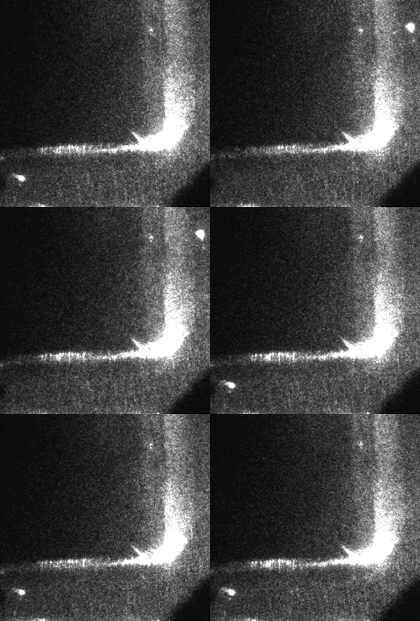
Turning point: A single atomic ion is shuttled back and forth around a corner. Light scattering makes the corner electrode visible.

You may think making a three-point turn in your car is easy, but how about doing the same with a single-charged atom?

That's what scientists have achieved for the first time, marking a major breakthrough for physics and a first step towards creating the complicated labyrinth of 'atomic motorways' needed for a quantum computer.

The microscopic motoring manoeuvre was performed by University of Sussex physicist Dr Winfried Hensinger with colleagues at the University of Michigan, USA. Details of the experiment are published in the January 2006 issue of the journal Applied Physics Letters.

The ability to shuttle ions (charged atoms) in a controlled environment is seen as an important demonstration of how to harness the seemingly magical properties of atoms. This development will help scientists to store and analyse the vast quantities of data used in highly sophisticated calculations - in super-fast quantum computers.

To be able to build this kind of computer, scientists need to trap ions - no mean feat in itself - then control their movements in a sophisticated labyrinth of 'atomic roads'. Such a process has previously been carried out for single ions along one line, but Dr Hensinger (now Lecturer in Atomic Molecular and Optical Physics at Sussex), and the Michigan team have shown how they can make atoms turn a corner.

Keen for more driving pleasure, they even managed to switch two ions around by having them perform a three-point turn. This will hopefully allow eventually for the mass-manipulation of atoms, vital for the operation of a quantum computer.

Ion traps are made from micro-fabricated electrodes, in which ions are controlled by electric fields in an ultra-high vacuum chamber. The new construction, the first two-dimensional ion trap array, is the most sophisticated yet. The ions are steered inside a T-junction that is laser micro-machined in thin layers of a material called alumina.

Dr Hensinger says: "This is big news because it is very difficult to trap atoms, let alone manipulate them in transit. This and other recent developments show that it should be possible to build a quantum computer with trapped ions. Now we can take two atoms and swap them around, which mathematically corresponds to a fundamental requirement for a quantum computer. This is the prerequisite to go from something academically interesting to something useful. This is a quantum leap in the development of the quantum computer."

Quantum technology could be used in the future to understand chemical reactions, create medicines, ultra-fast communications systems and seemingly impossible simulations, such as the creation of our universe.

Source: University of Sussex


print this article email this article download pdf blog this article bookmark this article     Stumble it Digg this share on Facebook retweet share on Reddit add to delicious
Rate this story - 4.3 /5 (18 votes)


January 18, 2006 all stories

Comments: 0

4.3 /5 (18 votes)
  • Stumble this up

  • Digg this

  • share this

  • hide
  • Related Stories

  • Physicists Demonstrate Three-Color Entanglement
    created Oct 07, 2009 | popularity not rated yet | comments 0
  • Ytterbium gains ground in quest for next-generation atomic clocks
    created Aug 11, 2009 | popularity not rated yet | comments 0
  • Sustained quantum information processing demonstrated
    created Aug 06, 2009 | popularity not rated yet | comments 0
  • All-in-one nanoparticle: A Swiss Army knife for nanomedicine
    created Jul 27, 2009 | popularity not rated yet | comments 0
  • Graphene's versatility promises new applications
    created Jul 09, 2009 | popularity not rated yet | comments 0


Other News

Solving big problems

Solving big problems with new quantum algorithm

Physics / Quantum Physics

created 7 hours ago | popularity 4.3 / 5 (12) | comments 0

(PhysOrg.com) -- In a recently published paper, Aram Harrow at the University of Bristol and colleagues from MIT in the United States have discovered a quantum algorithm that solves large problems much faster ...


The LHC tunnel

Peckish bird briefly downs big atom smasher

Physics / General Physics

created 19 hours ago | popularity 3.8 / 5 (9) | comments 11

A peckish bird briefly knocked out part of the world's biggest atom smasher by causing a chain reaction with a piece of bread, the European Organisation for Nuclear Research (CERN) said Monday.


First Bose-Einstein condensation of strontium

First Bose-Einstein condensation of strontium

Physics / Quantum Physics

created 12 hours ago | popularity 5 / 5 (4) | comments 1

In an international first, scientists from the Institute of Quantum Optics and Quantum Information (IQOQI, Austria) produced a Bose-Einstein condensate of the alkaline-earth element strontium, thus narrowly ...


Contracts Awarded for Production of NSLS-II Storage Ring Magnets

Physics / General Physics

created 4 hours ago | popularity not rated yet | comments 0

(PhysOrg.com) -- All seven contracts for the production of the NSLS-II storage ring magnets have now been awarded -- a significant milestone for the project. The magnets -- 750 in total -- will be made by vendors in the United ...


Ginzburg helped develop the Soviet Union's hydrogen bomb in the late 1940s and early 1950s

Russian bomb physicist Ginzburg dead at 93

Physics / General Physics

created 20 hours ago | popularity 5 / 5 (4) | comments 0

Nobel Physics prize winner Vitaly Ginzburg, who helped develop the Soviet hydrogen bomb, has died at age 93, the Russian Academy of Sciences said Monday.