Cutting fume hoods' hours saves energy and money
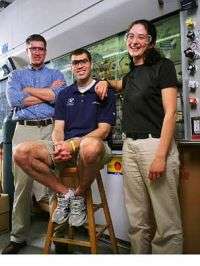
A device that sucks up noxious fumes also devours almost $1.4 billion worth of potential energy savings each year.
Fume hoods, widely used by high-tech industries, hospitals and universities, help keep workers from breathing harmful chemical vapors but can use a lot of energy. A single fume hood running 24 hours uses as much energy as a single-family home.
Possible energy savings for the more than 750,000 hoods across the United States is $1.39 billion annually, according to Lawrence Berkeley National Laboratory in California.
Thanks to a student's comprehensive analysis of fume hood use in MIT chemistry laboratories, MIT stands to save up to $1 million annually in energy costs.
Lab rat
During his senior year at MIT, Steven T. Amanti spent days and nights in the chemistry building.
That would not be unusual for a chemistry student. But Amanti was a mechanical engineering major working under Leon R. Glicksman, professor of building technology and mechanical engineering. Amanti prowled MIT's Building 18 because he was investigating a case of inadvertent energy abuse.
Amanti has moved on, but his senior thesis, "Potential Energy Savings on the MIT Campus," is still very much on the minds of MIT students, staff and administrators. His data led to an ongoing effort to cut electricity use through increased awareness of campus-wide use of fume hoods.
Fume hoods line the walls of more than a dozen labs in Building 18. There are 156 hoods on the upper five floors alone. Almost all chemistry experiments take place in the hoods, which are packed with gyrating test tubes, beakers filled with multicolored liquids and other chemistry equipment. Sliding glass door sashes open and close to provide access to the workspace.
What Amanti found was that on average, 67 hoods were left open at night and 88 were open during the daytime. Of the open hoods, only five were in use at night and 48 were in use during the day. In fact, 45 percent of the entire electrical load in the building was due to fume hood fans, including ones left open when not in use.
The hoods are attached to a building-wide ventilation system that sucks away chemical fumes. When a sash is closed, a valve attached to the hood decreases the flow of air to the hood. When enough sashes are shut, the fan assigned to those hoods also slows down into a more energy-efficient mode.
"If the unused hoods were closed, the consumption of electricity, steam and chilled water would be decreased by approximately 17 percent and save the Institute $350,000 a year in utility costs," Amanti wrote in his 2006 thesis.
Habit-forming
Amanti's research came to the attention of Timothy M. Swager, chemistry department head, who shared the report at a department retreat. He also brought it to the attention of Jim Doughty, environmental health and safety coordinator for the School of Science. With the help of Facilities, the Environment, Health and Safety (EHS) Office, and the Laboratory for Energy and the Environment (LFEE), Doughty prepared a presentation, made in November 2006, to raise awareness of energy use tied to fume hoods.
Graduate student Elsa Olivetti of materials science and engineering, one of the coordinators of student energy initiatives on campus, was a member of the team, which also included Doughty; Amanda Graham, LFEE education manager; Steven M. Lanou, deputy director of environmental sustainability for the Environmental Programs Office; Peter L. Cooper, manager of sustainability engineering and utility planning for the Department of Facilities; Richard J. Wilk, administrative officer for the Department of Chemistry; and Pamela Greenley of the EHS Office.
Olivetti, chemistry department representatives and an outside contractor did their own calculations. They found there are 1,200 hoods on campus, around half of which have variable air volume. Judicious use of these hoods could result in a savings of up to $1 million a year.
Chemistry graduate student Ryan Altman said that prior to the public education campaign, fume hood energy use "wasn't something we even thought about. It wasn't a consideration." Now Altman, an EHS lab representative on the research team of Stephen L. Buchwald, the Camille Dreyfus Professor of Chemistry, is conscientious about his own use of the equipment. He tries to ensure that his entire lab is aware of the effort, through e-mails, signs and word of mouth.
"The biggest challenge is to get it to be on people's minds to shut their hoods when they go home at night, so we are trying to bombard them with the message from all different venues," Doughty said. He is collecting data on current fume hood energy use to show how it is changing over time.
Altman said that when he tells labmates about the problem, people are concerned. "When I tell them the statistics and facts, they're surprised and shocked. They're willing to do something to help. It's just a matter of instilling good habits to replace the bad ones," he said.
Improving energy efficiency through fume hood use is one of the many campus opportunities being explored by the MIT Energy Initiative's Campus Energy Task Force to reduce MIT's energy and carbon footprint.
Source: MIT


