Research Links Brain Chemistry with Aggressive Personality
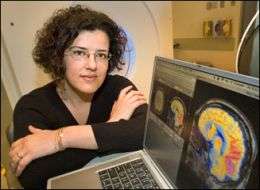
An image depicting research findings linking brain chemistry with aggressive personality has been named “2007 Image of the Year” by the Society for Nuclear Medicine (SNM). The research, which was performed at the U.S. Department of Energy’s Brookhaven National Laboratory, showed that healthy men with lower levels of a particular brain enzyme exhibited more aggressive personality traits, as measured by a standard personality questionnaire.
This neuroimaging research — in normal, non-violent subjects — strengthens the link between low levels of the brain enzyme, known as monoamine oxidase A (MAO A), and aggressive behavior, which has been a topic of research for more than two decades.
“Our study provides evidence of an association between brain MAO A level and aggressive personality traits in normal individuals,” said Nelly Alia-Klein, an assistant scientist at Brookhaven Lab’s Center for Translational Neuroimaging, who presented her work at the society’s 54th annual meeting in Washington, D.C. “If this model of understanding is tested with individuals who actually engage in aggressive or antisocial behavior, such as domestic violence, it could show promise in the future for pharmacological intervention against abnormal aggression,” she added.
The researchers assessed brain MAO A activity in 27 healthy, non-violent male volunteers using positron emission tomography (PET) scanning. This technique uses a radiotracer-tagged molecule that binds to brain MAO A and can be measured quantitatively by PET. The subjects also completed a standard, 240-question personality questionnaire, which gave the researchers a complete profile of the men’s personalities, not merely their tendency toward aggression.
The main finding: The lower the subjects’ brain MAO A activity levels, the more they answered “yes” to statements about taking advantage of others, causing them discomfort, having a short temper, vindictiveness, and enjoying violent movies. “Only aggressive personality was related to brain MAO A activity — not other personality dimensions,” Alia-Klein emphasized.
It is important to note that MAO-inhibitor drugs are effective in treating depression and are not associated with aggressive behavior, she added.
SNM past president and historian Henry N. Wagner Jr. announced the depiction of the Brookhaven Center for Translational Neuroimaging findings as the Image of the Year at a press conference on June 4 during the society’s annual meeting. The honored image, chosen from thousands presented at the meeting, graphically shows the group’s approach providing a visual model of their scientific study into the uncharted gene-brain-behavior complex. It consists of four images, including a PET scan showing brain MAO A activity.
“One of the major scientific contributions of molecular imaging is its ability to relate human brain chemistry and behavior,” said Wagner, who for 30 years has summarized current trends in molecular imaging and nuclear medicine, and annually selects an Image of the Year at the society’s meeting.
Source: Brookhaven National Laboratory


