The Loneliest Black Holes in the Universe
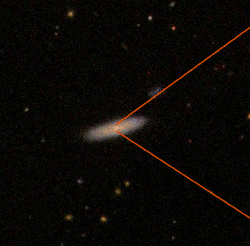
Actively growing supermassive black holes in centers of galaxies are common even in cosmic voids, the most rarefied and empty regions of the universe.
In a study of more than 1,000 void galaxies, using data from the Sloan Digital Sky Survey (SDSS-II), astronomers from Drexel and Widener Universities announced that the growth of these monster black holes – with masses millions to hundreds of millions times that of our sun –are found where galaxies are sparse and interact very little with each other. The researchers also found that the accretion of matter onto these void black holes is slower than in denser galactic environments.
These findings shed light on the black hole formation and evolution process by showing that the environment does affect how quickly galaxies proceed through their evolutionary cycle.
The simple presence of growing supermassive black holes in the rural outposts of the universe challenges the current theoretical models of galaxy and structure formation and evolution, explained Anca Constantin of Drexel University, lead author of the paper delivered today at the American Astronomical Society meeting in Honolulu.
“Interestingly, we see actively accreting galactic black holes in all phases of evolution in these sparse regions,” said Constantin. “This means that the black hole growth process is quite similar in what could be compared to the most reclusive countrysides and in the crowded urban regions of the universe.”
The void regions, nearly empty, three-dimensional fields hundreds of millions of light-years across, fill half of the universe. Only five percent of all galaxies live in these bubble-like regions. The other 95 percent of galaxies live together in communities, crowded into clusters, filaments, and walls: the cities and suburbs of the universe.
Studying a 700-million light year wide ‘slice’ of the universe, the researchers found that spectra of the centers of void galaxies show hot gases ionized by light emitted from matter swirling around supermassive black holes. Constantin adds that, “the more isolated accreting black holes are however not as active as the ones in more populous environs, and the fuel seems less available for accretion in voids than in ‘urban’ galaxies.”
Astronomer Fiona Hoyle, a member of the discovery team from Widener University added: “This is strange given that these reclusive galaxies are forming stars at higher rates than their counterparts in denser regions; this means there is plenty of fuel, but it is not efficiently channeled toward the central engine.”
Star formation requires the presence of large amounts of gas and so there must be more than enough gas in the void galaxies if their star forming rates are high, explained Hoyle. The smaller accretion rate observed in void galaxies means that this gas is just not getting down to the nuclear region where accretion happens. Interactions with other galaxies are thought to disturb the gravitational potential, which drives some gas into the nuclear region. “These interactions are not as frequent in voids, so the 'feeding' of the black hole is slower.”
These rugged individuals in voids do not need to compete with their neighbors for fuel, and their life cycle is rarely bothered, noted Constantin. In contrast, life is more hectic in crowded regions where galaxy interactions are frequent. As a consequence, galaxies are either stripped of their gas or more material is funneled toward the central engine. This means that there are many more chances the accretion onto black holes is enhanced or turned off in more 'urban environments.'
“On the other hand, the void galaxy black holes might take longer to reach the mature, low accretion rate phase, which might explain why the most massive, lazy black holes are less frequent in voids,” she noted. The data studied by Constantin may also show that active black holes appear to be more common in voids but only among small (less massive) galaxies, while less common among massive galaxies. This is also a clue that the life cycle of black hole growth in voids is delayed or slower compared to that in denser regions.
Discovery team member Michael Vogeley of Drexel said that it's particularly puzzling that the few most massive and sluggishly accreting void systems live within the most secluded sub-regions, while their "urban" counterparts are found in the most populated neighborhoods.
“Perhaps because massive objects are prone to accreting material around them, such a 'cleaning' process would contribute to emptying the already rarefied neighboring space in voids,” Vogeley noted. "This would leave little or insufficient material for future formation of other nearby massive, bright galaxies.” In contrast, within galaxy clusters where there is plenty of stuff around, accretion of surrounding material would make a small difference.
These results have been possible only because of the sheer number of void regions and void galaxies found in the SDSS-II data, the most ambitious survey of the universe ever undertaken, the researchers said. The sample used in the analysis announced today comprises more than 1,000 void galaxies. Previously, the black hole accretion in centers of void galaxies had been studied in only a handful of objects contained in only one void region, the Bootes Void.
The results are described in the paper "Active Galactic Nuclei in Void Regions" submitted for publication in The Astrophysical Journal.
Source: Drexel University


