Nitrate in Lake Superior: On the Rise
June 4, 2007 Nitrate in Lake Superior: On the Rise

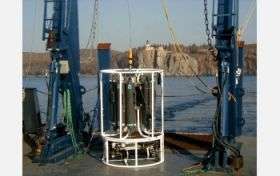
Split Rock Lighthouse on the north shore of Lake Superior as viewed from the deck of the research vessel Blue Heron. Scientists are taking water samples for nitrate and other substances in the lake. Credit: Robert Sterner

Nitrate levels in Lake Superior, which have been rising steadily over the past century, are about 2.7 percent of the way toward making the lake's water unsafe to drink, according to a study by University of Minnesota (UMN) researchers.

The study, funded by the National Science Foundation (NSF), is published online this week in the journal Geophysical Research Letters.

The complexity of the causes underlying the increase makes it difficult to predict when the water could become unhealthy. The trend is a concern because Lake Superior contains 10 percent of the Earth's supply of surface fresh water.

Although everyone is exposed to small, harmless amounts of nitrate from eating fruits and vegetables, nitrate contamination of drinking water can expose people to harmful levels.

Too much nitrate can reduce blood levels of oxygen, which poses a risk to infants and children or adults with lung or cardiovascular disease. Consuming excess nitrate over long periods of time is also suspected of causing cancer.

A compound made from nitrogen and oxygen, nitrate is a component of agricultural fertilizers and is generated by fossil fuel combustion. Nitrate in Lake Superior has increased about five-fold since the earliest measurements in 1906.

This level of nitrate doesn't reflect either post-World War II increases in fertilizer and fossil fuels, which would tend to increase levels faster, or the effects of the Clean Air Act of 1972, which would likely decrease levels, says Robert Sterner, a limnologist at UMN and lead author of the study. Sterner was recently appointed director of NSF's division of environmental biology, and will be on leave from UMN.

Because of Lake Superior's vast size, the lake registers change slowly and converts other forms of nitrogen within the lake--in decaying plant matter and sewage--into nitrate.

"We're still a long way from drinking water advisories based on nitrate for Lake Superior, but it's not too early to give this situation more attention," Sterner says. "We cannot easily or quickly reverse trends in this enormous lake."

"This study of Lake Superior tells us that if we ignore results of basic research on lakes and the changing biochemistry of their waters, we do so at our own peril," says Don Rice, director of NSF's chemical oceanography program, which funded the research.

Source: NSF


print this article email this article download pdf blog this article bookmark this article     Stumble it Digg this share on Facebook retweet share on Reddit add to delicious
Rate this story - 3.7 /5 (6 votes)


June 4, 2007 all stories

Comments: 0

3.7 /5 (6 votes)
  • Stumble this up

  • Digg this

  • share this

  • hide
  • Related Stories

  • New proxy reveals how humans have disrupted the nitrogen cycle
    created Jun 04, 2009 | popularity not rated yet | comments 0
  • Lichens function as indicators of nitrogen pollution in forests
    created Oct 06, 2008 | popularity not rated yet | comments 0
  • Evolving designer ecosystem sheds light on unintended consequences
    created Sep 03, 2008 | popularity not rated yet | comments 0
  • Large source of nitrate, a potential water contaminant, found in near-surface desert soils
    created Feb 29, 2008 | popularity not rated yet | comments 0
  • Is your drinking water safe?
    created Feb 28, 2008 | popularity not rated yet | comments 0


  • hide
  • Relevant PhysicsForums posts

  • Climate Science Update
    created 12 hours ago
  • The IPCC and the term "most"
    created Nov 23, 2009
  • Is global warming a fact?
    created Nov 23, 2009
  • Random variability of wind patterns
    created Nov 23, 2009
  • More from Physics Forums - Earth

Other News

Fermi Telescope Peers Deep into Microquasar

Fermi Telescope Peers Deep into Microquasar (w/ Video)

Space & Earth / Astronomy

created 8 hours ago | popularity 4.5 / 5 (4) | comments 0

(PhysOrg.com) -- NASA's Fermi Gamma-ray Space Telescope has made the first unambiguous detection of high-energy gamma-rays from an enigmatic binary system known as Cygnus X-3. The system pairs a hot, massive ...


The Energy Sources of Ultraluminous Galaxies

The Energy Sources of Ultraluminous Galaxies

Space & Earth / Astronomy

created 9 hours ago | popularity 4.4 / 5 (8) | comments 0

(PhysOrg.com) -- Ultraluminous infrared galaxies ((ULIRGs) are galaxies whose luminosity exceeds that of a trillion suns; for comparison, the Milky Way galaxy has a typical (and much more modest) luminosity ...


Space shuttle Atlantis, 7 astronauts back on Earth (AP)

Space shuttle Atlantis, 7 astronauts back on Earth

Space & Earth / Space Exploration

created 10 hours ago | popularity not rated yet | comments 0

(AP) -- Space shuttle Atlantis and its seven astronauts returned to Earth with a smooth touchdown Friday to end an 11-day flight that resupplied the International Space Station.


Herschel takes a peek at the ingredients of the galaxies

Herschel takes a peek at the ingredients of the galaxies

Space & Earth / Astronomy

created 7 hours ago | popularity 4.5 / 5 (2) | comments 0

(PhysOrg.com) -- The European Space Agency has today released spectacular new observations from the Herschel Space Observatory, including the UK-led SPIRE instrument. Spectrometers on board all three Hershel ...


China is set to launch its second moon orbiter next October, state media have reported

China to launch second lunar probe: state media

Space & Earth / Space Exploration

created 14 hours ago | popularity 5 / 5 (4) | comments 0

China will launch its second moon orbiter next October, state media reported Friday, as it powers ahead with a space programme that has sparked concerns abroad.