UW astronomer hits cosmic paydirt with Stardust
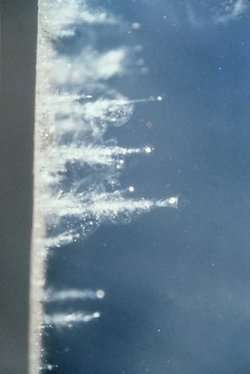
Scientists at the Johnson Space Center in Houston were excited and awed Tuesday by what they saw when the sample-return canister from the Stardust spacecraft was opened.
"It exceeds all expectations," said Donald Brownlee, a University of Washington astronomy professor who is principal investigator, or lead scientist, for Stardust. "It's a huge success. We can see lots of impacts. There are big ones, there are small ones."
Stardust returned to Earth in a spectacular re-entry early Sunday after a 7-year mission to collect particles from comet Wild 2 and samples of interstellar dust streaming into our solar system from other parts of the galaxy. The comet dates from the formation of the solar system 4.6 billion years ago.
Brownlee calculated there might be more than a million microscopic specks of dust embedded in Stardust's aerogel collector. Aerogel, a remarkable material that is as much as 99.9 percent empty space, greatly reduced the stress of impact on the particles, he said. The carrot-shaped tracks of much larger particles are visible in the aerogel from several feet away, Brownlee said, and in some of the tracks the black comet dust is visible at the end of the track. One track, he said, "is almost large enough to put your little finger into it."
Scientists will search the aerogel grid for dust samples, and more than 65,000 people have signed up to help in a project called Stardust@home, in which their home computers will examine images of tiny sections of the aerogel grid looking for dust particles.
The Johnson Space Center will be the curator of the Stardust samples, and as many as 150 scientists worldwide are waiting to study them.
"Stardust is a phenomenal success," Brownlee said.
Stardust on the Web:
stardust.jpl.nasa.gov
www.nasa.gov/stardust
Source: University of Washington


