Miniature robot for precise positioning and targeting in neurosurgery wins award
June 5, 2007 Miniature robot for precise positioning and targeting in neurosurgery wins award

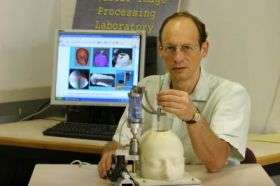
Professor Leo Joskowicz with his robot for performing neurosurgery. Credit: Hebrew University of Jerusalem.Photo by Sasson Tiram

While recent advances in neurosurgery have made it possible to precisely target areas in the brain with minimum invasiveness -- using a small hole to insert a probe, needle or catheter -- there remains a disadvantage. The small size of the openings reduces or eliminates direct site visibility and requires greater dexterity, stability and precision by the surgeon.

Now, an invention by a Hebrew University of Jerusalem researcher has made it possible to retain the advances of such keyhole surgery through utilization of the “services” of a tiny robot that can guide surgical procedures with great accuracy.

For this development, Prof. Leo Joskowicz of the School of Engineering and Computer Science at the Hebrew University has been named one of this year’s winners of a Kaye Innovation Award, to be presented on June 6 during the Hebrew University’s 70th Board of Governors meeting. Prof. Joskowicz is the founder of the Computer-Aided Surgery and Medical Image Processing Laboratory at the Hebrew University, which he heads to this day.

Although keyhole brain surgery, based on preoperative CT or MRI images, has obvious advantages for the patient, misplacement of the surgical instrument in these procedures may result in hemorrhage and severe neurological complications.

To overcome this problem, Prof. Joskowicz and his associates have developed a novel, image-guided system for precise, automatic targeting of structures inside the brain. The system is based on a miniature robot that can be programmed with detailed information obtained from preoperative electronic scans of the patient.

During surgery, the robot is directly affixed to a head clamp or to the patient's skull. It automatically positions itself with great accuracy in respect to the surgical targets. Once positioned, the robot locks itself in place and serves as a guide for insertion by the surgeon of a needle, probe, or catheter to carry out the procedure.

Source: The Hebrew University of Jerusalem


print this article email this article download pdf blog this article bookmark this article     Stumble it Digg this share on Facebook retweet share on Reddit add to delicious
Rate this story - 3.3 /5 (3 votes)


June 5, 2007 all stories

Comments: 0

3.3 /5 (3 votes)
  • Stumble this up

  • Digg this

  • share this

  • hide
  • Related Stories


  • hide
  • Relevant PhysicsForums posts

  • Improving the brain through chemistry
    created Nov 07, 2009
  • Sleep / REM Sleep and homeostasis
    created Nov 07, 2009
  • The Biceps Reflex
    created Nov 05, 2009
  • Consequenses of striking a Vein and an artery?
    created Nov 05, 2009
  • More from Physics Forums - Medical Sciences

Other News

Amyloid beta protein gets bum rap

Medicine & Health / Research

created 58 minutes ago | popularity not rated yet | comments 0

While too much amyloid beta protein in the brain is linked to the development of Alzheimer's disease, not enough of the protein in healthy brains can cause learning problems and forgetfulness, Saint Louis University scientists ...


Laser surgery does not appear to have long-term effects on corneal cells

Medicine & Health / Other

created 8 minutes ago | popularity not rated yet | comments 0

Laser eye surgery to correct vision problems does not appear to be associated with lasting changes to cells lining the inside of the cornea at nine years after the procedure, according to a report in the November issue of ...


Hundreds of genes distinguish patients likely to survive advanced melanoma

Medicine & Health / Cancer

created 1hour ago | popularity not rated yet | comments 0

Although the chances of surviving advanced melanoma aren't very good with current therapies, some patients can live for years with cancer that has spread beyond the skin to other organs. Now it may be possible to identify ...


Words, gestures are translated by same brain regions, says new research

Medicine & Health / Neuroscience

created 2 hours ago | popularity not rated yet | comments 0

Your ability to make sense of Groucho's words and Harpo's pantomimes in an old Marx Brothers movie takes place in the same regions of your brain, says new research funded by the National Institute on Deafness and Other Communication ...


Advance growing animal penile erectile tissue in lab may benefit patients

Medicine & Health / Research

created 1hour ago | popularity 5 / 5 (3) | comments 0

In an advance that could one day enable surgeons to reconstruct and restore function to damaged or diseased penile tissue in humans, researchers at Wake Forest University Baptist Medical Center's Institute for Regenerative ...