Hundreds of Antarctic Peninsula glaciers accelerating as climate warms
June 5th, 2007 Antarctic glacier

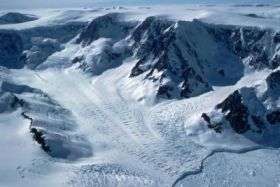
Hundreds of glaciers on the Antarctic Peninsula are flowing faster, further adding to sea level rise. Credit: British Antarctic Survey

Hundreds of glaciers on the Antarctic Peninsula are flowing faster, further adding to sea level rise according to new research published this week in the Journal of Geophysical Research. Climate warming, that is already causing Antarctic Peninsula increased summer snow melt and ice shelf retreat, is the most likely cause.

Using radar images acquired by European ERS-1 and -2 satellites, scientists from British Antarctic Survey (BAS) tracked the flow rate of over 300 previously unstudied glaciers. They found a 12% increase in glacier speed from 1993 to 2003. These observations - that echo recent findings from coastal Greenland - indicate that the cause is melting of the lower glaciers, which flow directly into the sea. As they thin, the buoyancy of the ice can lift the glaciers off their rock beds, allowing them to slide faster.

In February this year, the United Nations Intergovernmental Panel on Climate Change (IPCC) reported that they could not provide an upper limit on the rate of sea-level rise from Antarctica in coming centuries because of a lack of understanding of the behaviour of the large ice sheets.

These new results give scientists a clearer picture about the way that climate warming can affect glaciers both in the Arctic and Antarctic. Furthermore, they pave the way for more reliable projections of future sea level rise, and provide a better basis for policy decisions.

Lead author Dr Hamish Pritchard says, “The Antarctic Peninsula has experienced some of the fastest warming on Earth, nearly 3 C over the last half-century. Eighty-seven percent of its glaciers have been retreating during this period and now we see these glaciers are also speeding up. It’s important that we use tools such as satellite technology that allow us to monitor changes in remote and inaccessible glaciers on a regional scale. Understanding what’s happening now gives us our best chance of predicting what’s likely to happen in the future.”

Source: British Antarctic Survey


print this article email this article download pdf blog this article bookmark this article     Digg this Stumble it share on Facebook share on Reddit add to delicious save to Yahoo! bookmarks
4.2/5 after 10 votes


June 5th, 2007 all stories
Space & Earth / Earth Sciences

Comments: 0
Rank: 4.2/5 after 10 votes

  • Stumble this up

  • Digg this

  • Share it:
  • share on Facebook
  • share on MySpace
  • share on Slashdot
  • rss-newsfeed
  • share on Google
  • share on Reddit
  • add to delicious
  • save to Yahoo! bookmarks
  • share on Windows Live
  • Add to Mixx!
Rating: 4.2/5 after 10 votes


Tags


  • Physicists Demonstrate Quantum Memory with Matter Qubits
    Physicists Demonstrate Quantum Memory with Matter Qubits
    Physics / General Physics
    created Jul 03, 2009 | popularity 4.4 / 5 (17) | comments 1
  • 'Holey' Nanosheets for Wastewater Dye Removal
    Nanotechnology / Nanomaterials
    created Jul 01, 2009 | popularity 5 / 5 (5) | comments 1
  • Jellyfish Robot Swims Like its Biological Counterpart
    Jellyfish Robot Swims Like its Biological Counterpart
    Electronics / Robotics
    created Jun 26, 2009 | popularity 4.4 / 5 (8) | comments 1
  • Could Maxwell's Demon Exist in Nanoscale Systems?
    Could Maxwell's Demon Exist in Nanoscale Systems?
    Physics / General Physics
    created Jun 24, 2009 | popularity 4.4 / 5 (18) | comments 29
  • Living Safely with Robots, Beyond Asimov's Laws
    Living Safely with Robots, Beyond Asimov's Laws
    Electronics / Robotics
    created Jun 22, 2009 | popularity 4.6 / 5 (52) | comments 40
  • Other News

    Steam billows from the cooling towers at a nuclear power generating station in Byron

    Tropical zone expanding due to climate change: study

    Space & Earth / Earth Sciences

    created 51 minutes ago | popularity 5 / 5 (2) | comments 0

    Climate change is rapidly expanding the size of the world's tropical zone, threatening to bring disease and drought to heavily populated areas, an Australian study has found.


    US ambitions to send astronauts back to the moon as a prelude to missions to Mars have been put in doubt

    Forty years ago man first walked on the moon

    Space & Earth / Space Exploration

    created 22 hours ago | popularity 4.3 / 5 (4) | comments 2

    Forty years ago on July 20, 1969, American astronaut Neil Armstrong realized the oldest dream of human civilizations when he became the first man to walk on the moon.


    The least sea ice in 800 years

    The least sea ice in 800 years

    Space & Earth / Earth Sciences

    created Jul 01, 2009 | popularity 4.1 / 5 (64) | comments 60

    New research, which reconstructs the extent of ice in the sea between Greenland and Svalbard from the 13th century to the present indicates that there has never been so little sea ice as there is now. The ...


    Gas around young galaxy

    Intense heat killed the Universe's would-be galaxies, researchers say

    Space & Earth / Astronomy

    created Jul 01, 2009 | popularity 3.4 / 5 (21) | comments 27

    (PhysOrg.com) -- Our Milky Way galaxy only survived because it was already immersed in a large clump of dark matter which trapped gases inside it, scientists led by Durham University's Institute for Computational ...


    Scientists' Drill Hits Magma: Only Third Time on Record

    Scientists' Drill Hits Magma: Only Third Time on Record

    Space & Earth / Earth Sciences

    created Jun 29, 2009 | popularity 4.7 / 5 (22) | comments 20

    (PhysOrg.com) -- Scientists drilling a borehole deep into Iceland’s rocky crust to explore new methods of using geothermal energy hit a major roadblock on Thursday: Their drill ran into molten rock at a depth ...