Discovery of oldest human decorations -- thought to be 82,000 years old
June 5, 2007 Discovery of oldest human decorations -- thought to be 82,000 years old

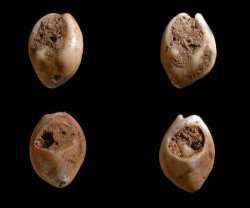
The shell beads. Credit: Ian Cartwright, Institute of Archaeology.

Archaeologists have discovered shell beads believed to be 82,000 years old – making them the oldest dated human decorations.

These finds of handmade beads, in a limestone cave in Morocco, suggest that humans were fashioning purely symbolic objects in Africa 40,000 years before they did it in Europe. A paper on the discovery is published in this month’s Proceedings of the National Academy of Sciences.

The discovery of beads at the Grotte des Pigeons, Taforalt, in Eastern Morocco was made by an international team of archaeologists from the UK, Morocco, France and Germany, led by Oxford University’s Institute of Archaeology.

Twelve Nassarius shells were perforated in their centres, and showed signs of being suspended or hung. They also appeared to have been covered in red ochre, like other less well-dated African beads. These symbolic, decorative objects are considered early signs of modern human behaviour and mark shifts in human development. Similar beads have been found at sites from Algeria, Israel, and South Africa, which probably date back to about the same time or slightly after the finds from Taforalt.

Lead author Professor Nick Barton, Director of Oxford’s Institute of Archaeology, said: ‘ Bead making in Africa was a widespread practice at the time, which was spread between cultures with different stone technology by exchange, or by long-distance social networks.

‘A major question in evolutionary studies today is “how early did humans begin to think and behave in ways we would see as fundamentally modern?”. The appearance of ornaments such as these may be linked to a growing sense of self-awareness and identity among humans, and cultural innovations must have played a large role in human development.’

Preliminary work by the team has also shown that these Nassarius shells are not isolated occurrences, but are present at various other sites in Morocco. The researchers are waiting for the dating results for these, but they may turn out to be even older than the discovery at Taforalt.

Source: University of Oxford


print this article email this article download pdf blog this article bookmark this article     Stumble it Digg this share on Facebook retweet share on Reddit add to delicious
Rate this story - 4.4 /5 (29 votes)


June 5, 2007 all stories

Comments: 0

4.4 /5 (29 votes)
  • Stumble this up

  • Digg this

  • share this

  • hide
  • Related Stories


  • hide
  • Relevant PhysicsForums posts

  • What is transpulmonary pressure?
    created Nov 24, 2009
  • Is there a gay gene?
    created Nov 23, 2009
  • Super quick question about Starling forces?
    created Nov 22, 2009
  • Questions about diffusion
    created Nov 22, 2009
  • More from Physics Forums - Biology

Other News

Explained: The Discrete Fourier Transform

Explained: The Discrete Fourier Transform

Other Sciences / Mathematics

created 14 hours ago | popularity 4.2 / 5 (18) | comments 8

(PhysOrg.com) -- In 1811, Joseph Fourier, the 43-year-old prefect of the French district of Isčre, entered a competition in heat research sponsored by the French Academy of Sciences. The paper he submitted ...


Ancient Greek Temple

Houses of the rising sun: Research sheds new light on Ancient Greeks

Other Sciences / Archaeology & Fossils

created 10 hours ago | popularity 5 / 5 (1) | comments 3

New research at the University of Leicester has identified scores of Sicilian temples built to face the rising Sun, shedding light on the practices of the Ancient Greeks.


Study: Race, class and gender shape religion's effect on American voters

Other Sciences / Social Sciences

created 6 hours ago | popularity not rated yet | comments 0

(PhysOrg.com) -- How Americans vote is strongly linked to their religious identities, but it is not an independent influence that transcends race, socio-economic class and gender, reports a new Cornell study.


Biology, training and profit sharing make best traders

Biology, training and profit sharing make best traders

Other Sciences / Mathematics

created 14 hours ago | popularity 5 / 5 (1) | comments 1

(PhysOrg.com) -- Cambridge researchers have identified a group of traders consistently able to outperform the market, even during the credit crisis.


UQ archaeology digs into the life behind Pompeii

Other Sciences / Archaeology & Fossils

created 6 hours ago | popularity 3.3 / 5 (3) | comments 0

(PhysOrg.com) -- Brisbane may be 2000 years and half-a-world away from Pompeii, but it hasn’t stopped a UQ archaeologist from digging up some hidden treasures.