Hitchin' a ride: Stray penguins probably reached northern waters by fishing boat
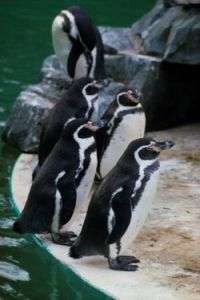
Guy Demmert got quite a surprise when he hauled a fishing net into his boat off the coast of southeast Alaska in July 2002. There among the salmon, in living black and white, was a Humboldt penguin, thousands of miles from where any of its kind should have been.
The flightless bird appeared to be healthy and in good condition, and Demmert snapped its picture before turning the bird loose.
It wasn't the first sighting of a penguin in Alaskan waters. In fact Demmert himself reported seeing one while fishing in 2001, and in 1976 a research cruise in the Gulf of Alaska recorded the sighting of "brown penguins."
So how is it that birds that swim rather than fly and live almost exclusively in the Southern Hemisphere turned up deep into the Northern Hemisphere? Did they migrate more than 5,000 miles from Peru? That's doubtful, say two University of Washington biologists. Were they the remnants of efforts to introduce breeding penguin colonies into the Northern Hemisphere? Probably not. Did they escape from zoos? Not likely.
The most probable explanation is that the creatures were hauled aboard boats -- probably fishing boats -- in southern waters and were kept by the crews as the vessels traveled far to the north, then were released, concludes a new research paper by Dee Boersma, a UW biology professor noted for her penguin studies, and Amy Van Buren, a UW doctoral student in biology.
"The crews keep the penguins as pets on board the boat. They're appealing," said Van Buren. "People keep them around because they're so cute."
The Humboldt is one of 17 penguin species, and is sometimes referred to as the Peruvian penguin because it typically lives along the coasts of Peru and Chile. The Galapagos penguin is the only species that lives north of the equator, and that is only because Isabella Island, one of the Galapagos Islands where the species lives and breeds, lies partially north of the equator.
There were efforts in the early to mid 20th century to establish breeding penguin colonies in the Northern Hemisphere, mostly in Scandinavia, the researchers noted, but after nearly a decade all the penguins had been killed by predators, died by other means or disappeared.
Northern sightings of penguins in the wild have been rare. There was a report of a single Humboldt penguin off British Columbia's Queen Charlotte Islands in 1944; one was reported near Long Beach, Wash., in 1975; three sightings of one to three Humboldts off the coast of Vancouver Island, B.C., were recorded in 1978, with pictures published in local newspapers; and a single penguin was reported off the Washington coast in 1985.
"People have always tried to move species around, and that's particularly true for penguins because people like penguins," Boersma said. "They're still regularly kept as pets in villages in Peru and Chile."
She noted that it is not uncommon for people in the north to mistake some native birds, particularly murres and auks, for penguins. Those birds occupy the same ecological niche in the Northern Hemisphere that penguins do in the south.
But in their paper in the June edition of the Wilson Journal of Ornithology, the researchers point out that the south lacks a particular type of predator -- bears -- that would make penguin survival difficult in the north.
They say it is unlikely the Humboldts swam from Peru to the Pacific Northwest, in part because it would mean traversing climate conditions the birds are not well equipped to handle.
There also isn't much chance the birds spotted in the wild were zoo escapees, the scientists said. Penguins used to be brought to North American zoos from the south on a regular basis, but those shipments stopped in 1972 with the adoption of international regulations that halted much of the trade. Since then, they said, zoos in the United States have bred penguins in captivity and managed their penguins as one large population, moving individuals from specific zoos to reduce inbreeding. It would not be easy for the birds to escape to the wild from a zoo.
"Most zoos use some kind of flipper tag, so a penguin that escaped from a zoo should be able to be identified pretty easily," Van Buren said.
She added that the more recent sightings could all have been the same birds, since penguins have been known to live 30 years in the wild.
"They could potentially, if they were young birds when they came north in the 1970s, have lived long enough to have been seen in Alaska in 2002," she said.
Source: University of Washington


