SanDisk Launches 64 Gigabyte Solid State Drives for Notebooks
June 5, 2007
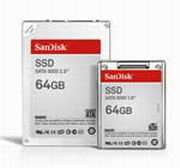
Reaching for the “sweet spot” of memory storage for laptop computers, SanDisk today expanded its line of solid state drive products with the introduction of a 64-gigabyte (GB) SSD aimed at both enterprise users and early adopter consumers such as gamers.
SanDisk 1.8-inch UATA 5000 and 2.5-inch SATA 5000 SSD products, which already are available in a 32GB capacity, are compatible as drop-in replacements for hard disk drives in most mainstream notebook computers.
The announcement was made at Computex Taipei 2007, where SanDisk is showcasing its comprehensive line of storage products for use in industrial and system-level embedded applications.
“Laptop manufacturers have requested more memory capacity for systems that use the Microsoft Vista platform, which can require a number of preloaded accessories and security suites,” said Doreet Oren, SanDisk director of SSD product marketing. “Also, there is interest in developing laptops for gaming, and the SSD is well-suited for the performance and memory requirements of those users. Thus, by offering greater capacities on our SSD products, we are making our products more appealing to a wider customer base.”
Compared to conventional hard drives still found in most notebook computers, SanDisk SSDs offer key benefits to computer manufacturers and their customers:
-- Durability and reliability. SanDisk SSDs deliver 2 million hours mean time between failures (MTBF), approximately six times more than notebook hard disks. With no moving parts, SanDisk SSDs are also much less likely to fail when a notebook computer is dropped or exposed to extreme temperatures.
-- High performance. With no moving parts, the flash-based SSD starts working almost immediately to achieve far better access speeds than a conventional hard disk drive. For example, in notebook computers, data moves to and from an SSD more than 100 times faster than data moving to and from a hard disk. SanDisk SSDs offer a sustained read rate of 67 megabytes (MB) per second and a random read rate of 7,000 inputs/outputs per second (IOPS) for a 512-byte transfer. As a result, notebooks equipped with a 2.5-inch SanDisk SSD can boot Microsoft Windows Vista Enterprise in as little as 30 seconds and access files at an average speed of 0.11 milliseconds. A notebook using a hard disk requires an average 48 seconds to boot and an average 17 milliseconds to access files.
-- Low power consumption. Compared to a typical hard disk drive, which consumes 1.9 watts during active operation, SanDisk SSDs consume 1.0 watt (0.5 watts for 1.8") while active and as little as 0.4 watts (0.2 watts for 1.8") while idle. This difference in power efficiency is particularly important in extending battery life for road warriors, enabling them to remain productive while in transit.
Gartner projects global consumption of SSDs in consumer and business notebooks to leap from about 4 million units in 2007 to 32 million units in 2010.
SanDisk SSD products are available now to manufacturers. The company plans to offer 64GB engineering samples in the third quarter, with mass production planned to commence prior to the end of the year.
Source: SanDisk
-
16 Gb SanDisk Netbook SDHC: More Storage for Your Netbook
Jun 02, 2009 |
2.3 / 5 (3) |
1
-
Sandisk Unleashes World's Fastest MLC SSD Family
Jan 08, 2009 |
5 / 5 (2) |
2
-
Sandisk Launches Next-Generation Solid-State Drives for Netbooks
Jan 06, 2009 |
4 / 5 (1) |
0
-
SanDisk Introduces ExtremeFFS, Aims 100 Times Faster SSDs
Nov 06, 2008 |
4.5 / 5 (11) |
1
-
SanDisk Releases Solid-State Drives Aimed at Ultra Low-Cost PCs
Jun 03, 2008 |
4.4 / 5 (17) |
2
-
Engineers build first sub-10-nm carbon nanotube transistor
Feb 01, 2012 |
4.9 / 5 (33) |
30
-
Something old, something new: Evolution and the structural divergence of duplicate genes
Jan 31, 2012 |
4.6 / 5 (7) |
1
-
The hidden nanoworld of ice crystals: Revealing the dynamic behavior of quasi-liquid layers
Jan 30, 2012 |
5 / 5 (4) |
1
-
Stock market network reveals investor clustering
Jan 27, 2012 |
3.9 / 5 (23) |
8
-
Of microchemistry and molecules: Electronic microfluidic device synthesizes biocompatible probes
Jan 26, 2012 |
5 / 5 (2) |
0
-
How to tilt a object
7 hours ago
-
How to calculate total compressibility in liquid porous solid system
13 hours ago
-
Need help reading 3-D
Feb 11, 2012
-
A way to send and receive wireless data
Feb 11, 2012
-
Calling function with no input argument
Feb 10, 2012
-
Force free body diagram problem on gym equipment
Feb 10, 2012
- More from Physics Forums - General Engineering
More news stories
Japan scientist makes 'Avatar' robot
A Japanese-developed robot that mimics the movements of its human controller is bringing the Hollywood blockbuster "Avatar" one step closer to reality.
Feb 10, 2012 |
5 / 5 (9) |
12
Intel packs performance and reliability into its latest SSD 520 series
Intel Corporation announced today its fastest, most robust client/consumer solid-state drive (SSD) to date, the Intel Solid-State Drive 520 Series (Intel SSD 520), a 6 gigabit-per-second (gbps) SATA III SSD ...
Feb 07, 2012 |
5 / 5 (1) |
4
Google rumored to have built Heads-Up-Display glasses prototype
(PhysOrg.com) -- 9to5Google is reporting that they have received a tip from someone they believe to be a reliable source saying that Google is working on a Heads-Up-Display (HUD) pair of eye-glasses. The per ...
New Kindle Touch is an impressive e-reader
When it comes to reading digital books, tablets are all the rage. But there's a lot to like about simple e-readers, which over the past year have become both a lot cheaper and a lot less clunky.
Electronics / Consumer & Gadgets
Feb 09, 2012 |
5 / 5 (4) |
1
Apple to debut 'iPad 3' in March: report
Apple will unveil a new version of its market-ruling iPad table computer in March, according to a report in Dow Jones-owned technology blog All Things D.
Electronics / Consumer & Gadgets
Feb 09, 2012 |
1.9 / 5 (21) |
0
Japan's Fukushima reactor may be reheating: operator
Temperature readings at one of the crippled Fukushima nuclear reactors have risen above Japan's stringent new safety standard but there was no immediate danger, its operator said Sunday.
Botox developer rues missing out on billions
Botox developer Alan Scott says he rues the day he handed over rights to the best-selling wrinkle-smoothing drug to a US company for just $4.5 million, saying he might have become a billionaire.
Australian women reject 'I love u' texts
Australian women may have embraced the digital era, but they prefer a face-to-face declaration of affection to an "I love u" text and find men addicted to their mobile phones a major turnoff.
Scientists discover molecular secrets of 2,000-year-old Chinese herbal remedy
For roughly two thousand years, Chinese herbalists have treated Malaria using a root extract, commonly known as Chang Shan, from a type of hydrangea that grows in Tibet and Nepal. More recent studies suggest that halofuginone, ...
New method to examine batteries -- MRI from the inside
There is an ever-increasing need for advanced batteries for portable electronics, such as phones, cameras, and music players, but also to power electric vehicles and to facilitate the distribution and storage of energy derived ...
Google might launch Drive for cloud storage soon
(PhysOrg.com) -- Google's next big move, according to the Wall Street Journal, is a cloud storage service called Drive. Hardly first to the plate, Google is simply catching up to introducing its cloud reposi ...