A new understanding of crystal structure of actinide metals
June 6, 2007 A new understanding of crystal structure of actinide metals

Credit: Lawrence Livermore National Laboratory

Researchers have a better understanding of how the crystal structure of some metals becomes stable through magnetism.

Magnetic stabilization of the crystal structures of metals is rare. In some metals, such as manganese, iron, and cobalt, the magnetic interaction energy is large enough to influence the crystal structure.

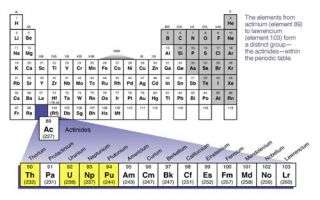
However, recent research shows that magnetically stabilized crystal structures also include the heavy actinide element, curium (Cm). In a diamond-anvil cell study, Cm was pressurized up to one million atmospheres of pressure, which caused the metal to undergo transformations between five different crystal phases.

But a new study by Livermore scientists goes one step further. The team, made up researchers from of Lawrence Livermore and Oak Ridge national laboratories and Daresbury Laboratory in the United Kingdom, probed the electronic and magnetic structure of Cm by using electron energy-loss spectroscopy (EELS) in a transmission electron microscope (TEM), electron atomic calculations and density functional theory (DFT). To date absorption-type experiments have not been performed on americium (Am) or Cm.

“Our results for curium go a long way in teaching us a general understanding of how this mechanism occurs,” said Kevin Moore, the LLNL lead author of the research paper that appears in the June 8 issue of the journal Physical Review Letters. Other Livermore researchers include Mark Wall, Adam Schwartz and Per Söderlind as well as Gerrit van der Laan from Daresbury and Richard Haire from Oak Ridge.

The Hund’s rule coupling is the key to producing the large spin polarization that dictates the newly found crystal structure of Cm under pressure.

Hund’s rule of maximum spin multiplicity is a principle of atomic chemistry, which assumes that a greater total spin state usually makes the resulting atom more stable, most commonly exhibited in a lower energy state, because it forces the unpaired electrons to reside in different spatial orbitals. By staying out of each others way, the electrons lower their total energy.

“This gives us great insight into the valence state and electron coupling mechanisms of 5f electrons in plutonium and americium, two metals that are significant to nuclear reactors,” Moore said. “Our data will help us refine our theoretically predictive codes for these metals to give us a better understanding of the physical properties of the metals and how they will behave under extreme conditions.”

The Livermore research also helps fill a gap in a recent Nature paper (446, page 513, 2007) from Rutgers University that had a missing data point in a table. The LLNL americium and curium data fill the blank space in the table.

“The two papers (PRL and Nature) greatly further our understanding of the middle actinide metals – plutonium, americium and curium.”

Source: Lawrence Livermore National Laboratory


print this article email this article download pdf blog this article bookmark this article     Stumble it Digg this share on Facebook retweet share on Reddit add to delicious
Rate this story - 4.3 /5 (22 votes)


June 6, 2007 all stories

Comments: 0

4.3 /5 (22 votes)
  • Stumble this up

  • Digg this

  • share this

  • hide
  • Related Stories

  • In-situ insights into alloys
    created Aug 26, 2009 | popularity not rated yet | comments 0
  • NIST finds 'a touch of glass' in metal, settles century-old question
    created Jun 17, 2009 | popularity not rated yet | comments 0
  • Actinide research published in Reviews of Modern Physics
    created Feb 11, 2009 | popularity not rated yet | comments 0
  • Domain walls that conduct electricity
    created Jan 29, 2009 | popularity not rated yet | comments 0
  • Solving the mysteries of metallic glass
    created Dec 22, 2008 | popularity not rated yet | comments 0


  • hide
  • Relevant PhysicsForums posts

  • Relaxation time approximation
    created 19 hours ago
  • Fermionic Condensate
    created Nov 21, 2009
  • Voltage drop in diode
    created Nov 21, 2009
  • ZENER BREAKDOWN has caused me a breakdown
    created Nov 20, 2009
  • More from Physics Forums - Atomic, Solid State, Comp. Physics

Other News

Aquatic creatures mix ocean water

Physics / General Physics

created 10 hours ago | popularity 5 / 5 (3) | comments 0

Understanding mixing in the ocean is of fundamental importance to modeling climate change or predicting the effects of an El Niño on our weather. Modern ocean models primarily incorporate the effects of winds and tides. However, ...


Generating electricity from air flow

Physics / General Physics

created 13 hours ago | popularity 3.9 / 5 (8) | comments 1

A group of researchers at the City College of New York is developing a new way to generate power for planes and automobiles based on materials known as piezoelectrics, which convert the kinetic energy of motion into electricity. ...


Nuclear weapons: Predicting the unthinkable

Physics / General Physics

created 13 hours ago | popularity 2.7 / 5 (3) | comments 0

If a nuclear weapon were detonated in a metropolitan area, how large would the affected area be? Where should first responders first go? According to physicist Fernando Grinstein, we have some initial understanding to address ...


Butterfly proboscis to sip cells

Physics / General Physics

created 11 hours ago | popularity not rated yet | comments 0

A butterfly's proboscis looks like a straw -- long, slender, and used for sipping -- but it works more like a paper towel, according to Konstantin Kornev of Clemson University. He hopes to borrow the tricks of this piece ...


Restored machine to explore mysteries of Big Bang (AP)

Restored machine to explore mysteries of Big Bang

Physics / General Physics

created Nov 21, 2009 | popularity 4.6 / 5 (18) | comments 19

(AP) -- Scientists are preparing the world's largest atom smasher to explore the depths of matter after successfully restarting the $10 billion machine following more than a year of repairs.