Envisat captures first image of Sargassum from space
June 6, 2007
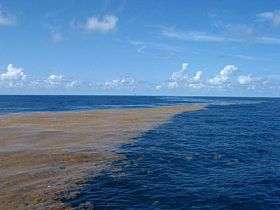
Sargassum slick observed in the western Gulf of Mexico, on 2 June 2003, off Corpus Christi, Texas. Credits: Tracy Villareal, University of Texas, Marine Science Institute
Sargassum seaweed, famous in nautical lore for entangling ships in its dense floating vegetation, has been detected from space for the first time thanks to an instrument aboard ESA’s environmental satellite, Envisat. The ability to monitor Sargassum globally will allow researchers to understand better the primary productivity of the ocean and better predict climate change.
Using optical radiance data from the Medium Resolution Imaging Spectrometer (MERIS) aboard Envisat, Dr Jim Gower and Stephanie King of the Canadian Institute of Ocean Sciences and Dr Chuamin Hu of the US University of South Florida were able to identify extensive lines of floating Sargassum in the western Gulf of Mexico in the summer of 2005.
"This appears to be the first report of a satellite image of Sargassum," Gower said. "It is usually associated with the area of the North Atlantic known as the Sargasso Sea after the Sargassum encountered there by early explorers. Our observations of Sargassum lines extending over large areas of the Gulf show that in this area and season it represents a significant fraction of marine primary productivity."
Marine primary production is the process by which floating vegetation, such as phytoplankton and seaweed, absorb atmospheric carbon dioxide through photosynthesis and convert it into organic carbon. By absorbing half of the carbon dioxide emitted into the atmosphere, the oceans have a profound influence on climate, making them major areas of interest for climate modellers.
The discovery was made using the MERIS maximum chlorophyll index (MCI) which provides an assessment of the amount of chlorophyll in vegetation to produce detailed images of chlorophyll per unit area. MERIS is uniquely suited for this because it provides images of above-atmosphere spectral radiance in 15 bands, including three bands at wavelengths of 665, 681 and 709 nanometres in order to measure the fluorescence emission from chlorophylla.
Chlorophyll is the green photosynthetic compound in plants that captures energy from sunlight necessary for photosynthesis. The amount of chlorophyll present in vegetation plays an important role in determining how healthy it is. Accurately monitoring chlorophyll from space, therefore, provides a valuable tool for modelling primary productivity.
"The 709 band used by MERIS is not present on other ocean-colour sensors. It was essential to our detecting Sargassum," Gower said. "The MCI index has allowed us to find so many interesting things, including Sargassum and Antarctic super blooms. It really gives us a new and unique view of the Earth."
Gower and King are now combining data from MERIS with a sophisticated processing algorithm and powerful Grid computing to broaden this new view. The basic principle behind Grid computing is that anything one computer can do, a pool of computers can do faster and better, enabling the solution of massively complex tasks beyond the capabilities of a single machine or local network.
By using Grid technology, Gower and King intend to compute 5-years worth of MERIS data to determine global estimates of Sargassum biomass and its contribution to ocean productivity. "So far, we have found two things (Sargassum and Antarctic superblooms) that have never been seen from space before," said King. "It is really very exciting."
Source: ESA
-
Mysterious flotsam in Gulf of Mexico came from Deepwater Horizon rig, study finds
Jan 19, 2012 |
5 / 5 (1) |
0
-
Greenpeace warns of radioactive sea life off Japan
May 26, 2011 |
not rated yet |
1
-
Weed-eating fish 'key to reef survival'
Mar 10, 2011 |
not rated yet |
0
-
In North Atlantic, researchers find a sea of garbage
Jun 13, 2010 |
4.6 / 5 (17) |
8
-
Queen's marine biologist investigates aliens beneath the waves
Jun 16, 2008 |
3 / 5 (1) |
0
-
Engineers build first sub-10-nm carbon nanotube transistor
Feb 01, 2012 |
4.9 / 5 (33) |
30
-
Something old, something new: Evolution and the structural divergence of duplicate genes
Jan 31, 2012 |
4.6 / 5 (7) |
1
-
The hidden nanoworld of ice crystals: Revealing the dynamic behavior of quasi-liquid layers
Jan 30, 2012 |
5 / 5 (5) |
1
-
Stock market network reveals investor clustering
Jan 27, 2012 |
3.9 / 5 (23) |
8
-
Of microchemistry and molecules: Electronic microfluidic device synthesizes biocompatible probes
Jan 26, 2012 |
5 / 5 (2) |
0
-
Do some geologists actually act a lot like Randy Marsh?
Feb 11, 2012
-
Discrepancy between oxygen and carbon-dioxide levels
Feb 09, 2012
-
where gems are found in the world
Feb 09, 2012
-
Wind Waves in Reservoir ~ Wind run-up and Wind set-up
Feb 08, 2012
-
Balance of oxygen in the atmosphere
Feb 01, 2012
-
The case for a methanol-based economy
Jan 30, 2012
- More from Physics Forums - Earth
More news stories
Alien matter in the solar system: A galactic mismatch
This just in: The Solar System is different from the space just outside it.
Space & Earth / Space Exploration
52 minutes ago |
3.7 / 5 (3) |
3
|
Transforming galaxies
(PhysOrg.com) -- Many of the Universe's galaxies are like our own, displaying beautiful spiral arms wrapping around a bright nucleus. Examples in this stunning image, taken with the Wide Field Camera 3 on ...
18 minutes ago |
5 / 5 (1) |
0
|
A continent ablaze in auroral and manmade light
The North American continent is literally set ablaze in a confluence of Auroral and Manmade light captured in spectacular new videos snapped by the astronauts serving aboard the International Space Station ...
Space & Earth / Space Exploration
11 minutes ago |
not rated yet |
0
A better picture of clouds
Some of us look at clouds and see animal shapes. Scientists are looking beyond. For the first time, a team of scientists led by Pacific Northwest National Laboratory used actual measurements of clouds and ...
Space & Earth / Earth Sciences
13 minutes ago |
not rated yet |
0
Scientists drill two miles down to ancient Lake Vostok
(PhysOrg.com) -- Russian scientists last week finished penetrating more than two miles through the Antarctic ice sheet to Lake Vostok, a huge freshwater lake that has been buried under the ice for millions ...
Space & Earth / Earth Sciences
2 minutes ago |
not rated yet |
0
Manipulating genes with hidden TALENs
(PhysOrg.com) -- A better understanding of gene function in model plant and animal systems could be used to develop useful traits in livestock and crop plants, and might someday lead to developments in stem ...
'Smart' microcapsules in a single step
(PhysOrg.com) -- A new, single-step method of fabricating microcapsules, which have potential commercial applications in industries including medicine, agriculture and diagnostics, has been developed by researchers ...
Tenofovir, leading HIV medication, linked with risk of kidney damage
(Medical Xpress) -- Tenofovir, one of the most effective and commonly prescribed antiretroviral medications for HIV/AIDS, is associated with a significant risk of kidney damage and chronic kidney disease that increases over ...
Ethanol mandate not the best option
Many people are willing to pay a premium for ethanol, but not enough to justify the government mandate for the corn-based fuel, a Michigan State University economist argues.
Nanostructured electrodes for rechargeable sodium-Ion batteries
Highly efficient 3V cathodes for rechargeable sodium-ion batteries have been developed by users from Argonne National Laboratory's Materials Science, Chemical Sciences & Engineering, and X-ray Sciences Divisions, ...