Students take Porsche to electric avenue
June 6, 2007
Students take Porsche to electric avenue

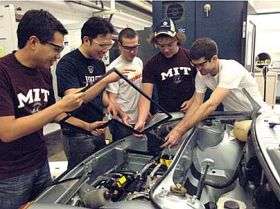
Left to right: Gerardo Lao, grad student in material science, Emmanuel Sin, mechanical engineering senior, Ryan King, mechanical engineering sophomore, Jeremy Kuenpel, freshman in mechanical engineering, Craig Wildman, graduate student in mechanical engineering team around the porsche in Sloan Automotive Lab. They are installing batteries in the front trunk compartment of the vehicle. Photo / Donna Coveney

For the past six months a team of MIT students has spent hundreds of hours--many late at night--converting a sleek Porsche 914 into an electric vehicle. Their goal? To demonstrate the viability of advanced electric vehicle technology and to help clarify what research and development has yet to be done.

The Porsche was donated by Professor Yang Shao-Horn of mechanical engineering, who with her husband, Quinn Horn, bought it off eBay and made it available to students interested in converting it to an electric-powered vehicle.

In addition to providing an unusual opportunity for hands-on learning, the project will ultimately yield information valuable to Shao-Horn's research on advanced batteries. Specifically, she and her team in the Electrochemical Energy Laboratory will be able to measure the conditions that batteries encounter inside an operating vehicle.

"In the laboratory we work on materials to make batteries safer, last longer and have higher energy," she said. "But we are also interested in gaining a good perspective on the system view. What's involved in building an electric vehicle, and what's required of the batteries?"

The student project took off a year ago when Valence Technology, Inc., agreed to donate 18 high-tech rechargeable batteries valued at $2,030 each, plus a battery-management system. While today's electric cars generally operate on conventional lead-acid batteries, Valence provided its enabling lithium phosphate rechargeable batteries, which are lighter, last longer, charge up faster, have a longer lifetime and don't pose a safety risk.

Leading the assembly team in the Sloan Automotive Laboratory is senior Emmanuel Sin, who was awarded the Peter Griffith Prize for an "outstanding experimental project and thesis" by the Department of Mechanical Engineering in May.

Sin's main collaborators on the project are sophomore Ryan King of mechanical engineering; freshman Jeremy Kuempel; graduate student Gerardo Jose la O', who initiated the project; and graduate student David Danielson, who obtained funding for supplies and tools from Maniv Energy Capital, LLC. Both la O' and Danielson are in the Department of Materials Science and Engineering.

To make the conversion, the students replaced the original engine with an electric motor, 12 of the batteries, the battery-management system, various relays and a controller that makes all the components work together. Things haven't always gone smoothly. "There's been a lot of adapting things that don't work as they're designed," said King. "We had to come up with some creative solutions."

In the next few weeks they hope to put the Porsche through its paces. For example, they'll determine its acceleration and top speed and will see how far it will go on a single charge.

According to their best estimates, the car should produce 50 to 60 horsepower and have a top speed of 70 to 100 mph. Plugging it into a wall socket should fully recharge the batteries in four to five hours, and it should then go 100 miles or more before it needs recharging.

Source: MIT


Rank 5 /5 (7 votes)
Tags

Relevant PhysicsForums posts
  • How to tilt a object
    created3 hours ago
  • How to calculate total compressibility in liquid porous solid system
    created9 hours ago
  • Need help reading 3-D
    createdFeb 11, 2012
  • A way to send and receive wireless data
    createdFeb 11, 2012
  • Calling function with no input argument
    createdFeb 10, 2012
  • Force free body diagram problem on gym equipment
    createdFeb 10, 2012
  • More from Physics Forums - General Engineering

More news stories

Google might launch Drive for cloud storage soon

(PhysOrg.com) -- Google's next big move, according to the Wall Street Journal, is a cloud storage service called Drive. Hardly first to the plate, Google is simply catching up to introducing its cloud reposi ...

Technology / Internet

created 17 hours ago | popularity 4.8 / 5 (5) | comments 5 | with audio podcast report

Iran blocks email, restricts net access: reports

Iran has further restricted access to the Internet and blocked popular email services for the past few days, in a move a top lawmaker said could "cost the regime dearly," media reports said on Sunday.

Technology / Internet

created 10 hours ago | popularity 5 / 5 (2) | comments 5

Walney offshore wind farm is world's biggest (for now)

(PhysOrg.com) -- The Walney wind farm on the Irish Sea--characterized by high tides, waves and windy weather--officially opened this week. The farm is treated in the press as a very big deal as the Walney ...

Technology / Energy & Green Tech

created Feb 11, 2012 | popularity 4.1 / 5 (14) | comments 56 | with audio podcast weblog

Navy to begin tests on electromagnetic railgun prototype launcher

The Office of Naval Research (ONR)'s Electromagnetic (EM) Railgun program will take an important step forward in the coming weeks when the first industry railgun prototype launcher is tested at a facility ...

Technology / Engineering

created Feb 06, 2012 | popularity 4.6 / 5 (20) | comments 95 | with audio podcast

Love a click away in Indonesia's Twitter Republic

He was a geeky kid from Yogyakarta, she a glamorous city girl in Jakarta. In a country with one of the world's most vibrant social networking scenes they fell in love on Twitter.

Technology / Internet

created 18 hours ago | popularity 4 / 5 (1) | comments 0


Scientists discover molecular secrets of 2,000-year-old Chinese herbal remedy

For roughly two thousand years, Chinese herbalists have treated Malaria using a root extract, commonly known as Chang Shan, from a type of hydrangea that grows in Tibet and Nepal. More recent studies suggest that halofuginone, ...

New method to examine batteries -- MRI from the inside

There is an ever-increasing need for advanced batteries for portable electronics, such as phones, cameras, and music players, but also to power electric vehicles and to facilitate the distribution and storage of energy derived ...

A mitosis mystery solved: How chromosomes align perfectly in a dividing cell

Although the process of mitotic cell division has been studied intensely for more than 50 years, Whitehead Institute researchers have only now solved the mystery of how cells correctly align their chromosomes during symmetric ...

Lab study raises questions over nano-particle impact

Tests involving chickens have raised questions about the impact on health from engineered nano-particles, the ultra-fine grains commonly used in drugs and processed foods, scientists said on Sunday.

Starve a virus, feed a cure? Findings show how some cells protect themselves against HIV

A protein that protects some of our immune cells from the most common and virulent form of HIV works by starving the virus of the molecular building blocks that it needs to replicate, according to research published online ...

Researchers find extensive RNA editing in human transcriptome

In a new study published online in Nature Biotechnology, researchers from BGI, the world's largest genomics organization, reported the evidence of extensive RNA editing in a human cell line by analysis of RNA-seq data, demons ...