Caribbean Amphibians Started with a Single, Ancient Voyage on a Raft from South America
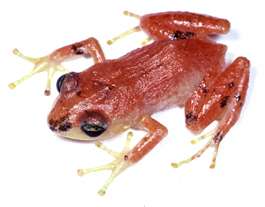
Nearly all of the 162 land-breeding frog species on Caribbean islands, including the coqui frogs of Puerto Rico, originated from a single frog species that rafted on a sea voyage from South America about 30-to-50-million years ago, according to DNA-sequence analyses led by a research group at Penn State, which will be published in the 12 June 2007 issue of the Proceedings of the National Academy of Sciences and posted in the journal's online early edition this week.
Similarly, the scientists found that the Central American relatives of these Caribbean amphibians also arose from a single species that arrived by raft from South America.
"This discovery is surprising because no previous theories of how the frogs arrived had predicted a single origin for Caribbean terrestrial frogs and because groups of close relatives rarely dominate the fauna of an entire continent or major geographic region," explained Penn State's Blair Hedges, the evolutionary biologist and professor of biology who directed the research. "Because land connections among continents have allowed land-dwelling animals to disperse freely over millions of years, the fauna of any one continent is usually a composite of many types of animals."
The field work for the study required nearly three decades to complete because many of the species are restricted to remote and isolated mountain tops or other inaccessible areas. Some species included in the study now are believed to be extinct because of habitat degradation and possibly other causes such as climate change.
A recent global assessment of amphibians found that the Caribbean Islands have the highest proportion of amphibian species threatened with extinction. Hedges and coauthor William Duellman, a professor emeritus of the University of Kansas, were involved in much of the field work. A third co-author of the study is Penn State graduate student Matthew Heinicke, who performed DNA sequencing and analyses.
One prominent theory had proposed that frog species on the large islands of Cuba, Jamaica, Hispaniola, and Puerto Rico had walked there across land bridges that existed when those islands were connected in a geologic arc about 70-to-80-million years ago. A second major theory proposed that they arrived, instead, by rafting across the Caribbean Sea after the giant asteroid impact near Cuba 65-million years ago, which is widely believed to have exterminated the dinosaurs. "Both theories acknowledged that the frog faunas must have arrived by rafting over water to the smaller and younger islands, the Lesser Antilles, because they never were connected by land to South America, but neither theory proposed that all of the Caribbean island frog species had a single common ancestor," Hedges said.
The anatomy of Caribbean frogs previously had led the advocates of both theories to conclude that species in Cuba and other western-Caribbean islands were related to different mainland species than were the species on Puerto Rico and other eastern-Caribbean islands, regardless of how they got there. "Discovering a single origin for all of these species from throughout the Caribbean islands was completely unexpected," Hedges said.
To make their discovery, the researchers sequenced the DNA of nearly 300 species of Caribbean, Central American, and South American frogs and used three mitochondrial genes and two nuclear genes in their study, building trees of relationships among the species and timing the divergences of the species with molecular-clock methods. "Molecular clocks work by counting the number of DNA-sequence mutations separating two species and then dividing that number by the rate of change, which is established with the help of fossils and geologic information," explained Hedges.
The study's DNA research revealed that, while many ocean dispersals may have occurred over time, only two led to the current faunas: one for the Caribbean islands and another for Central America. The scientists speculate that it may not be coincidental that these ancient and successful dispersals happened after the asteroid collision rather than earlier. "The asteroid impact generated giant waves that devastated the islands, probably eliminating any existing fauna at that time," Hedges said.
The original frogs that successfully colonized the Caribbean islands likely hitched a ride on floating mats of vegetation called flotsam, which is the method typically used by land animals to travel across salt water. "Some rafts of flotsam, if they are washed out of rivers during storms and caught in ocean currents, can be more than a mile across and could include plants that trap fresh water and insect food for frogs," Hedges said. It is not likely that the frog species dispersed simply by swimming because frogs dry easily and are not very tolerant of salt water.
In addition to the study's discoveries about Caribbean and Central American frogs, the research also revealed and defined an unusually large and unpredicted group of species in South America. "The South American group may have more than 400 species and is mostly associated with the large Andes mountains of South America," Hedges said.
"Until now, the entire group of these terrestrial, tropical frog species -- the eleutherodactylines -- have been considered a "black hole" in amphibian biology because of the poor understanding of their evolutionary history," explained Hedges. Scientists consider the knowledge of evolutionary relationships, also called "phylogeny," to be fundamental to many fields of biology, including medicine, anatomy, physiology, ecology, and conservation.
Source: Penn State


