Birds, Bees, and Moths Drive Flower Evolution
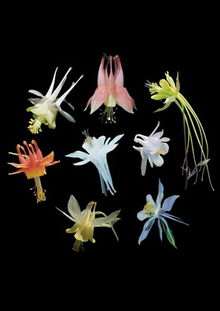
Flowers evolve in a predictable fashion to match the mouthparts of pollinating birds and insects, rather than engaging in a gradual "arms race" between flower and pollinator, according to a new study by researchers at the University of California, Davis and the University of California, Santa Barbara. An article describing the study is published in the June 7 issue of the journal Nature.
The research builds on work done by Charles Darwin more than 140 years ago.
Columbine flowers, found all over the Northern Hemisphere, but with exceptional diversity in Western North America, keep their nectar at the bottom of a spur that ranges from fractions of an inch to several inches long, depending on species. Bees, birds or hawkmoths that visit to drink the nectar get dusted with pollen.
Justen Whittall, currently a postdoctoral research fellow at UC Davis, built a genetic family tree of the North American columbines as part of his Ph.D. research with Scott Hodges, professor in the Department of Ecology, Evolution, and Marine Biology at UC Santa Barbara. They found that columbines repeatedly evolved in a predictable sequence from short to medium or from medium to long nectar spurs without becoming shorter. This progression matched the increasingly long tongues of bees, hummingbirds and hawkmoths, respectively.
Almost three-quarters of the variation in the flowers occurred rapidly when new species formed, most likely to take advantage of a new pollinator. The remaining variation could have occurred by a more gradual mechanism, like that proposed by Darwin.
"There's strong selection on the plant to draw pollinators into the flower for successful pollination," Whittall said.
In 1862, Darwin predicted that a jungle orchid with a long, deep flower would be pollinated by a moth with an equally long tongue. Such an insect was discovered in 1903, but was not actually observed pollinating the orchid until 1997.
Both Darwin and Alfred Russell Wallace, the other pioneer of evolutionary theory, proposed that flowers and pollinators engage in an evolutionary race. If the flower spur becomes slightly deeper, pollinators will tend to evolve to have longer tongues, and then the flowers become slightly deeper again, and so on in a series of small, reciprocal steps. "However, the columbines have evolved incredibly recently," Hodges said. "So, the tongues of their pollinators were probably already at an optimal length for other flowers when the columbines came on the scene. The plants apparently had to evolve rapidly to fit the tongues, but the tongues probably evolved very little."
Hodges explained that long-tongued pollinators can always reach nectar of flowers with short spurs but animals with short tongues can't get food from flowers with long spurs. This means that shifts in pollinators will generally be to ones with longer tongues and that spurs then get longer and longer during evolution.
"It's a great example of evolution at work, happening right in my backyard," Whittall said.
Source: University of California, Santa Barbara


