Probing Question: Are there upper and lower limits to temperature?
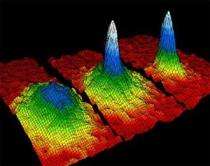
Most people have heard absolute zero described as the lowest possible temperature, but what does that mean? Is it really the coldest cold, or just the lowest temperature that we can measure? Is there a corresponding highest temperature? According to Moses Chan, Evan Pugh professor of physics at Penn State, answering these questions requires understanding the meaning of temperature.
"Temperature is a measure of the degree of 'disorder' or 'messiness' of a system," said Chan. "When a system is cooled down to absolute zero, then that system is perfectly ordered and all its constituents—molecules and atoms—are in their proper place. That is the lowest possible temperature." Absolute zero, or 0 K (kelvins) corresponds to -273.16 C, or -459.688 F.
Before quantum mechanics was developed as a model to explain the behavior of atomic and subatomic particles, scientists thought that all atoms would stop moving at absolute zero. However, even at this temperature, atoms and molecules retain what is known as zero-point energy, the lowest possible energy a system can have. As Chan explained it, the energy in the vacuum of empty space is considered a form of zero-point energy. Also described as the "ground" or "stationary" state, absolute zero is considered a stable state from which no energy can be removed.
"At low temperatures," Chan continued, "quantum mechanical effects dominate the properties of all matter." In some materials, the effect is truly spectacular. At sufficiently low temperatures, for instance, some types of matter become superconducting, carrying electric current with absolutely no resistance. Practical applications of this phenomena include high magnetic field MRI machines and very efficient electric motors and transformers.
Another vivid example of quantum effects can be found in liquid helium. When liquid helium becomes a superfluid, at temperatures below 2.176K, Chan noted, it can flow without friction. The lack of friction means the superfluid has no viscosity. If a droplet is caused to rotate inside a container, it can continue to rotate forever as if it were in a vacuum. To Chan, these are examples of macroscopic quantum phenomena—quantum mechanics operating on a macroscopic scale.
Back in the 1920s, physicists Satyendra Bose and Albert Einstein predicted that at very low temperatures particles such as atoms will bunch together at exactly the same lowest energy quantum state. This state of matter is known as a Bose-Einstein Condensate (BEC). The collection of particles acts like a single giant atom. This phenomenon, Chan noted, was finally observed in the laboratory in 1995 by cooling rubidium atoms in the vapor phase down to a temperature of 50 nanokelvins (billionths of a kelvin) above absolute zero. The physicists who observed it, Carl Weiman and Eric Cornell, were awarded a Nobel prize for their work.
Chan's own research at very low temperatures yielded another important breakthrough in 2004. "My former student, Eunseong Kim, found that solid helium also exhibits superfluid-like properties below 0.2K," he explained. "Finding this supersolid phase indicates that all three states of matter—vapor, liquid and solid—can undergo BEC." Supersolid phenomena have sparked the interest of low-temperature and theoretical physicists worldwide. Chan and his current students—Tony Clark, Xi Lin and Josh West—are continuing the effort to understand this fascinating discovery.
So, is there a high temperature analog to absolute zero? When a material becomes very hot, its particles have lots of thermal energy, Chan said. Solids melt and liquids vaporize because their thermal energy exceeds the forces that bind atoms or molecules together. At even higher temperature, atoms dissociate into electrons and ion plasma, yet another state of matter. As more energy is injected into a system, its temperature continues to rise.
"In the sense that there is a limit to the total energy that exists in the universe, there is a highest possible temperature," said Chan. Cosmologists postulate that at around 10-43 seconds, an unimaginably tiny fraction of an instant after the Big Bang (If you were to take a trip to the farthest galaxy from Earth, 10-43 would represent the first billionth of a millimeter you traveled), the temperature of the newborn universe was 1032 K. Even the center of today's Sun, at 15,000,000 C, is frigid by comparison.
It is clear that we can never harness all the energy in the universe, so the highest possible temperature is not attainable. Can we ever experience the other end of the scale—absolute zero? "No, we can get very close, but never to absolute zero," said Chan. "Some labs, including David Weiss's here at Penn State, can cool vapor samples to within a few nanokelvins, or billionths of a degree. But to bring something to perfect order, you have to get rid of the disorder or messiness. As the system gets closer to absolute zero, it becomes progressively harder and harder to remove that disorder."
Provided by Pennsylvania State University


