Strengthening nanotube fluorescence
In a way, nanotubes are nature's smallest candles. These tiny tubes are constructed from carbon atoms and they are so small that it takes about 100,000 laid side-by-side to span the width of a single human hair. In the last five years, scientists have discovered that some individual nanotubes are fluorescent.
That is, they glow when they are bathed in light. Some glow brightly. Others glow dimly. Some glow in spots. Others glow all over.
Until now, this property has been largely academic. But researchers from the Vanderbilt Institute of Nanoscale Science and Engineering (VINSE) have removed an obstacle that has restricted fluorescent nanotubes from a variety of medical applications, including anti-cancer treatments. In a paper published online in the Journal of the American Chemical Society on June 7, they describe a method that can successfully produce large batches of highly fluorescent nanotubes.
"Nanotubes have a number of characteristics that make them particularly suitable for use as contrast agents in cells and tissues," says Tobias Hertel, the associate professor of physics who headed the research. "Now that we know how to separate out the brightest ones, I hope that researchers will begin considering ways to use them in clinical applications."
The figure of merit for fluorescence is quantum efficiency: the ratio of the number of photons of light that a device emits to the number of photons it absorbs in the process. The VINSE team reports that they can produce populations containing trillions of nanotubes with a quantum efficiency of 1 percent, a factor of 100 better than previous ensemble measurements and close to the best quantum efficiencies reported for individual nanotubes.
The methods researchers use to produce nanotubes creates soot that contains a number of different types of nanotubes: metallic, semiconducting, double-walled, single-walled, etc. Of these, only the single-walled semiconducting nanotubes, or SWNTs, are capable of producing light. Metallic nanotubes actually inhibit the brightness of their fluorescent neighbors. But it has been very difficult to separate the strongly fluorescent SWNTs from all the rest in large quantities.
Nanotube soot is insoluble in water. So researchers routinely mix it with special soap and give it a dose of ultrasound to break apart clumps of nanotubes and force them to dissolve. The result is a dark liquid that is routinely put into an ultracentrifuge that subjects them to forces a few thousand times that of gravity. Centrifuging separates out a number of gross impurities.
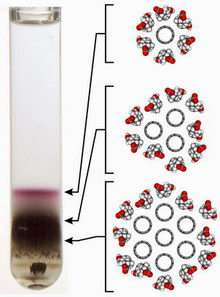
Hertel's team discovered that if they remove the most buoyant layer from the centrifuge, let it set for a while and then put it back in the ultracentrifuge for another 12 hours, the liquid separates into a number of distinct layers. The topmost layer has a purple color and, when analyzed, proves to contain a surprisingly uniform population of the brightest nanotubes.
The researchers had expected this approach to boost the quantum efficiency by five to ten times. The fact that the improvement was considerably larger — 20 to 100 times — came as a pleasant surprise.
"Quantum efficiency is critical, but there are several other factors that make nanotubes particularly well suited for use in living systems," says Hertel. These factors include:
Nanotubes emit light in a very narrow range of wavelengths, or colors. This makes it easier to pick out their signal against background noise. Furthermore, they produce light in a part of the spectrum — the near infrared where skin and other tissue is transparent — that allows the nanotube light to stand out.
Nanotubes are made entirely from graphitic carbon, which is non-toxic and, at least so far, experiments that have been done indicate that they do not damage living cells. By comparison, quantum dots, which are a popular alternative fluorescent tagging technology, are made from the elements cadmium and selenium that are toxic at relatively low levels and so have not been approved for clinical applications.
Nanotube fluorescence is extremely stable and can last for months. Fluorescent proteins — widely used for imaging living systems — begin fading within a few hours. Quantum dots last several days before degrading.
Hertel's team is currently working on the next step necessary for many biomedical uses: finding a way to attach molecules to the surface of the nanotubes that will allow them to bind to specific biological targets. The trick is to do so without dimming or extinguishing the nanotubes' delicate fluorescence.
An example of the possible medical applications of nanotube fluorescence is a collaboration that Hertel and Associate Professor of Biomedical Research Duco Jansen are planning. Jansen has been pursuing research that uses gold nanoclusters to burn away cancer cells. He has developed a selective method for attaching the gold clusters to the surface of tumors and then exposing them to wavelengths of light that cause them to grow hot enough to destroy nearby cells. The approach has one drawback: He doesn't have an easy way to identify the locations where the clusters attach. Nanotubes should work as well as gold clusters as microscopic blow torches while their fluorescence should make them easy to locate. At least that is the hypothesis the researchers hope to test.
Hertel's co-authors on the paper are Vanderbilt graduate student Jared Crochet and Michael Clemens, an undergraduate student from Brigham Young University.
Source: Vanderbilt University


