New collaborative research reveals chimpanzees can sustain multiple-tradition cultures
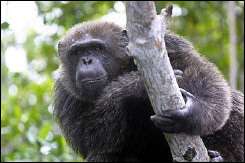
June 8th, 2007 A chimpanzee

Scientists have long wondered if local animal cultures exist, and now, based on findings by researchers at the Yerkes National Primate Research Center at Emory University, the University of Texas and St. Andrews University, Scotland, they have their answer: Yes.

The study, available in today’s online edition of Current Biology, confirms captive chimpanzees have the capacity to sustain the same kind of multiple-tradition cultures many researchers believe exist in the wild, providing further evidence chimpanzees and humans shared a common ancestor five to six million years ago who had a similar level of cultural complexity.

For years, primatologists have suggested different communities of chimpanzees across Africa vary in many behavior patterns, indicating they have cultures specific to each community. In the wild, however, it is difficult to prove behaviors are passed on by observation and learning.

In this study, members of the international collaborative research team taught forms of tool use and food extraction techniques to high-ranking individuals in four different captive chimpanzee communities. Researchers then observed as those individuals passed on the techniques to other members of their communities. The researchers included Frans de Waal, PhD, Victoria Horner, PhD, and Kristin Bonnie from the Yerkes Research Center, lead researchers Andrew Whiten, PhD, and Antoine Spireti from St. Andrews University, and Susan Lambeth, PhD, and Steven Schapiro, PhD, from the University of Texas.

In the Yerkes-based portion of the study, Dr. de Waal, Dr. Horner and Dr. Bonnie worked with two chimpanzee groups and introduced each to one of two alternative sequences of complex behaviors. The sequences included collecting, transporting and depositing a token into a bucket or a pipe to receive a food reward from a separate, unrelated location.

After each group of chimpanzees observed a high-ranking female member of its own group complete an action sequence, the majority of the chimpanzees followed that sequence for the remainder of the testing period. Over time, the different methods chosen by each high-ranking female were passed among members of her group, thereby becoming a local tradition.

In all, the researchers observed 10 traditions spread throughout the chimpanzee groups at the Yerkes Research Center and the University of Texas.

“This study nicely summarizes our collaborative work of the last five years, showing we can artificially introduce cultures in chimpanzees, which supports the idea cultural variation observed in the wild is learned,” says Dr. de Waal. “We are the first to show cultures potentially can jump from group to group if you offer chimpanzees the opportunity to watch other groups. It’s a bit like Westerners learning to eat with chopsticks."

Source: Emory University


print this article email this article download pdf blog this article bookmark this article     Digg this Stumble it share on Facebook share on Reddit add to delicious save to Yahoo! bookmarks
4.3/5 after 19 votes


June 8th, 2007 all stories
Biology /

Comments: 0
Rank: 4.3/5 after 19 votes

  • Stumble this up

  • Digg this

  • Share it:
  • share on Facebook
  • share on MySpace
  • share on Slashdot
  • rss-newsfeed
  • share on Google
  • share on Reddit
  • add to delicious
  • save to Yahoo! bookmarks
  • share on Windows Live
  • Add to Mixx!
Rating: 4.3/5 after 19 votes

  • Related Stories

  • Here's one I made earlier: Chimps learn from watching videos
    created Jul 01, 2009 | popularity not rated yet | comments 0
  • Humans related to orangutans, not chimps
    created Jun 18, 2009 | popularity not rated yet | comments 0
  • Researchers shed light on trading behavior in animals -- and humans
    created Jun 08, 2009 | popularity not rated yet | comments 0
  • Reconstructing the evolution of laughter in great apes and humans
    created Jun 04, 2009 | popularity not rated yet | comments 0
  • Necessity is the mother of invention for clever birds (w/Videos)
    created May 25, 2009 | popularity not rated yet | comments 0

Tags


  • Physicists Demonstrate Quantum Memory with Matter Qubits
    Physicists Demonstrate Quantum Memory with Matter Qubits
    Physics / General Physics
    created Jul 03, 2009 | popularity 4.4 / 5 (17) | comments 1
  • 'Holey' Nanosheets for Wastewater Dye Removal
    Nanotechnology / Nanomaterials
    created Jul 01, 2009 | popularity 5 / 5 (5) | comments 1
  • Jellyfish Robot Swims Like its Biological Counterpart
    Jellyfish Robot Swims Like its Biological Counterpart
    Electronics / Robotics
    created Jun 26, 2009 | popularity 4.4 / 5 (8) | comments 1
  • Could Maxwell's Demon Exist in Nanoscale Systems?
    Could Maxwell's Demon Exist in Nanoscale Systems?
    Physics / General Physics
    created Jun 24, 2009 | popularity 4.4 / 5 (18) | comments 29
  • Living Safely with Robots, Beyond Asimov's Laws
    Living Safely with Robots, Beyond Asimov's Laws
    Electronics / Robotics
    created Jun 22, 2009 | popularity 4.6 / 5 (52) | comments 40
  • Other News

    California water plan aims to save Puget Sound orcas

    Biology / Ecology

    created 59 minutes ago | popularity not rated yet | comments 0

    A plan to restore salmon runs on California's Sacramento River also could help revive killer whale populations 700 miles to the north in Puget Sound, as federal scientists struggle to protect endangered species in a complex ...


    Scientists 'rebuild' giant moa using ancient DNA

    Biology / Plants & Animals

    created Jul 01, 2009 | popularity 5 / 5 (10) | comments 12

    (PhysOrg.com) -- Scientists have performed the first DNA-based reconstruction of the giant extinct moa bird, using prehistoric feathers recovered from caves and rock shelters in New Zealand.


    Pacific Giant Salamander (Dicamptodon tenebrosus)

    Salamanders, regenerative wonders, heal like mammals, people

    Biology / Microbiology

    created Jul 01, 2009 | popularity 4.9 / 5 (19) | comments 10

    The salamander is a superhero of regeneration, able to replace lost limbs, damaged lungs, sliced spinal cord -- even bits of lopped-off brain. But it turns out that remarkable ability isn't so mysterious after ...


    Genetically modified trees

    Anti-biotech groups obstruct forest biotechnology

    Biology / Biotechnology

    created Jun 30, 2009 | popularity 3.7 / 5 (7) | comments 5

    The potential of forest biotechnology to help address significant social and environmental issues is being "strangled at birth" by the rigid opposition of some groups and regulations that effectively preclude ...


    Super-sleepers could help super-sizers!

    Super-sleepers could help super-sizers!

    Biology / Plants & Animals

    created Jun 29, 2009 | popularity 5 / 5 (2) | comments 4

    Burrowing frogs can survive buried for several years without food or water. Scientists have discovered that the metabolism of their cells changes radically during the dormancy period allowing the frogs to ...