New quantum key system combines speed, distance
June 9, 2007
New Quantum Key System Combines Speed, Distance

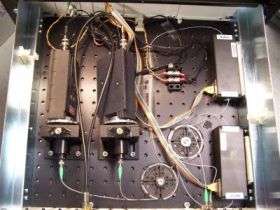
Detection stage of the NIST prototype quantum key distribution system: Photons are "up-converted" from 1310 to 710 nm by one of the two NIST-designed converters at right, then sent to one of two commercial silicon avalanche photo diode units to the left. Credit: NIST

Researchers at NIST have built a prototype high-speed quantum key distribution system, based on a new detector system that achieves dramatically lower noise levels than similar systems.

Researchers at the National Institute of Standards and Technology have built a prototype high-speed quantum key distribution (QKD) system, based on a new detector system that achieves dramatically lower noise levels than similar systems. The new system, they say, can perform a theoretically unbreakable “one-time pad” encryption, transmission and decryption of a video signal in real-time over a distance of at least 10 kilometers.

Key distribution—the problem of ensuring that both the sender and receiver of an encrypted message (and no one else) share the same long string of random digits (the so-called “key”) used to encode and decode the message—has always been one of the most important challenges in cryptography. Since the 1980’s it’s been recognized that the unique properties of quantum mechanics—the fact that certain measurements cannot be made without altering the thing measured—offered the possibility of a system that could transmit as long a key as desired between two parties with no chance that it could be copied undetectably by a third party.

Since then the race has been on to build a fast, practical and reliable QKD system. One important requirement for any candidate system is that it be compatible with existing fiber-optic telecom networks that transmit at wavelengths of either 1550 or 1310 nanometers (nm) to reach the greatest distance. Another requirement is a highly efficient photon detector that can detect single photons reliably without introducing significant amounts of “noise.” One of the best low-noise detectors, a silicon-based avalanche photo diode (Si-APD), does not function at the telecom wavelengths. Instead, it operates best at much shorter wavelengths around 700 nm. To take advantage of the Si-APD, the NIST group designed a sub-system to “up-convert” single photons from a transmission wavelength of 1310 nm to 710 nm for high-efficiency detection.

Their QKD system that incorporates this up-conversion technique, described in a recent paper, generates and transmits secure keys at a rate of over half a million bits per second over 10 km of optical fiber, fast enough to encrypt streaming digital video using one-time pad in real time. The group also has transmitted secure keys at rates near 10 kilobits per second at five times that distance. The same team last year set a speed record for transmission of secure keys over a kilometer of fiber (see http://www.physorg … 4589539.html). This work improves the distance by at least 10 times.

Advantages of the new system, according to the research team, include high speed, high efficiency, low noise and convenience of operation. The fact that it uses a 1310 nm transmission wavelength somewhat limits the propagation distance but adds the advantage that the parallel “classical-quantum” communication, which is needed for a full QKD system, can be realized in a single fiber without significant interference.

Details of NIST’s up-conversion QKD research are available at http://w3.antd.nis … v/quin.shtml.

Citation: H. Xu, L. Ma, A. Mink, B. Hershman and X. Tang. 1310-nm quantum key distribution system with up-conversion pump wavelength at 1550 nm. Optics Express, Vol. 15, Issue 12, pp. 7247-7260.

Source: National Institute of Standards and Technology

4.1 /5 (18 votes)  

Rank 4.1 /5 (18 votes)
Tags

Relevant PhysicsForums posts
  • Can Plasma Be Solid
    created2 hours ago
  • What is delta Δ ?
    created3 hours ago
  • Need some help understanding Hertz–Knudsen formula
    created3 hours ago
  • Anatomy of Fat man: implosion-critical bomb
    created5 hours ago
  • what makes two sounds similar???
    created6 hours ago
  • What would happen when a jet travelling at Mach 10 experiences engine failure
    created12 hours ago
  • More from Physics Forums - General Physics

More news stories

Explained: Sigma

It's a question that arises with virtually every major new finding in science or medicine: What makes a result reliable enough to be taken seriously? The answer has to do with statistical significance -- but ...

Physics / General Physics

created Feb 09, 2012 | popularity 5 / 5 (20) | comments 76

Quantum physicist explains $100K offer for proof scaled-up quantum computing is impossible

(PhysOrg.com) -- MIT researcher Scott Aaronson has certainly riled the physics community with his offer this past Friday, of $100,000 to anyone who can prove that scaled-up quantum computing is impossible. ...

Physics / Quantum Physics

created Feb 08, 2012 | popularity 4.3 / 5 (15) | comments 37 | with audio podcast weblog

Diamond light, brighter than the sun

It’s the size of five football pitches and generates light 10 billion times brighter than the sun. As the Diamond Light Source celebrates its tenth anniversary this year, Penny Bailey visits one of the ...

Physics / General Physics

created Feb 07, 2012 | popularity 4.1 / 5 (10) | comments 18 | with audio podcast

Physicists 'record' magnetic breakthrough

An international team of scientists has demonstrated a revolutionary new way of magnetic recording which will allow information to be processed hundreds of times faster than by current hard drive technology.

Physics / General Physics

created Feb 07, 2012 | popularity 4.6 / 5 (43) | comments 15 | with audio podcast

Hints of the Higgs - papers are submitted

Back in December 2011, the ATLAS and CMS experiments at CERN presented some exciting results that provided tantalising hints of the Higgs boson.

Physics / General Physics

created Feb 08, 2012 | popularity 4.3 / 5 (8) | comments 10


Scientists discover molecular secrets of 2,000-year-old Chinese herbal remedy

For roughly two thousand years, Chinese herbalists have treated Malaria using a root extract, commonly known as Chang Shan, from a type of hydrangea that grows in Tibet and Nepal. More recent studies suggest that halofuginone, ...

New method to examine batteries -- MRI from the inside

There is an ever-increasing need for advanced batteries for portable electronics, such as phones, cameras, and music players, but also to power electric vehicles and to facilitate the distribution and storage of energy derived ...

A mitosis mystery solved: How chromosomes align perfectly in a dividing cell

Although the process of mitotic cell division has been studied intensely for more than 50 years, Whitehead Institute researchers have only now solved the mystery of how cells correctly align their chromosomes during symmetric ...

Google might launch Drive for cloud storage soon

(PhysOrg.com) -- Google's next big move, according to the Wall Street Journal, is a cloud storage service called Drive. Hardly first to the plate, Google is simply catching up to introducing its cloud reposi ...

Lab study raises questions over nano-particle impact

Tests involving chickens have raised questions about the impact on health from engineered nano-particles, the ultra-fine grains commonly used in drugs and processed foods, scientists said on Sunday.

Overeating may double risk of memory loss

New research suggests that consuming between 2,100 and 6,000 calories per day may double the risk of memory loss, or mild cognitive impairment (MCI), among people age 70 and older. The study was released today and will be ...