A bug man's life
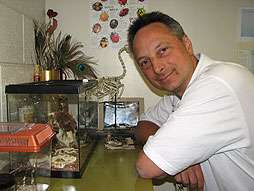
Marvin Gunderman has cockroaches in his office, but he won't be calling the exterminator any time soon. The cockroaches are his pets, not pests. Gunderman, also known as the "bug man," is an insect aficionado.
As technical coordinator, curator of entomology and insect taxonomist in the Department of Biology, Gunderman is as happy as a bug in a rug.
"I'm a very happy guy," he says. "I'm getting paid to do what I love. Not many people can say that."
His office is a plethora of insect paraphernalia. The walls are covered with bug posters and display cases filled with pinned insects. Bug books line his bookcases. He even has a bug on his mug.
Gunderman's fascination with the insect world started in childhood. He began collecting them in jars at the age of 10. By his teens, he was making his own displays out of cigar boxes, sewing pins and handwritten labels. While attending McMaster, he took every course on invertebrates he could find, graduating with a B.Sc. in 1983, followed by an M.Sc. He began working at McMaster in 1989.
Digital photography has taken his passion for bugs to another level. He explained that while children enjoy catching bugs and keeping them in jars, eventually resulting in the bug's demise, photography allows him to observe bugs in their natural habitat without killing them.
Gunderman gets bug-eyed over beetles, but not just any beetles. Tiger beetles are his favourite.
"They're the most beautiful insects I've ever seen," he says. A tiger beetle even graces his business cards. And that bug on his mug? It's a tiger beetle too.
The biggest misconception about bugs is that "they're all harmful, they all bite, and they're all poisonous," says Gunderman. He adds that only two per cent of insects fall into these categories, and all insects are "vitally important to all ecosystems."
Gunderman assists with bug-related courses at McMaster and teaches a summer course on insect taxonomy at the Queen's University Biological Station.
He also takes his bug collection on tour to local schools.
"I like to work with young kids and get them to love insects, which they usually do, before their parents instill fear," he explains.
So the next time you see a spider in your home, resist the urge to squish it. Just leave it alone, Gunderman advises. The eight-legged exterminators eat other bugs.
Source: McMaster University


