What lies beneath: new research looks deep into the centre of the Earth
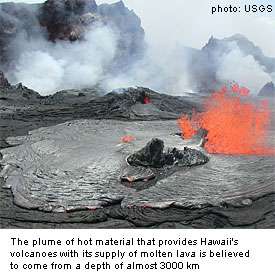
New research published this week on the evolution of volcanoes sheds light on what lies deep beneath the Earth's surface. The research, published in Nature, suggests that the plume of hot material that provides Hawaii's volcanoes with its continuous supply of molten lava originates from a depth of almost 3000 km, at the border between the Earth's core and its rocky mantle. This is far deeper than had been thought possible by many scientists.
Plumes are hot, narrow currents that well up in the mantle and which are responsible for the formation of long chains of volcanoes such as those of the Hawaiian Islands. The question of whether plumes rise from the boundary between the core of the Earth and the mantle that surrounds it, or from a much shallower boundary layer within the mantle, has been hotly debated for more than a quarter of a century.
The new research proved the presence of material from the Earth's core by using a new type of mass spectrometer to analyse the isotope signature of the element thallium in Hawaiian volcanic rocks. Isotope analysis can reveal the physical, chemical and biological processes to which a single element has been subjected.
Dr Mark Rehkamper, from Imperial College London's Department of Earth Sciences and Engineering and the senior author of the research, said: "It is only recently that scientists have developed the ability to analyse these volcanic rocks in enough detail to reveal exactly where in the Earth's interior they came from. The previous evidence has unfortunately been quite ambiguous but our new thallium isotope results are now able to conclusively rule out some of the alternative models. What remains is clear evidence of interaction between the Earth's core and mantle."
The evidence that plumes originate at the core-mantle boundary suggests that the mantle constitutes one big convective system, like a soup being continuously stirred, rather than being made up of several layers. It also reveals that sedimentary material from the Earth's surface is subducted into the mantle to make its way back to the surface in the plumes, over time periods of one or two billion years.
Previous analysis of volcanic rocks from Hawaii looked at the isotope signature of the element osmium in them and appeared to show that material from the earth's core was present. However, some scientists argued that the presence of core material was due to contamination of the mantle plume with sediments from the Earth's surface. The new research demonstrates that the quantities of sedimentary material were much too low for this to be the case.
The research was carried out by scientists at Imperial College London, ETH Zurich, Macquarie University, the Australian National University and the University of Oxford. It was funded by ETH Zurich, Schweizerische Nationalfonds and the Danish Research Agency.
Source: Imperial College, University of London


