From mirror to mist: Cracking the secret of fracture instabilities
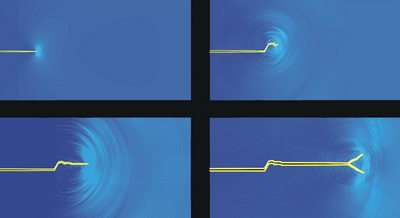
Researchers from Max Planck Institute for Metals Research and Massachusetts Institute of Technology have performed atom-by-atom investigations of how cracks propagate in brittle materials.
Scientists from the Max Planck Institute for Metals Research in Stuttgart, Germany and the Massachusetts Institute of Technology in Cambridge, Massachusetts have simulated the atomistic details of how cracks propagate in brittle materials and gained significant insight into the physics of dynamical fracture instabilities. They have shown quantitatively that fracture instabilities are controlled by the properties of materials under extreme deformation conditions near a moving crack tip (Nature, January 19, 2006).
Their study further shows that in rubber-like materials that stiffen with strain, cracks can move at speeds faster than the Rayleigh-wave speed while creating mirror-like surfaces. These findings may have significant implications on the understanding of fracture in different materials at different scales, from nano-materials to airplanes, buildings or even earthquake dynamics.
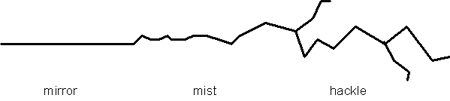
Scientists have been trying for decades to describe how cracks spread in materials. Experiments have shown that crack propagation in brittle materials involves a transition from mirror-smooth fracture surfaces at low crack speeds to increasingly rough and irregular surfaces at higher speeds (see images). This instability of dynamic fracture can be seen in a wide variety of brittle materials including ceramics, glasses, polymers and semiconductors.
Now, Markus Buehler of the Massachusetts Institute of Technology and Huajian Gao of the Max Planck Institute for Metals Research have performed careful, quantitative studies of dynamic fracture instabilities based on large-scale molecular dynamics simulations.
"Our atomistic simulations show that the key to understand the experimental observations reported in the literature is to consider the material behaviour close to the breaking of bonds." Most existing theories of fracture are based on small material deformation, assuming a linear relationship between stress and strain. However, the relation between stress and strain in real solids is strongly nonlinear due to large deformation near a moving crack tip. This fact stems from the details of atomistic or molecular interactions in materials.
Based on their modelling work, they have proposed a simple model that is an extension of existing theories, referred to as the modified instability model. "Our new model reduces to existing theories in limiting cases, but allows a unified treatment of the instability problem applicable to a much wider range of materials," says Markus Buehler. In materials like ceramics, metals or silicon that strongly soften close to bond breaking, the hyperelastic effect leads to a reduction in local wave speed, which results in decreased energy transport to the crack tip, and reduced instability speeds.
The scientists have made another surprising observation. "We find that elastically stiffening rubber-like materials can dramatically change the instability dynamics of cracks," says Markus Buehler. Rubber is rather soft at small deformation, and becomes harder as the stretch is increased. "In elastically stiffening materials, stable crack motion at super-Rayleigh crack speeds is possible." These results are in clear contrast to any existing theories, in which the speed of elastic waves is considered to be the limiting speed of fracture. Recent experimental results of fracture experiments in rubber have also shown cracks exceeding the shear wave speed.
The main contribution described in the paper is the development of a more complete understanding of dynamic fracture, leading to significant insight into the physics of dynamical fracture instabilities. Their findings could have wide impact in many scientific and engineering disciplines. This work may help to improve the understanding of how materials break at different scales, ranging from nanomaterials to buildings, as well as the understanding of earthquakes.
Source: Max-Planck-Gesellschaft


