Spacecraft, heal thyself
January 20, 2006 Spacecraft, heal thyself

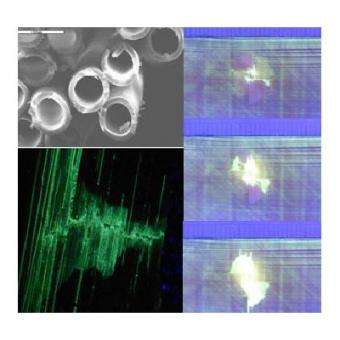
Hollow fibres just 30 micrometres in diameter tread the new material. When damage occurs, the fibres break releasing liquids that seep into the cracks and harden, repairing the damage. Credits: ESA

Building spacecraft is a tough job. They are precision pieces of engineering that have to survive in the airless environment of space, where temperatures can swing from hundreds of degrees Celsius to hundreds of degree below zero in moments. Once a spacecraft is in orbit, engineers have virtually no chance of repairing anything that breaks. But what if a spacecraft could fix itself?

Thanks to a new study funded by ESA's General Studies Programme, and carried out by the Department of Aerospace Engineering, University of Bristol, UK, engineers have taken a step towards that amazing possibility. They took their inspiration from nature. "When we cut ourselves we don't have to glue ourselves back together, instead we have a self-healing mechanism. Our blood hardens to form a protective seal for new skin to form underneath," says Dr Christopher Semprimoschnig, a materials scientist at ESA's European Space Technology Research Centre (ESTEC) in the Netherlands, who oversaw the study.

He imagined such cuts as analogous to the 'wear-and-tear' suffered by spacecraft. Extremes of temperature can cause small cracks to open in the superstructure, as can impacts by micrometeroids - small dust grains travelling at remarkable speeds of several kilometres per second. Over the lifetime of a mission the cracks build up, weakening the spacecraft until a catastrophic failure becomes inevitable.

The challenge for Semprimoschnig was to replicate the human process of healing small cracks before they can open up into anything more serious. He and the team at Bristol did it by replacing a few percent of the fibres running through a resinous composite material, similar to that used to make spacecraft components, with hollow fibres containing adhesive materials. Ironically, to make the material self-repairable, the hollow fibres had to be made of an easily breakable substance: glass. "When damage occurs, the fibres must break easily otherwise they cannot release the liquids to fill the cracks and perform the repair," says Semprimoschnig.

In humans, the air chemically reacts with the blood, hardening it. In the airless environment of space, alternate mechanical veins have to be filled with liquid resin and a special hardener that leak out and mix when the fibres are broken. Both must be runny enough to fill the cracks quickly and harden before it evaporates.

"We have taken the first step but there is at least a decade to go before this technology finds its way onto a spacecraft," says Semprimoschnig, who believes that larger scale tests are now needed. The promise of self-healing spacecraft opens up the possibility of longer duration missions. The benefits are two-fold. Firstly, doubling the lifetime of a spacecraft in orbit around Earth would roughly halve the cost of the mission. Secondly, doubling spacecraft lifetimes means that mission planners could contemplate missions to far-away destinations in the Solar System that are currently too risky.

In short, self-healing spacecraft promise a new era of more reliable spacecraft, meaning more data for scientists and more reliable telecommunication possibilities for us all.

Source: ESA


print this article email this article download pdf blog this article bookmark this article     Stumble it Digg this share on Facebook retweet share on Reddit add to delicious
Rate this story - 4.8 /5 (28 votes)


January 20, 2006 all stories

Comments: 0

4.8 /5 (28 votes)
  • Stumble this up

  • Digg this

  • share this

  • hide
  • Related Stories

  • How the moon got its stripes
    created Jul 15, 2009 | popularity not rated yet | comments 0
  • Jets on Saturn's moon Enceladus not geysers from underground ocean
    created Jun 24, 2009 | popularity not rated yet | comments 0
  • Supercooled and supersized technologies aboard Herschel and Planck
    created May 11, 2009 | popularity not rated yet | comments 0
  • Slicing solar power costs: New method cuts waste in making most efficient solar cells
    created Sep 15, 2008 | popularity not rated yet | comments 0
  • Phoenix Close-Up Images of 'Snow Queen' Show Changes
    created Jul 30, 2008 | popularity not rated yet | comments 0


Other News

Planetary Society plans new 'solar sail'

Space & Earth / Space Exploration

created 14 hours ago | popularity 4.9 / 5 (7) | comments 0

(AP) -- Four years after its first solar sail ended up in the ocean instead of orbit, The Planetary Society announced Monday that by the end of 2010 it will try again to launch a spacecraft that will be propelled by the ...


Controversial new climate change results

Controversial new climate change results

Space & Earth / Environment

created 3 hours ago | popularity 5 / 5 (1) | comments 3

(PhysOrg.com) -- New data show that the balance between the airborne and the absorbed fraction of CO2 has stayed approximately constant since 1850, despite emissions of CO2 having risen from about 2 billion ...


L-R: Chiwetel Ejiofor, Amanda Peet and John Cusack at the premiere of "2012"

NASA on crusade to debunk 2012 apocalypse myths

Space & Earth / Space Exploration

created 19 hours ago | popularity 4.5 / 5 (2) | comments 3

The world is not coming to an end on December 21, 2012, the US space agency insisted Monday in a rare campaign to dispel widespread rumors fueled by the Internet and a new Hollywood movie.


NASA satellites make a movie and get rainfall, wind info on Ida

NASA satellites make a movie and get rainfall, wind info on Ida (w/ Video)

Space & Earth / Earth Sciences

created 19 hours ago | popularity not rated yet | comments 0

NASA satellites are amazing examples of technology. The TRMM satellite peers into tropical cyclones and can tell how much rain is falling per hour and where. QuikScat uses microwave technology to measure Ida's ...


The GOES-12 satellite sees Large Hurricane Ida nearing landfall

The GOES-12 satellite sees Large Hurricane Ida nearing landfall

Space & Earth / Earth Sciences

created 20 hours ago | popularity 5 / 5 (1) | comments 0

Residents of the U.S. Gulf coast thought they were getting a break this hurricane season until Ida showed up. Today, November 9, Ida is a hurricane and is headed for a landfall in the western Florida Panhandle ...