Plasma vessel for Wendelstein 7-X fusion experiment ready
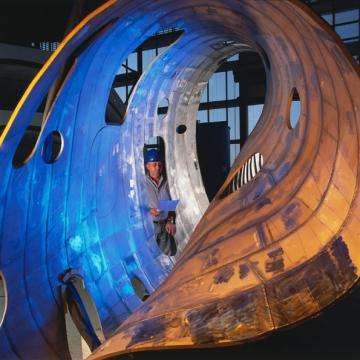
The first large production order for the Wendelstein 7-X fusion experiment, construction of the plasma chamber, has been successfully completed: The 20 sectors of the bizarrely shaped 35-ton vessel were assembled from several hundred individual components – an engineering masterpiece. Installation of the whole complex device, which started in spring 2005 at the Greifswald branch of Max Planck Institute of Plasma Physics, will take about six years.
The aim of fusion research is to derive energy from fusion of atomic nuclei like the sun. To ignite the fusion fire the fuel in a future power plant, a hydrogen plasma, has to be confined in magnetic fields and heated to temperatures of over 100 million degrees. Wendelstein 7-X, which on completion will be the biggest fusion device of the stellarator type in the world, is aimed at investigating the suitability of this concept for application in power plants.
The plasma vessel was produced in 20 sections by MAN DWE GmbH at Deggendorf, Germany, four of which are already in use at IPP for installing the experiment. The assembled ring-shaped plasma chamber with a diameter of about 12 metres will later confine the plasma heated to 100 million degrees. The shape of the vessel is matched to the twisting plasma ring. This peculiar shape in conjunction with the high precision required constitutes a major challenge for production: tolerances of less than 3 millimetres being called for in some cases.
In order to fashion the bizarre shape from steel, the 35-ton vessel was assembled from 200 individual rings. Each ring, in turn, is composed of several finger-thick steel strips 18 centimetres wide which are multiply bent in keeping with the twisting contours. The more than 800 individual components of the vessel are joined vacuum-proof by more than 1,600 metres of brazing. For this purpose the components to be connected were placed in exactly defined positions two millimetres apart, the gaps being closed by hand with several adjacent and superposed brazed layers of wire – a total of several kilometres of brazing wire being used in the process.
The 299 ports through which later the plasma is to be observed and heated and heat-loaded wall areas are to be cooled were then cut out of the vessel sections with a sharp water beam. Each of the 20 sectors was fitted inside with holders for the later wall cladding and outside with cooling and heating pipes. All vessel segments and pipes were then tested for ultra-high vacuum proofing. Production was accompanied from the outset by three-dimensional measurement with the laser tracker, ensuring that the prescribed shape had indeed been exactly attained: “The asymmetric shape in conjunction with the high precision required makes all this”, states Bernd Hein, the IPP engineer responsible for the plasma vessel, “a feat of construction bordering on the technically feasible that called for supreme craftsmanship from the team”.
When the experiment is ready, the plasma vessel will be enclosed inside a wreath of 70 super-conducting magnet coils that generate the magnetic cage keeping the plasma suspended away from the interior walls of the plasma vessel. The coil wreath, in turn, is enclosed by a thermally insulating outer sheath. Superinsulation encloses the vacuum between the plasma vessel and outer vessel and separates the magnet coils, cooled to superconduction temperature with liquid helium, from their hot surroundings. The whole device is composed of five almost structurally identical modules, each pre-assembled and then joined up in the experimentation hall to form a ring. Installation of Wendelstein 7-X, started in spring 2005, will take about six years.
Source: Max Planck Institute of Plasma Physics


