Fruit Bats are not 'Blind as a Bat'
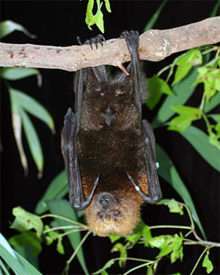
The retinas of most mammals contain two types of photoreceptor cells, the cones for daylight vision and colour vision, and the more sensitive rods for night vision. Nocturnal bats were traditionally believed to possess only rods. Now scientists at the Max Planck Institute for Brain Research in Frankfurt and at The Field Museum for Natural History in Chicago have discovered that nocturnal fruit bats (flying foxes) possess cones in addition to rods. Hence, fruit bats are also equipped for daylight vision.
The researchers conclude that cone photoreceptors might be useful for spotting predators and for social interactions at periods of roosting during the day. Flying foxes often use exposed treetops as daytime roosts, where they assemble in large colonies.
The mammalian order bats (Chiroptera) has two suborders, microbats (Microchiroptera) and fruit bats or flying foxes (Megachiroptera). In contrast to microbats, fruit bats do not echolocate. They have large eyes and pronounced visual centres in the brain. Fruit bats need a good sense of vision, because when they forage at night for nectar and fruit, they orient by vision and the sense of smell. During the flights to the foraging grounds at dusk and the return to the daytime roost at dawn, the animals navigate solely by vision. On moonless nights, fruit bats cannot fly and stay hungry. Visual navigation at twilight and sometimes also during the daytime did not fit the older view that fruit bats only possess rods, the photoreceptors for night vision. This prompted Brigitte Müller and Leo Peichl of the Max Planck Institute for Brain Research in Frankfurt/Main and Steven Goodman from The Field Museum for Natural History in Chicago to study the photoreceptors of fruit bats with modern histological methods.
To identify the different photoreceptor types, the researchers stained the retinas of various fruit bat species with visual pigment-specific antibodies. As expected, all megabats had high densities of rod photoreceptors, the prerequisite for nocturnal visual orientation. In addition, all species could be shown to possess cone photoreceptors, comprising about 0.5 percent of the photoreceptors. "This share of cones appears small, but from studies of other night-active mammals we know that it allows daylight vision", says lead author Brigitte Müller. For example, cats and dogs only have two to four percent cones, and even the diurnal human retina contains an average of only five percent cones. "The retina of flying foxes is no ‘evolutionary quirk’, but conforms to the general mammalian blueprint that comprises rods and cones", says Müller.
The studied flying fox species (genus Pteropus) were shown to have two spectral cone types, the so-called blue cones that detect short-wave light, and the so-called green cones that detect middle-to-long-wave light. With these two cone types, flying foxes have the prerequisite for dichromatic colour vision, the common mammalian condition. Curiously, the retinas of the three other studied genera Rousettus (rousette fruit bat), Eidolon (straw coloured fruit bat), and Epomophorus (epauleted fruit bat) completely lack blue cones, they possess only green cones. "With just one cone type, spectral discriminations are not possible, so these species must be colour blind", says Leo Peichl. "A loss of blue cones is a rare event in evolution, it has been found in only a few mammals." The scientists conclude that for the three affected fruit bat genera colour vision is less crucial than for the flying foxes.
Flying foxes (Pteropus) have their daytime roosts in large open treetops, where they are exposed to birds of prey. Here, a visual ‘early warning’ helps survival. "Furthermore, flying foxes don’t sleep all day; they often change their positions in the tree and interact with their neighbours. Young flying foxes also make training flights during the day. All these daytime activities require visual capabilities", says Brigitte Müller. In contrast, Rousettus roosts in caves, and Epomophorus in the darkest parts of large trees. That may explain why these genera have somewhat smaller eyes, lower cone densities, and no colour vision. "In our outdoor enclosures, flying foxes roost openly during daytime, whereas the other genera retreat to darkened sleeping cubicles", relates Dana LeBlanc of the Lubee Bat Conservancy in Florida. As useful as the cones are during daylight, they don’t help the fruit bats in their search for food. At night, all mammals depend on the more sensitive rods that convey no colour information.
Citation: Brigitte Müller, Steven M. Goodman & Leo Peichl, Cone photoreceptor diversity in the retinas of fruit bats (Megachiroptera), Brain, Behavior and Evolution 70: 90-104 (2007)
Source: Max Planck Institute for Brain Research


