The woes of Kilimanjaro: Don't blame global warming
June 12th, 2007 The woes of Kilimanjaro: Don't blame global warming

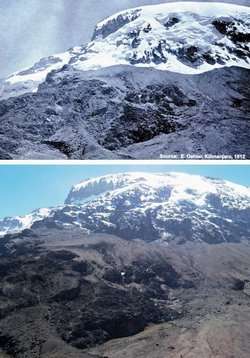
A photograph by Edward Oehler taken in 1912 (top) shows the extent of the icecap atop Mount Kilimanjaro, and a similar photo taken in 2006 by Georg Kaser illustrates the icecap's decline.

The "snows" of Africa's Mount Kilimanjaro inspired the title of an iconic American short story, but now its dwindling icecap is being cited as proof for human-induced global warming.

However, two researchers writing in the July-August edition of American Scientist magazine say global warming has nothing to do with the decline of Kilimanjaro's ice, and using the mountain in northern Tanzania as a "poster child" for climate change is simply inaccurate.

"There are dozens, if not hundreds, of photos of midlatitude glaciers you could show where there is absolutely no question that they are declining in response to the warming atmosphere," said climatologist Philip Mote, a University of Washington research scientist.

But in the tropics -- particularly on Kilimanjaro -- processes are at work that are far different from those that have diminished glacial ice in temperate regions closer to the poles, he said.

Mote and Georg Kaser, a glaciologist at the University of Innsbruck in Austria, write in American Scientist that the decline in Kilimanjaro's ice has been going on for more than a century and that most of it occurred before 1953, while evidence of atmospheric warming there before 1970 is inconclusive.

They attribute the ice decline primarily to complex interacting factors, including the vertical shape of the ice's edge, which allows it to shrink but not expand. They also cite decreased snowfall, which reduces ice buildup and determines how much energy the ice absorbs -- because the whiteness of new snow reflects more sunlight, the lack of new snow allows the ice to absorb more of the sun's energy.

Unlike midlatitude glaciers, which are warmed and melted by surrounding air in the summer, the ice loss on Kilimanjaro is driven strictly by solar radiation. Since air near the mountain's ice almost always is well below freezing, there typically is no melting. Instead ice loss is mainly through a process called sublimation, which requires more than eight times as much energy as melting. Sublimation occurs at below-freezing temperatures and converts ice directly to water vapor without going through the liquid phase. Mote likens it to moisture-sapping conditions that cause food to suffer freezer burn.

Fluctuating weather patterns related to the Indian Ocean also could affect the shifting balance between the ice's increase, which might have occurred for decades before the first explorers reached Kilimanjaro's summit in 1889, and the shrinking that has been going on since.

Glaciers in more temperate latitudes have declined sharply as the troposphere around them has warmed (the troposphere is the atmospheric layer from the Earth's surface to about 10 miles in altitude). The best example of a glacier declining because of atmospheric warming might be the South Cascade Glacier in Washington state, perhaps the most-studied glacier in North America. Photographs by government scientists in 1928 and in 2000, along with detailed surveys, showed that the glacier lost half its mass during that time. Similar evidence exists for a number of other glaciers, Mote said.

But in their analysis of already published research, Kaser and Mote say the same factors do not apply to Kilimanjaro's icecap, even though its decline has been cited in forums such as the Academy Award-winning documentary film "An Inconvenient Truth."

"There is no evidence to support that assertion," Mote said. "It's not that it is impossible, but rather the decline is most likely associated with processes dominated by sublimation and with an energy balance dominated by solar radiation, rather than by a warmer troposphere."

The volcano Kibo is the highest point on Kilimanjaro, about 19,340 feet above sea level. A rough survey in 1889 suggested that Kibo's icecap occupied about 12.5 square miles. By 1912, more than two decades before Ernest Hemingway wrote his masterpiece short story "The Snows of Kilimanjaro," it had dwindled to about 7.5 square miles. By 1953 it had shrunk to about 4.3 square miles and by 2003 it was at a little more than 1.5 square miles.

The level of nearby Lake Victoria, the world's largest tropical freshwater lake, also declined in the late 19th century, when the decline of Kibo's icecap began. The lake and the icecap likely suffer from a precipitation decline caused by Indian Ocean variability, which also could also have caused the icecap to vary in size and shape over millennia, Mote said.

"It is certainly possible that the icecap has come and gone many times over hundreds of thousands of years," he said. "But for temperate glaciers there is ample evidence that they are shrinking, in part because of warming from greenhouse gases."

Source: University of Washington


print this article email this article download pdf blog this article bookmark this article     Digg this Stumble it share on Facebook share on Reddit add to delicious save to Yahoo! bookmarks
4.4/5 after 25 votes

Rank Filter

Move the slider to adjust rank threshold, so that you can hide some of the comments.


Display comments: newest first

  • Ragtime - Jan 13, 2008
    • Rank: 1 / 5 (2)
    The article simple means: the Kilimanjaro ice doesn't melt. It rather sublimes, because of high altitude, by the same way, like the glaciers in Tibet are disapearing.

    The global reason still reamains the very same: more heat and less water.

June 12th, 2007 all stories
Space & Earth / Earth Sciences

Comments: 1
Rank: 4.4/5 after 25 votes

  • Stumble this up

  • Digg this

  • Share it:
  • share on Facebook
  • share on MySpace
  • share on Slashdot
  • rss-newsfeed
  • share on Google
  • share on Reddit
  • add to delicious
  • save to Yahoo! bookmarks
  • share on Windows Live
  • Add to Mixx!
Rating: 4.4/5 after 25 votes

  • Related Stories

  • What is really happening to the Greenland icecap?
    created Nov 03, 2008 | popularity not rated yet | comments 0
  • Scientists probe Antarctic glaciers for clues to past and future sea level
    created Oct 28, 2008 | popularity not rated yet | comments 0
  • Oldest DNA Ever Recovered Suggests Earth Was Warmer
    created Jul 05, 2007 | popularity not rated yet | comments 0
  • Nature study explains mystery of Mars icecaps
    created May 14, 2005 | popularity not rated yet | comments 0
  • Mars data published in Science this week
    created Jul 02, 2009 | popularity not rated yet | comments 0

Tags


  • Physicists Demonstrate Quantum Memory with Matter Qubits
    Physicists Demonstrate Quantum Memory with Matter Qubits
    Physics / General Physics
    created Jul 03, 2009 | popularity 4.4 / 5 (17) | comments 1
  • 'Holey' Nanosheets for Wastewater Dye Removal
    Nanotechnology / Nanomaterials
    created Jul 01, 2009 | popularity 5 / 5 (5) | comments 1
  • Jellyfish Robot Swims Like its Biological Counterpart
    Jellyfish Robot Swims Like its Biological Counterpart
    Electronics / Robotics
    created Jun 26, 2009 | popularity 4.4 / 5 (8) | comments 1
  • Could Maxwell's Demon Exist in Nanoscale Systems?
    Could Maxwell's Demon Exist in Nanoscale Systems?
    Physics / General Physics
    created Jun 24, 2009 | popularity 4.4 / 5 (18) | comments 29
  • Living Safely with Robots, Beyond Asimov's Laws
    Living Safely with Robots, Beyond Asimov's Laws
    Electronics / Robotics
    created Jun 22, 2009 | popularity 4.6 / 5 (52) | comments 40
  • Other News

    Forty years ago man first walked on the moon

    Space & Earth / Space Exploration

    created 6 hours ago | popularity 5 / 5 (2) | comments 0

    Forty years ago on July 20, 1969, American astronaut Neil Armstrong realized the oldest dream of human civilizations when he became the first man to walk on the moon.


    The least sea ice in 800 years

    The least sea ice in 800 years

    Space & Earth / Earth Sciences

    created Jul 01, 2009 | popularity 4.3 / 5 (59) | comments 52

    New research, which reconstructs the extent of ice in the sea between Greenland and Svalbard from the 13th century to the present indicates that there has never been so little sea ice as there is now. The ...


    Gas around young galaxy

    Intense heat killed the Universe's would-be galaxies, researchers say

    Space & Earth / Astronomy

    created Jul 01, 2009 | popularity 3.2 / 5 (19) | comments 25

    (PhysOrg.com) -- Our Milky Way galaxy only survived because it was already immersed in a large clump of dark matter which trapped gases inside it, scientists led by Durham University's Institute for Computational ...


    Scientists' Drill Hits Magma: Only Third Time on Record

    Scientists' Drill Hits Magma: Only Third Time on Record

    Space & Earth / Earth Sciences

    created Jun 29, 2009 | popularity 4.7 / 5 (20) | comments 19

    (PhysOrg.com) -- Scientists drilling a borehole deep into Iceland’s rocky crust to explore new methods of using geothermal energy hit a major roadblock on Thursday: Their drill ran into molten rock at a depth ...


    NASA manager pitches a cheaper return-to-moon plan

    Space & Earth / Space Exploration

    created Jun 30, 2009 | popularity 4 / 5 (7) | comments 18

    (AP) -- Like a car salesman pushing a luxury vehicle that the customer no longer can afford, NASA has pulled out of its back pocket a deal for a cheaper ride to the moon.