Toshiba Develops New NAND Flash Technology
June 12, 2007 Toshiba Develops New NAND Flash Technology

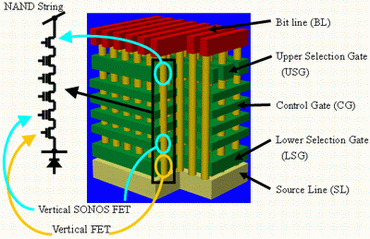
The structure of the new memory cell.

Toshiba Corporation today announced a new three dimensional memory cell array structure that enhances cell density and data capacity without relying on advances in process technology, and with minimal increase in the chip die size. In the new structure, pillars of stacked memory elements pass vertically through multi-stacked layers of electrode material and utilize shared peripheral circuits. The innovative design is a potential candidate technology for meeting future demand for higher density NAND flash memory.

Typically, advances in memory density reflect advances in process technology. Toshiba’s new approach is based on innovations in the stacking process. Existing memory stacking technologies simply stack two-dimensional memory array on top of another, repeating the same set of processes.

While this achieves increased memory cell density, it makes the manufacturing process longer and more complex. The new array does increase memory cell density, is easier to fabricate, and does not produce much increase in chip area, as peripheral circuits are shared by several silicon pillars.

Toshiba’s cutting edge etching technology drives a through-hole down through a stacked substrate, i.e. a multi-layer sandwich of gate electrodes and insulator films. Pillars of silicon lightly doped with impurities are deposited to fill in the holes. The gate electrode wraps around the silicon pillar at even intervals, and a pre-formed nitride film for data-retention, set in each joint, functions as a NAND cell.

Toshiba's new method has a SONOS structure-- silicon-oxide-nitride-oxide- silicon --and the electrical charge is held in the silicon-nitride film, which is formed inside gate holes. Traps are formed to lock the electrical charge inside the silicon-nitride film.

NAND flash memory functions through batch processing of cells, in large numbers of elements connected in series. Toshiba’s new array increases density without increasing chip dimension, as the number of connected elements increases in direct proportion to stack height. For example, a 32-layer stack realizes 10 times the integration of a standard chip formed with the same generation of technology.

Toshiba will further develop this elemental technology to the level where it matches current structures in terms of security and reliability.

This announcement was presented in the VLSI symposium on June 12.

Source: Toshiba


print this article email this article download pdf blog this article bookmark this article     Stumble it Digg this share on Facebook retweet share on Reddit add to delicious
Rate this story - 4.7 /5 (14 votes)


June 12, 2007 all stories

Comments: 0

4.7 /5 (14 votes)
  • Stumble this up

  • Digg this

  • share this

  • hide
  • Related Stories


  • hide
  • Relevant PhysicsForums posts

  • Fourier transform same as signal.
    created 3 hours ago
  • Calculating temperature rise of aluminum wire
    created 13 hours ago
  • Help Understanding Power in Circuits
    created 19 hours ago
  • phone antenna design
    created 22 hours ago
  • More from Physics Forums - Electrical Engineering

Other News

Selling chip makers on optical computing

Selling chip makers on optical computing

Technology / Semiconductors

created 13 hours ago | popularity 4.9 / 5 (7) | comments 1

(PhysOrg.com) -- Computer chips that transmit data with light instead of electricity consume much less power than conventional chips, but so far, they've remained laboratory curiosities. Professors Vladimir ...


Facebook creates dual-class structure, but no IPO (AP)

Facebook creates dual-class structure, but no IPO

Technology / Business

created 9 hours ago | popularity 1 / 5 (1) | comments 0

(AP) -- Facebook has created a dual-class stock structure designed to give founder Mark Zuckerberg and other existing shareholders control over the company.


Taking the drudgery out of software development

Taking the drudgery out of software development

Technology / Software

created 10 hours ago | popularity 3.3 / 5 (4) | comments 1

(PhysOrg.com) -- Software developers will no longer have to reinvent the wheel when writing new programs and applications thanks to a clever new set of tools and a central repository of 'building blocks'.


Software takes a hard look at traffic fatalities

Technology / Software

created 5 hours ago | popularity not rated yet | comments 0

Bergen County Police and a Hackensack, N.J., drug treatment center are among a growing number of agencies using a software program to identify dangerous intersections, spot teen driving trends and reduce accident fatalities.


Google, Yahoo zero in on Internet 'freedom' bill

Technology / Internet

created 8 hours ago | popularity 4 / 5 (1) | comments 1

Google Inc. and other Internet companies have zeroed in on a resilient effort by a Republican lawmaker to pass legislation that could restrict their ability to take a nuanced approach to operating in "repressive" foreign ...