Towards Molecular Electronics: New Way of Making Molecular Transistors
January 20th, 2006 Towards Molecular Electronics: New Way of Making Molecular Transistors

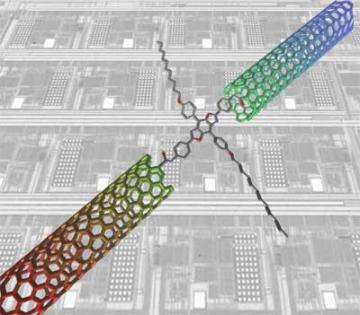
A digital rendering of two carbon nanotubes linked by a single organic molecule. Such arrangements are much smaller than the traditional integrated circuit.

Researchers at Columbia University's Nanoscience Center are on the verge of solving one of the most vexing barriers facing advances in molecular electronics: incorporating individual molecules into functional nanoscale devices and exploiting their electrical and chemical properties.

Scientists have long been intrigued by carbon nanotubes, tiny straws of pure carbon measuring less than a hair's width across. Successfully linking them in stable arrangements would allow for an impressive increase in both the speed and power of a variety of electronics. This new research at Columbia sets the stage for advances in real-time diagnosis and disease treatment, surgical robotics, and information storage and retrieval, potentially rendering room-sized supercomputers obsolete.

In the Jan. 20, 2006, issue of Science, Columbia scientists explain how they have developed a unique way to connect the ends of carbon nanotubes by forming robust molecular bridges between them. The Columbia team was able to combine the best qualities of carbon nanotubes and organic molecules in a single electronic switch, the journal reported.

Previously, researchers working in this area of nanotechnology have made transistors out of carbon nanotubes with switches connecting molecules to metal wire leads. This Columbia research illustrates a more elegant way of making molecular transistors, since the nanotube leads are already the same size as the molecules, and they are made of carbon, making it easier to connect them chemically.

This new method of wiring molecules into the gaps of single-walled carbon nanotubes employs oxidative cutting -- a lithographic technique that makes each cut-end of the nanotube more prone to molecular bonding. These new methods of constructing molecular bridges could one day revolutionize the size and scale of computer hardware by allowing engineers to design circuits at the nanoscale limits. The Columbia research, involving the ability to link nanotubes with an incredibly small diameter, brings scientists closer to creating miniature devices that also process information with molecules.

"Molecular electronics has real-world relevance," says Colin Nuckolls, an associate professor of chemistry, and a co-author of the Science paper. "It opens the door to new types of ultrasmall switches and sensors. We are able to form a bridge, both literally and figuratively, by combining reaction chemistry with ultrafine lithography."

The nanotubes themselves are long, thin cylinders of carbon unique for their size, shape and physical structure. They can be thought of as a sheet of graphite forming a hexagonal lattice of carbon, (see image) rolled into a tube, explains Columbia senior research scientist Shalom Wind, another co-author of the paper. They have been shown to possess remarkable mechanical and electronic properties, he added.

Attaching molecular wires to single-walled nanotubes involves cutting a tube using nanolithography combined with a localized oxidation process that leaves a nanotube with two ends that are capped with carbon-based acid groups and separated by a molecule-sized gap. In that tiny space, a molecule can be chemically joined with each end to form a robust nanotube/molecule complex, which operates as a nanoscale transistor.

The nature of this work is also expected to keep alive "Moore's Law," the prediction made in 1965 by Intel co-founder Gordon Moore who predicted the number of transistors per square inch on integrated circuits would double every year. Moore said the trend would continue for the foreseeable future; but without an order-of-magnitude shift in the scale of computer circuitry -- a promise represented in Columbia's latest work–that prediction could hit a wall in the next decade, experts say.

Source: Columbia University (By Alex Lyda)


print this article email this article download pdf blog this article bookmark this article     Digg this Stumble it share on Facebook share on Reddit add to delicious save to Yahoo! bookmarks
4.4/5 after 43 votes


January 20th, 2006 all stories
Nanotechnology /

Comments: 0
Rank: 4.4/5 after 43 votes

  • Stumble this up

  • Digg this

  • Share it:
  • share on Facebook
  • share on MySpace
  • share on Slashdot
  • rss-newsfeed
  • share on Google
  • share on Reddit
  • add to delicious
  • save to Yahoo! bookmarks
  • share on Windows Live
  • Add to Mixx!
Rating: 4.4/5 after 43 votes

  • Related Stories

  • Nanotubes weigh the atom
    created Jun 29, 2009 | popularity not rated yet | comments 0
  • Scientists report significant advances in flexible electronics research
    created Jun 18, 2009 | popularity not rated yet | comments 0
  • World's smallest incandescent (nano)lamp with carbon nanotube filament
    created May 06, 2009 | popularity not rated yet | comments 0
  • Fitter frames: Nanotubes boost structural integrity of composites
    created Mar 26, 2009 | popularity not rated yet | comments 0
  • Scientists Track Heat in Tiny Rolls of Carbon Atoms
    created Mar 02, 2009 | popularity not rated yet | comments 0

Tags


  • Physicists Demonstrate Quantum Memory with Matter Qubits
    Physicists Demonstrate Quantum Memory with Matter Qubits
    Physics / General Physics
    created Jul 03, 2009 | popularity 4.4 / 5 (17) | comments 1
  • 'Holey' Nanosheets for Wastewater Dye Removal
    Nanotechnology / Nanomaterials
    created Jul 01, 2009 | popularity 5 / 5 (5) | comments 1
  • Jellyfish Robot Swims Like its Biological Counterpart
    Jellyfish Robot Swims Like its Biological Counterpart
    Electronics / Robotics
    created Jun 26, 2009 | popularity 4.4 / 5 (8) | comments 1
  • Could Maxwell's Demon Exist in Nanoscale Systems?
    Could Maxwell's Demon Exist in Nanoscale Systems?
    Physics / General Physics
    created Jun 24, 2009 | popularity 4.4 / 5 (18) | comments 29
  • Living Safely with Robots, Beyond Asimov's Laws
    Living Safely with Robots, Beyond Asimov's Laws
    Electronics / Robotics
    created Jun 22, 2009 | popularity 4.6 / 5 (52) | comments 40
  • Other News

    A 'quantum of sol' -- how nanotechnology could hold the key to a solar-powered future

    A 'quantum of sol' -- how nanotechnology could hold the key to a solar-powered future

    Nanotechnology / Nanomaterials

    created Jun 30, 2009 | popularity 3.9 / 5 (14) | comments 16

    (PhysOrg.com) -- A new generation of 'nano-structured' millimetre-sized solar cells that could convert the sun's energy to electricity more than twice as efficiently as current technology, is the subject of ...


    Australian researchers are set to begin human trials of a tiny nano-cell that acts as a "Trojan horse" against cancer

    Hi-tech 'Trojan horse' can kill cancer cells: researchers

    Nanotechnology / Bio & Medicine

    created Jun 29, 2009 | popularity 4.6 / 5 (11) | comments 7

    Australian researchers are set to begin human trials of a tiny nano-cell that acts as a "Trojan horse" against cancer cells, a breakthrough they say may curb the need for debilitating chemotherapy.


    Harnessing Nanoparticles To Track Cancer Cell Changes

    Nanotechnology / Bio & Medicine

    created Jul 03, 2009 | popularity not rated yet | comments 1

    The more dots there are, the more accurate a picture you get when you connect them. Cancer researchers adopting that philosophy have developed a new imaging technology that could give scientists the ability to simultaneously ...


    'Holey' Nanosheets for Wastewater Dye Removal

    Nanotechnology / Nanomaterials

    created Jul 01, 2009 | popularity 5 / 5 (5) | comments 1

    (PhysOrg.com) -- Researchers have discovered that extremely thin sheets of nickel oxide with hexagonally shaped holes can absorb hazardous dyes from wastewater nearly as well as the best traditional methods, but are recyclable. ...


    Computer-Guided Nanoparticle Therapy Destroys Tumors

    Nanotechnology / Bio & Medicine

    created Jun 29, 2009 | popularity 5 / 5 (11) | comments 0

    Gold nanoshells are among the most promising new nanoscale therapeutics being developed to kill tumors, acting as antennas that turn light energy into heat that cooks cancer to death. Now, a multi-institutional research team ...