Biologists unravel the genetic secrets of black widow spider silk
June 13, 2007 Biologists unravel the genetic secrets of black widow spider silk

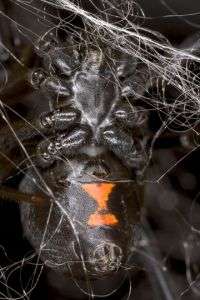
Female black widow spider (Latrodectus hesperus) with her dragline silk. Photo credit: Mark Chappell, UCR.

Biologists at the University of California, Riverside have identified the genes, and determined the DNA sequences, for two key proteins in the “dragline silk” of the black widow spider – an advance that may lead to a variety of new materials for industrial, medical and military uses.

The black widow spider’s dragline silk is a standout compared to other spider silks because of its superior strength and extensibility, a combination which enables black widow dragline silk to absorb enormous amounts of energy. These properties suggest that synthetically-produced silk might find applications as diverse as lightweight super-strong body armor, components of medical devices and high-tech athletic attire.

The researchers – Associate Professor of Biology Cheryl Hayashi, postdoctoral researchers Nadia Ayoub and Jessica Garb, and graduate students Robin Tinghitella and Matthew Collin – report their findings in the June 13 online edition of the journal PLoS ONE, published by the Public Library of Science (PLoS). In the article, they describe their work to identify the genes encoding the two key proteins, named MaSp1 and MaSp2, and determine the genes’ complete DNA sequences. The UCR Office of Technology Commercialization has filed a patent application on the gene sequences.

There are currently no products on the market based on the dragline silk of spiders. “There’s nothing quite as good yet as natural dragline silk, but we should get a lot closer now that we have the full genetic recipe,” Hayashi said.

With the ingredients and their genetic blueprint now known, it may be possible to synthetically produce the proteins by inserting the genetic sequences into host organisms such as bacteria, plants or animals, she said. Once the pure proteins are harvested, a manufacturing challenge will be spinning them into silk fibers that have the same remarkable properties as spider spun silk. But several advances have recently been made in artificial spinning methods.

When spiders manufacture dragline silk, their silk glands produce a “gooey” slurry of the proteins needed, which are transported to the spinneret through a duct where the proteins interact and align to form the silk strands.

“The production of artificial silk is not quite there yet,” Hayashi said. “Now, with the full length genes known and as we learn more about theses two proteins, hopefully we will have a better shot at mimicking nature.”

Spider silks have some of the best mechanical properties of any known natural fibers, thus they are being considered in the improvement of a variety of products including surgical microsutures and specialty ropes. Dragline silk – just one type of the seven different silks that an individual spider produces – are used by spiders as the structural foundation of their webs and to support their body weight as they move about. The dragline silk of black widows is one of the strongest and toughest spider silks identified thus far.

Source: University of California - Riverside


print this article email this article download pdf blog this article bookmark this article     Stumble it Digg this share on Facebook retweet share on Reddit add to delicious
Rate this story - 4.1 /5 (16 votes)


June 13, 2007 all stories

Comments: 0

4.1 /5 (16 votes)
  • Stumble this up

  • Digg this

  • share this

  • hide
  • Related Stories

  • Stretchy spider silks can be springs or rubber
    created May 31, 2008 | popularity not rated yet | comments 0
  • Proteins as Parents
    created Jul 31, 2006 | popularity not rated yet | comments 0
  • Why spiders' silk threads don't twist
    created Mar 30, 2006 | popularity not rated yet | comments 0
  • Spider silks, the ecological materials of tomorrow?
    created Dec 04, 2004 | popularity not rated yet | comments 0
  • Identifying Molecules in Infrared Could Lead to New Medicines
    created Oct 27, 2009 | popularity not rated yet | comments 0


Other News

The six elephants in Sierra Leone were shot and "crudely butchered"

S.Leone elephants 'wiped out' by poachers: official

Biology / Ecology

created 16 hours ago | popularity 5 / 5 (5) | comments 6

Poachers "wiped out" the entire elephant herd in Sierra Leone's only wildlife park, wildlife managers said Thursday after police said they had arrested a gang of 10 poachers.


First-ever blueprint of a minimal cell is more complex than expected

First-ever blueprint of a minimal cell is more complex than expected

Biology / Cell & Microbiology

created 14 hours ago | popularity 5 / 5 (14) | comments 1

What are the bare essentials of life, the indispensable ingredients required to produce a cell that can survive on its own? Can we describe the molecular anatomy of a cell, and understand how an entire organism ...


Ecological speciation by sexual selection on good genes: Is speciation adaptive?

Biology / Ecology

created 14 hours ago | popularity 5 / 5 (1) | comments 0

Darwin suggested that the action of natural selection can produce new species, but 150 years after the publication of his famous book, 'On the Origin of Species', debate still continues on the mechanisms of speciation. New ...


Whiteflies sabotage alarm system of plant in distress

Whiteflies sabotage alarm system of plant in distress

Biology / Plants & Animals

created 19 hours ago | popularity 5 / 5 (2) | comments 0

(PhysOrg.com) -- When spider mites attack a bean plant, the plant responds by producing odours which attract predatory mites. These predatory mites then exterminate the spider mite population, thus acting ...


Knockouts in human cells point to pathogenic targets

Knockouts in human cells point to pathogenic targets

Biology / Cell & Microbiology

created 18 hours ago | popularity not rated yet | comments 0

(PhysOrg.com) -- Whitehead researchers have developed a new approach for genetics in human cells and used this technique to identify specific genes and proteins required for pathogens.