New Evidence Points to Oceans on Mars
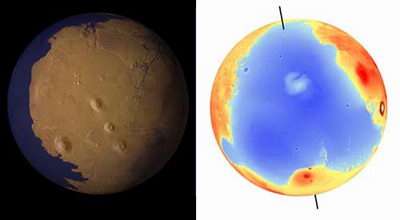
Scientists have found new evidence to support the presence of large oceans on Mars in the past. Published in the June 14 issue of Nature, the research suggests that changes in Mars’ orientation with respect to its axis might be responsible for large variations in the topography of shoreline-like features on the planet. Scientists have studied these features for more than 30 years, and the current study presents a new, alternative explanation for how they formed.
Geophysicists have discovered that irregularities in proposed Martian shorelines might be explained by surface deformation from “true polar wander.” Through this phenomenon, Mars' spin axis and poles shifted by nearly 3,000 kilometers along the surface sometime within the past 2 or 3 billion years. Spinning planets bulge at their equator and solid surfaces deform differently than liquid sea surfaces. As a result, surface topography of the shorelines deformed as the planet’s rotation axis shifted.
In the 1990s, NASA's Mars Global Surveyor spacecraft mapped the Martian topography and found that ancient shorelines aged between 2 and 4 billion years, known as Deuteronilus and Arabia, vary in elevation by about a half of a mile and more than a mile and a half, respectively. In contrast, changes in shoreline elevation on Earth are much gentler, leading many experts to argue against their connection to past oceans on Mars.
“A similar scenario to what we are proposing on Mars has been used to explain sea level variations—deformed shorelines—over geologic time scales of 1-100 million years on Earth,” said study coauthor Isamu Matsuyama of Carnegie’s Department of Terrestrial Magnetism. “But the deformations along Deuteronilus and Arabia are quite dramatic, so the connection has not been as easy to make. We believe this work significantly strengthens the case for large Martian oceans in the ancient past.” Matsuyama developed models for true polar wander driven by internal and surface processes on Mars.
The team proposes that true polar wander combined with the presence of vast oceans could in fact account for the striking deformation of the Deuteronilus and Arabia shorelines on Mars.
“When the spin axis moves relative to the surface, the surface deforms, and that is recorded in the shoreline,” said coauthor Michael Manga, professor of earth and planetary science at UC Berkeley.
Any major shift of planetary mass—on the surface, within the mantle, even an impact from outer space—could cause a shift of the rotation axis because a spinning body is most stable with its mass farthest from its spin axis. Accordingly, the Tharsis rise, the planet’s biggest feature, is situated at the equator between both today’s poles and the two ancient poles.
The question remains: What caused Mars’ rotation axis to move relative to the crust"
Manga has a hunch about the mass shift that precipitated the tilt of Mars' rotation axis. If a flood of water had filled the Arabia ocean about 3 billion years ago, to a depth some have calculated at 700 meters, that mass at the pole might have been enough to shift the pole 50 degrees to the south. Once the water disappeared, the pole could have shifted back, then shifted again by 20 degrees during the deluge that created the Deuteronilus shoreline.
Mark Richards, also coauthor and professor of earth and planetary science at UC Berkeley, has modeled true polar wander in Earth's past, generated by changes in the planet’s hot mantle. Richards wonders whether thermal convection within Mars’ own hot interior could have also caused the poles to wander, citing the recent activity of Olympus Mons, the planet’s largest volcanic vent.
Lead author Taylor Perron, a postdoctoral fellow in Harvard University's Department of Earth and Planetary Sciences and former UC Berkeley graduate student, made calculations to show that the resistance of the elastic crust could create elevation differences of several kilometers along a shoreline, in accord with topographic measurements.
Source: Carnegie Institution


