Physicists discover 'triple-scoop' baryon
June 13, 2007 Physicists discover 'triple-scoop' baryon

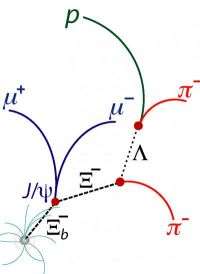
The Cascade-b particle (Ξb) is short-lived. Once produced, it travels only several millimeters before the action of the weak nuclear force causes it to disintegrate into two well-known particles called J/Ψ and Ξ-. The J/Ψ then promptly decays into a pair of muons, common particles that are cousins of electrons. The Ξ- baryon, on the other hand, travels several centimeters before decaying into yet another unstable particle called a Λ baryon, along with another long-lived particle called a pion. The Λ baryon too can travel several centimeters before ultimately decaying to a proton and a pion. Credit: Fermilab

Physicists of the DZero experiment at the Department of Energy's Fermi National Accelerator Laboratory have discovered a new heavy particle, the Ξb (pronounced "zigh sub b") baryon, with a mass of 5.774±0.019 GeV/c2, approximately six times the proton mass.

The newly discovered electrically charged Ξb baryon, also known as the "cascade b," is made of a down, a strange and a bottom quark. It is the first observed baryon formed of quarks from all three families of matter. Its discovery and the measurement of its mass provide new understanding of how the strong nuclear force acts upon the quarks, the basic building blocks of matter.

The DZero experiment has reported the discovery of the cascade b baryon in a paper submitted to Physical Review Letters on June 12.

"Knowing the mass of the cascade b baryon gives scientists information they need in order to develop accurate models of how individual quarks are bound together into larger particles such as protons and neutrons," said physicist Robin Staffin, Associate Director for High Energy Physics for the Department of Energy's Office of Science.

The cascade b is produced in high-energy proton-antiproton collisions at Fermilab's Tevatron. A baryon is a particle of matter made of three fundamental building blocks called quarks. The most familiar baryons are the proton and neutron of the atomic nucleus, consisting of up and down quarks. Although protons and neutrons make up the majority of known matter today, baryons composed of heavier quarks, including the cascade b, were abundant soon after the Big Bang at the beginning of the universe.

The Standard Model elegantly summarizes the basic building blocks of matter, which come in three distinct families of quarks and their sister particles, the leptons. The first family contains the up and down quarks. Heavier charm and strange quarks form the second family, while the top and bottom, the heaviest quarks, make the third. The strong force binds the quarks together into larger particles, including the cascade b baryon. The cascade b fills a missing slot in the Standard Model.

Prior to this discovery, only indirect evidence for the cascade b had been reported by experiments at the Large Electron-Positron collider at the CERN Laboratory near Geneva, Switzerland. For the first time, the DZero experiment has positively identified the cascade b baryon from its decay daughter particles in a remarkably complex feat of detection. Most of the particles produced in high-energy collisions are short-lived and decay almost instantaneously into lighter stable particles. Particle detectors such as DZero measure these stable decay products to discover the new particles produced in the collision.

Once produced, the cascade b travels several millimeters at nearly the speed of light before the action of the weak nuclear force causes it to disintegrate into two well-known particles called J/Ψ ("jay-sigh") and Ξ- ("zigh minus"). The J/Ψ then promptly decays into a pair of muons, common particles that are cousins of electrons. The Ξ-baryon, on the other hand, travels several centimeters before decaying into yet another unstable particle called a Λ ("lambda") baryon, along with another long-lived particle called a pion. The Λ baryon too can travel several centimeters before ultimately decaying to a proton and a pion. Sifting through data from trillions of collisions produced over the last five years to identify these final decay products, DZero physicists have detected 19 cascade b candidate events. The odds of the observed signal being due to something other than the cascade b are estimated to be one in 30 million.

The DZero paper on the cascade b discovery is available in the hep/ex preprint location at http://arxiv.org/abs/0706.1690 .

Source: Fermi National Accelerator Laboratory


print this article email this article download pdf blog this article bookmark this article     Stumble it Digg this share on Facebook retweet share on Reddit add to delicious
Rate this story - 4.6 /5 (47 votes)


June 13, 2007 all stories

Comments: 0

4.6 /5 (47 votes)
  • Stumble this up

  • Digg this

  • share this

  • hide
  • Related Stories

  • Fermilab's CDF observes Omega-sub-b baryon
    created Jun 29, 2009 | popularity not rated yet | comments 0
  • Fermilab physicists discover 'doubly strange' particle
    created Sep 03, 2008 | popularity not rated yet | comments 0
  • Back-to-Back b Baryons in Batavia
    created Jun 26, 2007 | popularity not rated yet | comments 0
  • Searching for Exotic Particles from Cosmic-Ray Collisions
    created Apr 05, 2007 | popularity not rated yet | comments 0
  • Sea lions killed, but Columbia salmon toll rises
    created Nov 07, 2009 | popularity not rated yet | comments 0


  • hide
  • Relevant PhysicsForums posts

  • Young's Double Slit - Fringe Width
    created 3 hours ago
  • Pressure exerted by a liquid is different to gas?
    created 4 hours ago
  • Work
    created 6 hours ago
  • I need some help with this project (optics and lens design)
    created 8 hours ago
  • More from Physics Forums - General Physics

Other News

First Bose-Einstein condensation of strontium

First Bose-Einstein condensation of strontium

Physics / Quantum Physics

created 23 minutes ago | popularity not rated yet | comments 0

In an international first, scientists from the Institute of Quantum Optics and Quantum Information (IQOQI, Austria) produced a Bose-Einstein condensate of the alkaline-earth element strontium, thus narrowly ...


The LHC tunnel

Peckish bird briefly downs big atom smasher

Physics / General Physics

created 7 hours ago | popularity 3.6 / 5 (8) | comments 9

A peckish bird briefly knocked out part of the world's biggest atom smasher by causing a chain reaction with a piece of bread, the European Organisation for Nuclear Research (CERN) said Monday.


Ginzburg helped develop the Soviet Union's hydrogen bomb in the late 1940s and early 1950s

Russian bomb physicist Ginzburg dead at 93

Physics / General Physics

created 8 hours ago | popularity 5 / 5 (2) | comments 0

Nobel Physics prize winner Vitaly Ginzburg, who helped develop the Soviet hydrogen bomb, has died at the age of 93, the Russian Academy of Sciences said Monday.


Stars Fueled by Dark Matter Could Hold Secrets to the Universe

Stars Fueled by Dark Matter Could Hold Secrets to the Universe

Physics / General Physics

created Nov 03, 2009 | popularity 4.5 / 5 (52) | comments 43

(PhysOrg.com) -- The first stars in the universe may have been very different from the stars we see today, yet they may hold clues to understanding some of the mysterious features of the universe. These "dark ...


Second Law of Thermodynamics May Explain Economic Evolution

Second Law of Thermodynamics May Explain Economic Evolution

Physics / General Physics

created Nov 02, 2009 | popularity 4.3 / 5 (31) | comments 28

(PhysOrg.com) -- Terms such as the "invisible hand," laissez-faire policy, and free-market principles suggest that economic growth and decline in capitalist societies seem to be somehow self-regulated. Now, ...