Nanoparticles Unlock the Future of Superalloy Metals
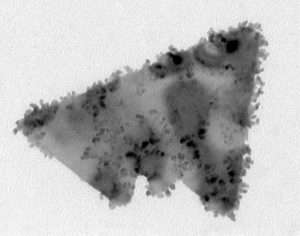
Sandia National Laboratories is pioneering the future of superalloy materials by advancing the science behind how those superalloys are made.
As part of Sandia’s nanoscale research, a group of experts specializing in inorganic synthesis and characterization, modeling, and radiation science have designed a radical system of experiments to study the science of creating metal and alloy nanoparticles.
This research has vast implications, says Tina Nenoff, project lead. The lightweight, corrosion-resistant materials that the team is creating are needed for weapons casings, gas turbine engines, satellites, aircraft, and power plants.
“What we’re doing is taking a completely new approach to thinking about producing superalloy materials,” Nenoff says. “We’re using radiation to break down the molecular structure of substances and form nanoparticles — a synthetic approach that is flexible and versatile for making large quantities of superalloy nanoparticle compositions that can’t be easily created otherwise.”
A quick trip down memory lane to the days of high school science class will recall those chapters on material and chemical science defining alloys as a combination of two or more elements, at least one of which is a metal, where the resulting material has metallic properties different — sometimes significantly different — from the properties of its components. For instance, steel is stronger than iron, its primary component.
Superalloys, as the name would imply, stand out from the general population of alloys in the same way Superman would be considered extraordinary compared to the rest of us. These specialized alloys are exceptionally strong, lightweight, and able to withstand extremes that would destroy everyday metals like steel and aluminum.
“These high-performance superalloys are revered for their remarkable mechanical strength and their resistance to corrosion, oxidation, and deformation at high temperatures,” says Jason Jones, Sandia researcher.
In the past, the development of these superalloys has depended on chemical and technological innovations, and been driven mainly by the aerospace and power industries where superalloys are in high demand.
“The method of radiation we’re studying — known as radiolysis — introduces an entirely new area of research into creating alloys and superalloys through nanoparticle synthesis,” Nenoff says. “This process holds promise as a universal method of nanoparticle formation. By developing our understanding of the basic material science behind these nanoparticle formations, we’ll then be able to expand our research into other aspects of superalloys, like nickel-based alloys.”
The team is focusing its research on studying the science that happens in the “novel metastable phase spaces” that are not accessible with traditional alloy production methods, such as melting, Nenoff says. These “phase spaces” are possible points in a given path, or orbit, that represent the motion of a particle over a period of time. Each potential state of that particle’s system corresponds to one unique point in a phase space. Understanding these spaces is important for determining what alloys are created and how they form.
In the team’s experiments, solvent molecules are combined with molecules or ions and dissolved in water, and the researchers then subject the solution to radiolysis. By varying the reaction conditions and using alcohols as agents to limit particle growth size, the researchers say they have determined through high-resolution transmission electron microscopy that they have been able to successfully grow particles that are nearly identical, delivering essentially defect-free superalloy metal nanoparticles.
The team of Sandia researchers perform these highly specialized experiments with the unique combination of the in-house Gamma Irradiation Facility (GIF) and the Ion Beam Materials Research Laboratory (IBMRL), which provide the radiation environments demanded by this research.
“The target solutions are placed in the testing cells at the GIF where they are exposed to a variety of gamma irradiation test configurations and controlled radiation dose rates,” says Don Berry, GIF supervisor. “High-intensity radioactive sources, which are kept submerged below 18 feet of deionized water to shield workers from radiation, are then raised via elevators into the testing cells to irradiate the targets. Once the irradiation is completed, the radioactive sources are returned to their shielded location in the water pool, and workers can again safely enter the cells.”
In their study of the particle growth that takes place, the researchers expose the test solutions to even higher doses of radiation at the IBMRL.
“The ion beam irradiation experiments take place in a custom-built cell at the external beam end-station of the Tandem Van de Graff accelerator and result in intense dose rates in the solution,” says ion beam researcher Jim Knapp. “A beam of protons exits the vacuum and passes through a thin Kapton film before entering into the target solution. The system can expose targets for up to several hours, but the exposures needed in these experiments are usually only fractions of a second.”
After irradiation at the GIF or IBMRL, samples — none of which are radioactive — are studied using a variety of techniques, such as ultraviolet-visible spectroscopy and high-resolution transmission electron microscopy to understand what effects time and experimental variables have on particle formation, size, shape, and composition.
Depending on the combination of reactants, dose, and dose rate of radiation, researchers have been able to create nanometer-sized particles of gold in a variety of shapes including spheres, rods and pyramids.
Researchers are also translating the results of these experiments into computer simulations. Kevin Leung, Sandia researcher, is leading the effort to use abinitio molecular dynamics, along with other methods, to interpret and understand the controlling factors in the researchers’ experiments.
“Using the results from the experiments, together with Sandia’s world-class computational capabilities, we’ll simulate the structure of the nanocrystal initiation,” Leung says. “By examining the free energy present in the interface between the different materials, we will be able to understand what factors govern the size of these metal alloy nanocrystals. Modeling this region of the metastable phase space right after radiation has been applied promises to be a new and exciting area of research.”
“What we’re doing is really breaking ground in the fundamental research in the science of the formation of superalloy nanoparticles,” Nenoff says. “This is really the new frontier in superalloys.”
Source: Sandia National Laboratories


