New fabrication technique yields nanoscale UV LEDs
June 13, 2007
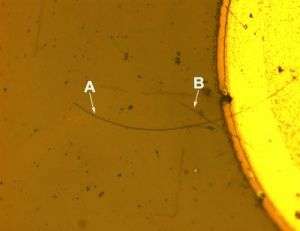
Nanowire LED Micrograph

[Top] Micrograph of a complete nanowire LED with the end contact. The long nanowire (A) is about 110 micrometers long, a shorter nanowire (B) crosses it. The bright circular section is the metal post from which the nanowires are aligned. Credit: NIST

Researchers at the National Institute of Standards and Technology, in collaboration with scientists from the University of Maryland and Howard University, have developed a technique to create tiny, highly efficient light-emitting diodes (LEDs) from nanowires.

As described in a recent paper, the fabricated LEDs emit ultraviolet light—a key wavelength range required for many light-based nanotechnologies, including data storage—and the assembly technique is well-suited for scaling to commercial production.

Light-based nanoscale devices, such as LEDs, could be important building blocks for a new generation of ultracompact, inexpensive technologies, including sensors and optical communications devices. Ultraviolet LEDs are particularly important for data-storage and biological sensing devices, such as detectors for airborne pathogens. Nanowires made of a particular class of semiconductors that includes aluminum nitride, gallium nitride and indium nitride are the most promising candidates for nanoscale LEDs. But, says NIST researcher Abhishek Motayed, "The current nanowire LEDs are created using tedious nanowire manipulation methods and one-by-one fabrication techniques, which makes them unsuitable for commercial realization."

The NIST team used batch fabrication techniques, such as photolithography (printing a pattern into a material using light, similar to photography), wet etching and metal deposition. They aligned the nanowires using an electric field, eliminating the delicate and time-consuming task of placing each nanowire separately.

A key feature of the new nanowire LEDs is that they are made from a single compound, gallium nitride (GaN). Each LED consists of an "n-type" GaN nanowire placed on the surface of a "p-type" GaN thin film. "N-type" and "p-type" refer to semiconductors with, respectively, an abundance of electrons and an abundance of positively charged electron vacancies called holes. P-n junctions made from the same basic compound yield more efficient LEDs than those made with different compounds, and so can operate at lower power.

When the proper voltage is applied to the junction, it emits light with a peak wavelength of 365 nanometers, which falls squarely in the ultraviolet range. The group produced and tested more than 40 of these LEDs; all showed very similar emission properties. They also displayed excellent thermal stability—withstanding temperatures up to 750 degrees Celsius—and operational stability, showing no signs of deterioration even after two continuous hours of operation at room temperature. These properties indicate that this LED production method yields reliable, stable devices. The researchers say their method could be used to fabricate other nanowire structures as well as applications requiring a large area of nanoscale light sources.

Citation: A. Motayed, A. Davydov, M. He, S. N. Mohammed and J. Melngailis. 365 nm operation of n-nanowire/p-gallium nitride homojunction light emitting diodes. Applied Physics Letters 90, 183120 (2007)

Source: National Institute of Standards and Technology

4.5 /5 (20 votes)  

Rank 4.5 /5 (20 votes)
Tags

Related Stories
Relevant PhysicsForums posts
  • Can Plasma Be Solid
    created2 hours ago
  • What is delta Δ ?
    created2 hours ago
  • Need some help understanding Hertz–Knudsen formula
    created3 hours ago
  • Anatomy of Fat man: implosion-critical bomb
    created5 hours ago
  • what makes two sounds similar???
    created5 hours ago
  • What would happen when a jet travelling at Mach 10 experiences engine failure
    created12 hours ago
  • More from Physics Forums - General Physics

More news stories

Lab study raises questions over nano-particle impact

Tests involving chickens have raised questions about the impact on health from engineered nano-particles, the ultra-fine grains commonly used in drugs and processed foods, scientists said on Sunday.

Nanotechnology / Bio & Medicine

created 7 hours ago | popularity 5 / 5 (5) | comments 0

New kind of solar cell could capture significantly more energy than current cells

New solar cells could increase the maximum efficiency of solar panels by over 25%, according to scientists from the University of Cambridge.

Nanotechnology / Nanophysics

created Feb 08, 2012 | popularity 4.5 / 5 (13) | comments 14 | with audio podcast

Nanoshell whispering galleries improve thin solar panels

Visitors to Statuary Hall in the U.S. Capitol Building may have experienced a curious acoustic feature that allows a person to whisper softly at one side of the cavernous, half-domed room and for another on ...

Nanotechnology / Nanomaterials

created Feb 07, 2012 | popularity 4.4 / 5 (7) | comments 6 | with audio podcast

'Dark plasmons' transmit energy

Microscopic channels of gold nanoparticles have the ability to transmit electromagnetic energy that starts as light and propagates via "dark plasmons," according to researchers at Rice University.

Nanotechnology / Nanophysics

created Feb 09, 2012 | popularity 4.8 / 5 (10) | comments 1 | with audio podcast

Revealing how a battery material works

Since its discovery 15 years ago, lithium iron phosphate (LiFePO4) has become one of the most promising materials for rechargeable batteries because of its stability, durability, safety and ability to deliver ...

Nanotechnology / Nanomaterials

created Feb 08, 2012 | popularity 5 / 5 (6) | comments 0 | with audio podcast


Scientists discover molecular secrets of 2,000-year-old Chinese herbal remedy

For roughly two thousand years, Chinese herbalists have treated Malaria using a root extract, commonly known as Chang Shan, from a type of hydrangea that grows in Tibet and Nepal. More recent studies suggest that halofuginone, ...

New method to examine batteries -- MRI from the inside

There is an ever-increasing need for advanced batteries for portable electronics, such as phones, cameras, and music players, but also to power electric vehicles and to facilitate the distribution and storage of energy derived ...

A mitosis mystery solved: How chromosomes align perfectly in a dividing cell

Although the process of mitotic cell division has been studied intensely for more than 50 years, Whitehead Institute researchers have only now solved the mystery of how cells correctly align their chromosomes during symmetric ...

Google might launch Drive for cloud storage soon

(PhysOrg.com) -- Google's next big move, according to the Wall Street Journal, is a cloud storage service called Drive. Hardly first to the plate, Google is simply catching up to introducing its cloud reposi ...

Overeating may double risk of memory loss

New research suggests that consuming between 2,100 and 6,000 calories per day may double the risk of memory loss, or mild cognitive impairment (MCI), among people age 70 and older. The study was released today and will be ...

Starve a virus, feed a cure? Findings show how some cells protect themselves against HIV

A protein that protects some of our immune cells from the most common and virulent form of HIV works by starving the virus of the molecular building blocks that it needs to replicate, according to research published online ...