Magnetic Misfits: South Seeking Bacteria in the Northern Hemisphere
January 20, 2006
Magnetic Misfits: South Seeking Bacteria in the Northern Hemisphere

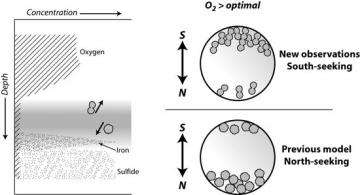
The profile on the left shows the chemistry of Salt Pond in Falmouth, MA in midsummer, when it is chemically stratified. The grey band marks the zone where magnetotactic bacteria are most abundant. On the right is what magnetotactic bacteria would look like under the microscope with a bar magnet. (Illustration by Jack Cook, Woods Hole Oceanographic Institution)

Magnetotactic bacteria contain chains of magnetic iron minerals that allow them to orient in the earth’s magnetic field much like living compass needles. These bacteria have long been observed to respond to high oxygen levels in the lab by swimming towards geomagnetic north in the Northern Hemisphere and geomagnetic south in the Southern Hemisphere. In either hemisphere, this behavior would also lead them downward in the water column into areas with their preferred oxygen level. But an unusual bacterium in New England has been found doing just the opposite, a magnetic misfit of sorts.

Scientists have dubbed the bacterium the barbell for its appearance. In a study reported in this week’s issue of Science, researchers from the Woods Hole Oceanographic Institution (WHOI) and Iowa State University used genetic sequencing and other laboratory techniques to identify the barbell, which was found coexisting with other previously described magnetotactic bacteria in a local marine pond in Falmouth, MA. They also found dense populations of a small, unidentified rod-shaped bacterium that showed a similar “backwards” behavior.

Magnetotactic bacteria concentrate large amounts of iron within their cells, far more than all other marine bacteria. They could play a significant role in iron cycling in stratified marine environments, particularly ponds and salt marshes.

Lead author Sheri Simmons of the Woods Hole Oceanographic Institution says magnetotactic bacteria are found throughout the world in chemically stratified marine and freshwater environments. They can reach high densities under the right conditions and will swim along the magnetic field axis and up or down in the water column to locate their preferred or ideal living conditions. If oxygen levels are too high or too low, they will seek a layer in the water column where the level is just right.

The scientists collected samples of the barbells and rods at Salt Pond, a marine pond that is seasonally stratified near the Woods Hole Oceanographic Institution on Cape Cod, Massachusetts. Using a rowboat and a new water sampler designed and built by WHOI engineers, the team collected samples at various depths in the pond in the summers of 2003, 2004 and 2005. Much to their surprise, they found high concentrations of bacteria that swim toward geomagnetic south when exposed to high levels of oxygen, the opposite of all previously described swimming behavior in magnetotactic bacteria. They also found magnetotactic bacteria with a mixture of north and south polarities.

The coexistence of magnetotactic bacteria with north and south polarity in the same environment contradicts the currently accepted model of magnetotaxis, which says that all magnetotactic bacteria in the Northern Hemisphere swim north and downward to reach their desired habitat when exposed to high-oxygen conditions.

Simmons and colleagues Dennis Bazylinski of Iowa State University and Katrina Edwards of WHOI studied the bacteria under laboratory conditions, and say the behavior of the bacteria in situ could be different from laboratory behavior. Their results, however, suggest new models are needed to explain how these magnetotactic bacteria behave in the environment.

“Only a few species of magnetotactic bacteria have been cultivated in the lab,” Simmons said. “We need to develop more methods to do that since we cannot observe their behavior directly in the environment. We are also interested in how much iron these bacteria sequester in nature. What is their distribution and abundance, and how does that affect the chemistry of their environment?”

Source: Woods Hole Oceanographic Institution

3.8 /5 (6 votes)  

Rank 3.8 /5 (6 votes)
Tags

Relevant PhysicsForums posts

More news stories

A frank discussion of the power law and linking correlation to causation

(PhysOrg.com) -- Michael Stumpf a mathematics professor at Imperial College in London, and Mason Porter a lecturer at Oxford have teamed together to write and publish a perspective piece in Science regarding the in ...

Other Sciences / Mathematics

created Feb 10, 2012 | popularity 5 / 5 (5) | comments 8 | with audio podcast report

US workers are 'giving away the store,' costing firms billions

Nearly 70 percent of the nation's service employees give away free goods and services – from hamburgers to cable TV – costing companies billions of dollars a year, according to a groundbreaking study.

Other Sciences / Economics & Business

created Feb 09, 2012 | popularity 3.3 / 5 (3) | comments 10

New insights into how to correct false knowledge

The abundance of false information available on the Internet, in movies and on TV has created a big challenge for educators.

Other Sciences / Social Sciences

created Feb 07, 2012 | popularity 4.9 / 5 (7) | comments 9 | with audio podcast

Employers feel no love for unscrupulous practice of 'service sweethearting'

A new study led by two Florida State University marketing professors finds that some frontline service employees who are rewarded for hikes in customer loyalty and satisfaction also may engage in "service ...

Other Sciences / Economics & Business

created Feb 10, 2012 | popularity 4.5 / 5 (2) | comments 7

Neanderthal demise due to many influences, including cultural changes: study

As an ice age crept upon them thousands of years ago, Neanderthals and modern human ancestors expanded their territory ranges across Asia and Europe to adapt to the changing environment.

Other Sciences / Archaeology & Fossils

created Feb 07, 2012 | popularity 4.4 / 5 (5) | comments 8 | with audio podcast


Walney offshore wind farm is world's biggest (for now)

(PhysOrg.com) -- The Walney wind farm on the Irish Sea--characterized by high tides, waves and windy weather--officially opened this week. The farm is treated in the press as a very big deal as the Walney ...

GPS court ruling leaves US phone tracking unclear

A US Supreme Court decision requiring a warrant to place a GPS device on the car of a criminal suspect leaves unresolved the bigger issue of police tracking using mobile phones, legal experts say.

Europeans protest controversial Internet pact

Tens of thousands of people marched in protests in more than a dozen European cities Saturday against a controversial anti-online piracy pact that critics say could curtail Internet freedom.

Study finds that anti-diabetic medication can prevent the long-term effects of maternal obesity

In a study to be presented today at the Society for Maternal-Fetal Medicine's annual meeting, The Pregnancy Meeting, in Dallas, Texas, researchers will report findings that show that short therapy with the anti-diabetic medication ...

Anonymous briefly knocks CIA website offline (Update 2)

The website of the Central Intelligence Agency was briefly inaccessible on Friday after the hacker group Anonymous claimed to have knocked it offline.

Europe stakes billion-dollar bet on new rocket

A pencil-slim rocket is scheduled to lift into space from South America on Monday, carrying a billion-dollar bet that Europe can grab a juicy slice of the market to place satellites in low orbit.