Penn researchers link cell's protein recycling systems
June 14, 2007
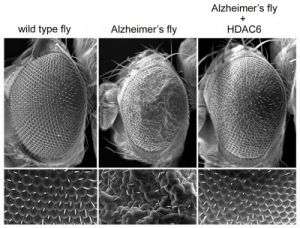
Neurodegeneration in a fruit fly eye. Normal or wild type eye (left) appears uniformly structured. Eye in fruit fly model of Alzheimer's disease (middle) appears rough and deformed. Eye in fruit fly model of Alzheimer's disease in which extra HDAC6 protein is expressed (right) appears uniformly structured as in wild type. Credit: J. Paul Taylor, MD, PhD, University of Pennsylvania School of Medicine
Many age-related neurological diseases are associated with defective proteins accumulating in nerve cells, suggesting that the cell’s normal disposal mechanisms are not operating correctly. Now, researchers at the University of Pennsylvania School of Medicine have discovered a molecular link between the cell’s two major pathways for breaking down proteins and have succeeded in using this link to rescue neurodegenerative diseases in a simple animal model. The study appears this week in Nature.
The cell has two internal pathways for breaking down proteins. The ubiquitin-proteasome pathway marks unwanted proteins with ubiquitin tags and shuttles them for rapid breakdown to a complicated structure called the proteasome. The second is the autophagy-lysosomal system, a more general process in which proteins are surrounded by membranes inside the cell for bulk digestion.
“The dogma has been that the autophagy-lysosomal and the proteasomal systems are trains that run on different tracks, with similar purposes, but no point of intersection,” explains senior author J. Paul Taylor, MD, PhD, Assistant Professor of Neurology. “The new finding directly challenges this thinking by showing that one system can be induced to compensate for the other. Cells are able to shift proteins between the systems. We think that this molecular link can be used to benefit a wide variety of neurodegenerative diseases because accumulation of toxic proteins is a common underlying feature of age-related neurodegeneration.”
Taylor and his group study fruit flies in which the proteasome is disabled by a genetic mutation, which results in neurodegeneration. They use the fly eye, a neuron-rich tissue, as a surrogate for the brain because it is easy to visualize. They discovered that making the lysosomal system more or less active dramatically influenced the severity of neurodegeneration.
“We found that whenever we knocked the lysosome system down, neurodegeneration always got worse,” says Taylor. “Then when we activated the autophagy system by feeding the flies a drug called rapamycin, neurodegeneration was prevented.” The accumulated misfolded proteins were cleared out by the lysosome system. “Then we knew that this system can compensate for the impaired proteasome function, which in itself tells us that the two pathways intersect,” says Taylor. “The question was, ‘How is this working?’”
The Role of HDAC6
“That’s where the power of fruit flies comes in,” Taylor explains. “We can use fruit flies to rapidly screen through many genes to find the one we’re interested in. In the process of screening, our attention was drawn to HDAC6 because we already knew that it could bind to ubiquitin-tagged proteins and transport them within the cell. So we wondered, could HDAC6 be the link"”
Taylor’s group showed that if the HDAC6 gene is knocked out, inducing autophagy no longer rescues the fly eyes from neurodegeneration. Therefore, autophagy requires HDAC6 to work. They also showed that by simply expressing extra HDAC6, neurodegeneration was prevented in flies with proteasome impairment. Taylor’s group then moved on to fly models of human neurodegenerative disease and showed that they, too, are rescued by over-expression of HDAC6.
Therefore, the researchers suggest that the level of the HDAC6 in a cell regulates its sensitivity to accumulation of misfolded proteins, and that increasing the activity of HDAC6 can prevent the degeneration normally associated with accumulating old, damaged proteins. The researchers suggest further that when proteasomes are impaired or overwhelmed, which leads to accumulation of defective proteins, HDAC6 facilitates delivery to the autophagy-lysosomal system for degradation. “That’s how we think HDAC6 links the two systems,” says Taylor.
Dr Taylor and his team are now testing the ability of HDAC6 to prevent neurodegeneration in several mouse models, including motor neuron disease, Parkinson’s disease, and Huntington’s disease. They are also attempting to identify pharmacologic approaches to augmenting HDAC6 activity.
Source: University of Pennsylvania School of Medicine
-
Researchers find mutation causing neurodegeneration
Jan 19, 2012 |
2 / 5 (2) |
0
-
Diet counts: Iron intake in teen years can impact brain in later life
Jan 12, 2012 |
4 / 5 (1) |
0
-
In the brain, 'ORMOSIL' nanoparticles hold promise as a potential vehicle for drug delivery
Jan 09, 2012 |
5 / 5 (2) |
0
-
New insights into nanoparticles and dividing cells
Dec 19, 2011 |
5 / 5 (1) |
0
-
Regulatory enzyme overexpression may protect against neurodegeneration in Huntington's disease
Dec 18, 2011 |
5 / 5 (1) |
1
-
Engineers build first sub-10-nm carbon nanotube transistor
Feb 01, 2012 |
4.9 / 5 (31) |
30
-
Something old, something new: Evolution and the structural divergence of duplicate genes
Jan 31, 2012 |
4.6 / 5 (7) |
1
-
The hidden nanoworld of ice crystals: Revealing the dynamic behavior of quasi-liquid layers
Jan 30, 2012 |
5 / 5 (3) |
1
-
Stock market network reveals investor clustering
Jan 27, 2012 |
3.9 / 5 (23) |
8
-
Of microchemistry and molecules: Electronic microfluidic device synthesizes biocompatible probes
Jan 26, 2012 |
5 / 5 (1) |
0
-
Is Everyday Technology Killing Us?
Feb 08, 2012
-
Exercise and weight loss
Feb 08, 2012
-
Why do we have head aches? Our brains can't feel anything.
Feb 07, 2012
-
"The end of diseases" by David Agus, interview from Daily Show with Jon Stewart
Feb 04, 2012
-
Oncolytic adenovirus
Feb 04, 2012
-
Nutrition label stuffs and diets
Feb 02, 2012
- More from Physics Forums - Medical Sciences
More news stories
Complex wiring of the nervous system may rely on a just a handful of genes and proteins
Researchers at the Salk Institute have discovered a startling feature of early brain development that helps to explain how complex neuron wiring patterns are programmed using just a handful of critical genes. ...
8 hours ago |
4.9 / 5 (9) |
0
|
Both maternal and paternal age linked to autism
Older maternal and paternal age are jointly associated with having a child with autism, according to a recently published study led by researchers at The University of Texas Health Science Center at Houston (UTHealth).
Medicine & Health / Psychology & Psychiatry
12 hours ago |
4.3 / 5 (3) |
0
|
New understanding of DNA repair could eventually lead to cancer therapy
A research group in the Faculty of Medicine & Dentistry at the University of Alberta is hoping its latest discovery could one day be used to develop new therapies that target certain types of cancers.
12 hours ago |
4.8 / 5 (5) |
0
|
Curry spice component may help slow prostate tumor growth
Curcumin, an active component of the Indian curry spice turmeric, may help slow down tumor growth in castration-resistant prostate cancer patients on androgen deprivation therapy (ADT), a study from researchers ...
13 hours ago |
4.4 / 5 (8) |
0
|
Team isolates nerve cells involved in storing long term memory and gene proteins associated with them
(Medical Xpress) -- A research team in Taiwan has succeeded in isolating two nerve cells in fruit fly brains that are believed to be the major players in allowing for the formation of long term memories. Furthermore, ...
Google users warned of threat to smartphone wallets
Users of Google smartphone wallets were being warned on Friday that there is a way to crack pass codes intended to thwart thieves from going on illicit shopping sprees.
Anonymous knocks CIA website offline (Update)
The website of the Central Intelligence Agency was inaccessible on Friday after the hacker group Anonymous claimed to have knocked it offline.
New error-correcting codes guarantee the fastest possible rate of data transmission
Error-correcting codes are one of the triumphs of the digital age. Theyre a way of encoding information so that it can be transmitted across a communication channel such as an optical fiber o ...
Humans may have helped the decline of African rainforests 3000 years ago
(PhysOrg.com) -- Large areas of rainforests in Central Africa mysteriously disappeared over three thousand years ago, to be replaced by savannas. The prevailing theory has been that the cause was a change ...
New power source discovered
(PhysOrg.com) -- Researchers at the Massachusetts Institute of Technology (MIT) and RMIT University have made a breakthrough in energy storage and power generation.
The power of estrogen -- male snakes attract other males
A new study has shown that boosting the estrogen levels of male garter snakes causes them to secrete the same pheromones that females use to attract suitors, and turned the males into just about the sexiest ...